Advertising & visual culture · Lyfera Editorial · 2026-09-14
The new face of advertising does not have to be human
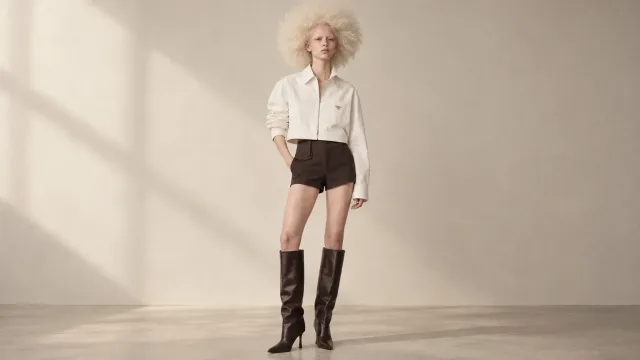
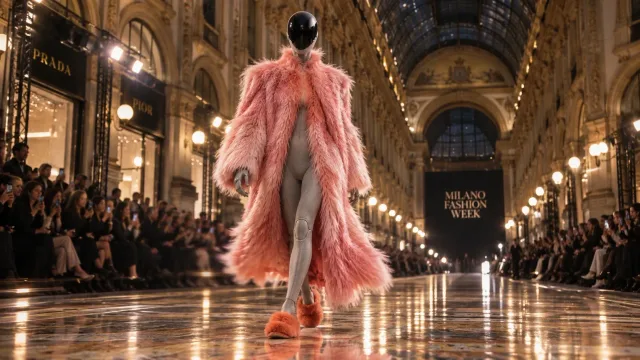
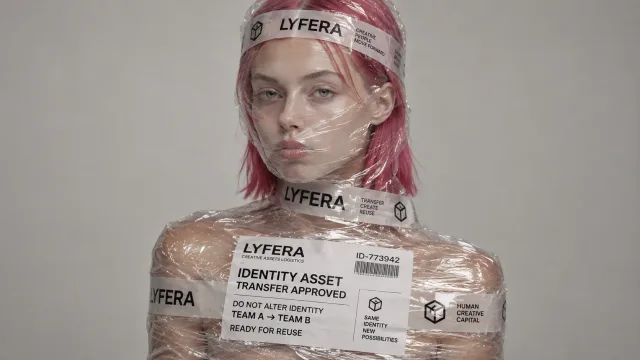
Artificial talents extend the possibilities of casting. Through materials, recognisable identities and sustained creative direction, humanoids can become part of a brand’s visual language.
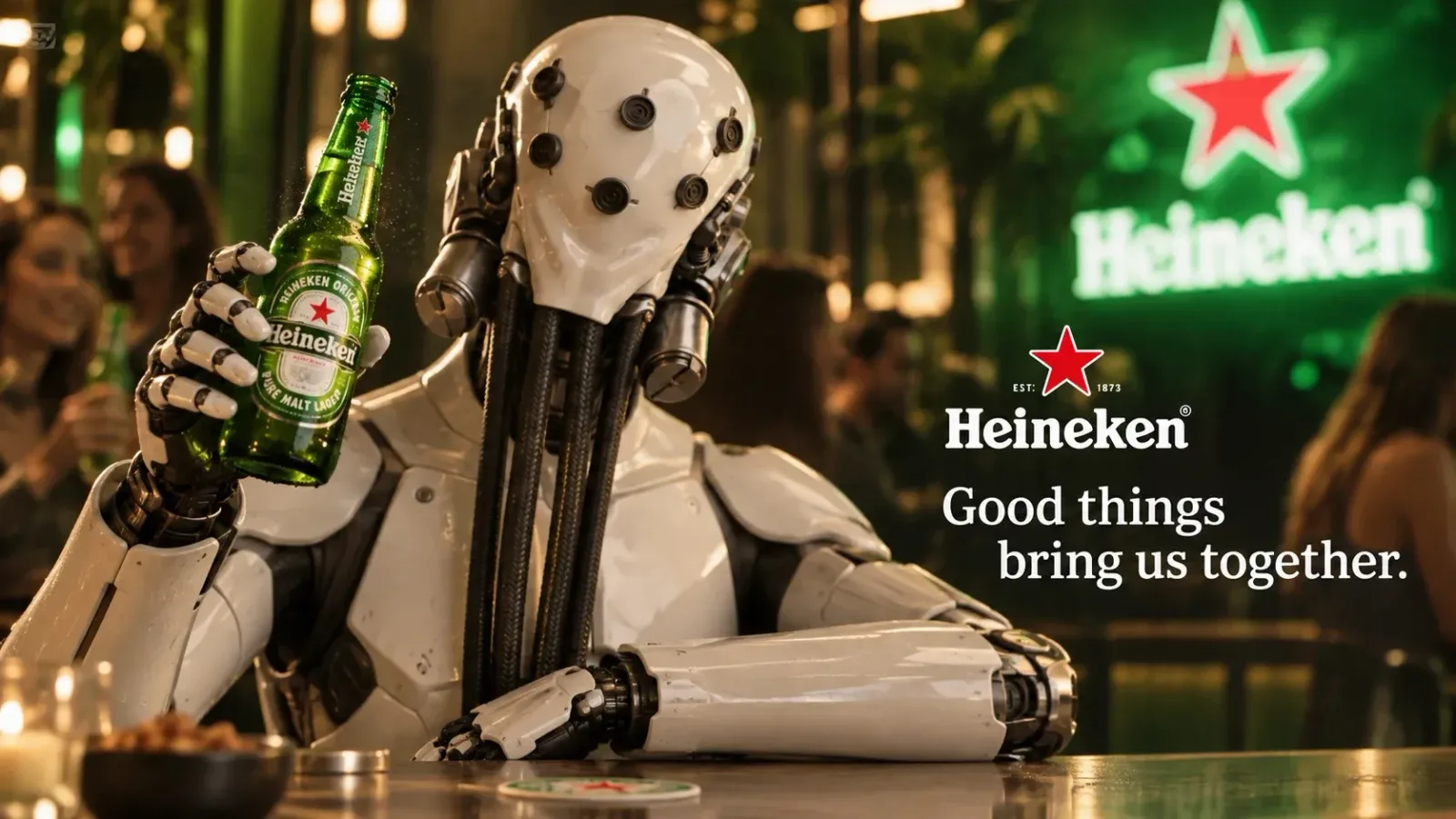
Advertising has always used people as part of a brand's language. A face does more than demonstrate a product: it suggests character, aspiration, cultural references and a particular way of belonging to the world. This is why casting remains a central creative decision even in campaigns where the audience may never learn the performer's name.
Artificial talents extend the range of that decision. The subject of a campaign can be developed with some of the same deliberation applied to a product, a space or a visual identity. AI humanoids in advertising are particularly interesting in this respect because the body itself can become part of the campaign's vocabulary, from its proportions and surface materials to the way it receives light.
The creative opportunity lies in developing a presence with characteristics that a conventional casting could not supply, then deciding how those characteristics contribute to the campaign. An unfamiliar body may attract attention initially, but the campaign still needs to establish why this particular subject belongs with this particular idea.
Casting remains a question of identity
The first question in an artificial casting is familiar: who can represent the brand in a way that feels specific? The most spectacular subject is not necessarily the most appropriate one. An unusual feature may be valuable because it creates a productive relationship with the product, the setting or the attitude of the campaign.
A technology brief concerned with precision might favour a character whose structure is visibly ordered. A fashion concept could benefit from a body that introduces tension into the silhouette of a garment. A luxury composition may require a more remote, sculptural presence, where the character's stillness gives the surrounding materials room to register. These are possible creative directions, rather than fixed rules about what each sector should look like.
The humanoid roster in Lyfera offers a useful way to explore these differences. Saga Møller's faceted geometry, Aava Lehtonen's wire-mesh face and Tessa Calloway's translucent amber helmet do not communicate the same thing. Choosing among them changes the campaign before lighting or location has been decided.
This also explains why using the same talent for every concept would waste much of the opportunity. A roster becomes useful when its differences lead to different ideas. The task of casting is to recognise which identity introduces the right possibilities, then develop those possibilities without turning every subject into a variation of the same generic futuristic figure.
Materials and skin become part of the brand's language
When a character does not need to reproduce human anatomy, its surface can take on a much broader role. Metal, ceramic, translucent layers, engineered fibres and soft membranes can be combined with different approaches to joints, facial structure and the boundary between the body and its clothing.
These choices can create relationships with a product without reproducing it literally. An automotive concept might connect the tension of a character's surfaces with the treatment of a vehicle's interior. A fashion story might use a rigid body to reveal the softness of a fabric. A technology campaign could explore how a character appears to sense its environment, making an abstract product idea visible through posture and construction.
The difference between a meaningful relationship and a decorative effect becomes apparent when we ask why a material is present. Chrome chosen only because it appears futuristic can produce a familiar image very quickly. A particular reflection, texture or degree of translucency chosen to support the campaign's central idea has a more precise function.
Solveig's fine suspended filaments offer one example. At portrait scale they create an unusual face; at a closer distance they become individual strands with weight, spacing and changing colour. Developing that feature into the visual language of a campaign could connect the talent with woven surfaces, pleated architecture or the way light moves across a material. The contextual image in this section explores those relationships through a fictional fashion study.
Where a real product is involved, that exploration needs to remain separate from claims about the product itself. An invented surface can serve the campaign's atmosphere, while packaging, construction and functional details still require their own accurate representation. A compelling concept image does not establish that accuracy automatically.
One talent across different campaigns
A recurring performer can accumulate meaning over several campaigns. Viewers begin to recognise the face and connect it with earlier appearances, even when the setting or the product has changed. A virtual brand ambassador can be developed around a similar relationship, provided its identity remains coherent enough for those associations to form.
That coherence does not require every image to look alike. The same talent could appear in a restrained studio composition and later in an expansive exterior scene. Clothing, atmosphere and gesture can change while a recognisable facial structure or physical characteristic continues to connect the appearances.
The difficulty is that variation can easily become drift. If proportions, surface behaviour and identifying details change unintentionally, the audience may be looking at several vaguely related characters rather than one continuing presence. Maintaining an artificial identity consequently involves editorial work: selecting references, deciding what may change and checking whether the result still belongs to the intended talent.
Lyfera's approach to persistent identity is relevant to that distinction. The talent provides a continuing point of reference from which new representations can be developed. In the paired image accompanying this section, Inês Silveira appears in two proposed visual contexts while the fluted mask and cranial silhouette carry recognition between them. The pair is an editorial exploration, not a claim of perfect consistency or a record of two commissioned campaigns.
For a brand, the longer-term question is whether that continuity becomes meaningful to its audience. Familiarity has to be built through the quality and relevance of the appearances; it cannot be assumed merely because the same character file was used again.
From a campaign subject to a continuing creative presence
The possibilities become broader when a talent is considered across a sequence of encounters. A campaign may begin with a portrait, continue through a wider scene and reveal a different aspect of the subject in a close study. Those images can perform different roles while contributing to the same understanding of the character.
In a more extensive production, that thinking could inform moving image, social content, digital experiences or physical installations. Each medium would need its own production process. A still image does not automatically provide an animated performance, an interactive character or a finished installation, and these possibilities should not be confused with a list of functions currently delivered by Lyfera.
The creative principle is nevertheless useful at the planning stage. When the identity is considered first, the team can ask what each appearance contributes and which qualities need to survive the transition. A close-up may establish a particular surface, while a distant composition makes the character's relation to space more important. Both can belong to the same campaign without repeating the same visual.
This changes how an AI fashion campaign can be conceived. Instead of treating each new generation as an isolated opportunity, a creative team can build an archive of decisions around a recurring subject. Over time, that archive can help distinguish an intentional evolution from a departure that weakens recognition.
The image for this section places Céleste within a fictional metaphysical fashion environment. It develops the relationship between the talent's iridescent skin, fine metal details and the surrounding surfaces. The intention is to show how an existing identity can support a wider visual direction without making the setting interchangeable with any other synthetic character.
The value of being visibly artificial
There is no reason to assume that the most valuable humanoid talent will be the one that most successfully passes for a human. Advertising has long worked through idealisation, abstraction and imagined worlds. A subject that openly departs from ordinary anatomy can contribute to that tradition when the departure has a clear creative purpose.
A face made from folded planes changes the way we read expression. A veil of fibres redirects attention towards movement and light. Completely dark eyes can introduce distance into a portrait that otherwise contains familiar skin texture and proportions. Such features become interesting through the relationships they create with the rest of the image.
Being clear about the artificial nature of the subject also gives the audience the context needed to interpret it. Lyfera identifies these figures as artificial talents and explains its approach in the AI Disclosure. The work can then be considered as an intentional construction, with its origins acknowledged, rather than relying on an audience mistaking the subject for a real person.
Fashion, automotive, luxury and technology offer fertile ground for this kind of exploration because each already uses materials and bodies to express ideas that extend beyond the practical description of a product. An AI humanoid advertising talent adds another possible participant to that process. Its usefulness depends on the precision of the relationship between the character, the campaign and the people who encounter it.
The new face of a campaign may therefore be human, artificial or deliberately difficult to place. What matters is whether that choice allows the brand to say something recognisable, and whether the subject has enough character to make the audience interested in seeing it again.