Artificial identities · Lyfera · 2026-10-06
An artificial talent can outlast its creative team
A recurring artificial character can remain visible after its original production team leaves. How to keep responsibility for the published work clear across a creative handover.
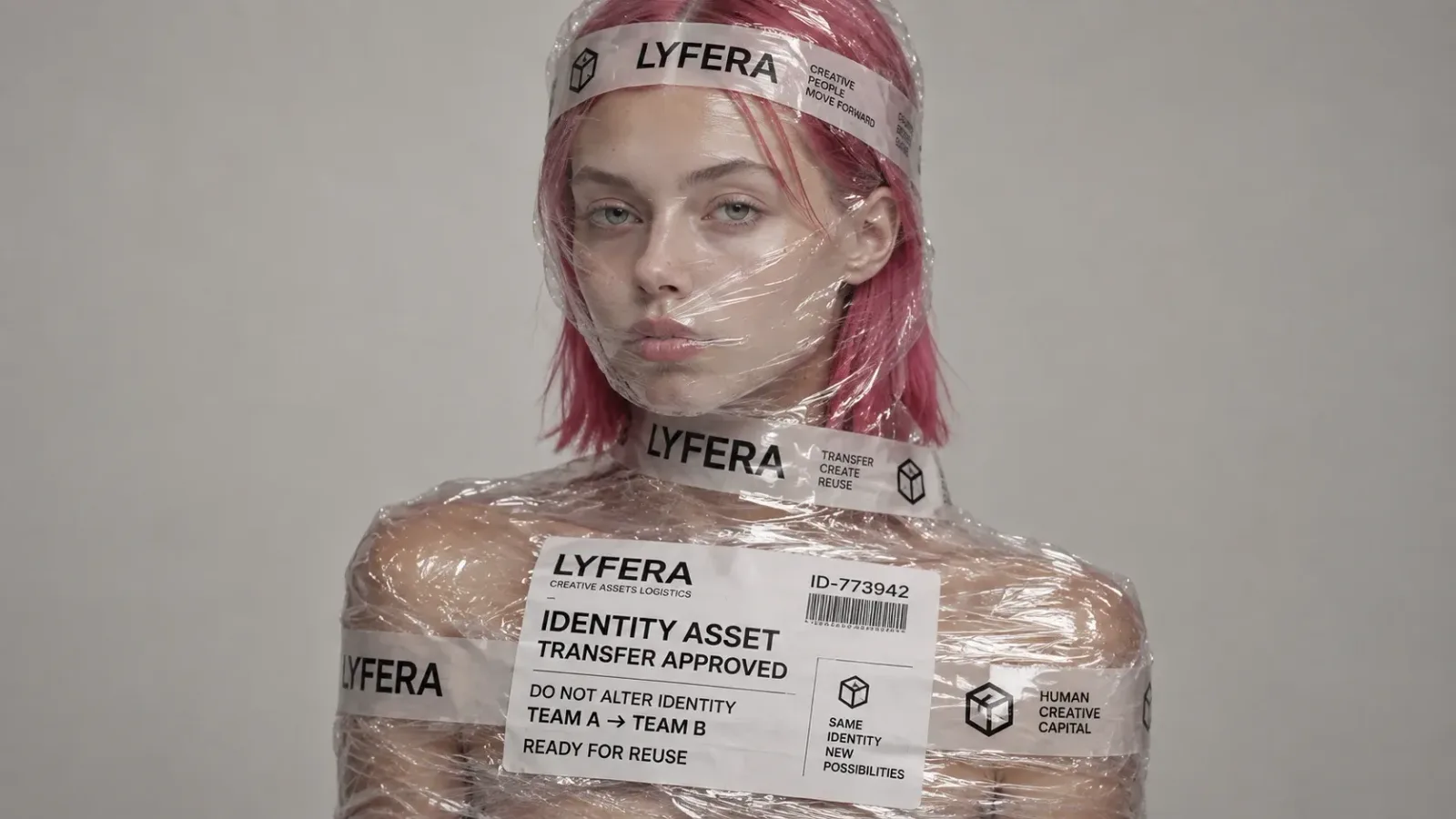
Imagine a fictional fashion character introduced for a small brand's autumn campaign. A studio develops the identity, an editor gives the character a voice, and the brand commissions the first appearances. A year later, a different team produces the work. The face remains recognisable and the earlier images remain online. A reader asks about something the character recommended during the first campaign. Who receives that question, and who can give an answer?
The continuing image makes the handover almost invisible. An artificial talent can retain a face while the people selecting its words, approving its associations and responding to its audience change. For a commissioner, that is a reason to think about continuity beyond the character's biography. Someone needs to remain responsible for the public work when the original production team is no longer making it.
Authenticity has an organisational side
A review accepted by Frontiers in Psychology on 5 October 2026 offers a useful way into this question. Xiao-Rui Lin, Amily Fikry, Wei-Guo Zhang and Kai Ding describe a corpus-based analysis of 1,676 research articles. Their abstract distinguishes several configurations of authenticity, including one they call governed synthetic authenticity. In research on synthetic influencers, they identify ownership, automation and accountability alongside persona coherence and disclosure as relevant concerns. This is a framework drawn from a particular literature corpus, rather than an experiment demonstrating how a particular audience will respond.
At the time of writing, the publisher provides the accepted abstract and says the final formatted article will follow. The full methods and synthesis therefore remain unavailable for this reading. The narrower editorial question developed here is our own: how should a recurring identity remain answerable when the people directing it change? A plausible character and a dependable point of responsibility can be developed together.
Separate the character's voice from the editorial answer
Return to the hypothetical autumn campaign. The talent's caption might express a preference for a particular jacket within an openly fictional scene. A reader asking where to buy that jacket needs information from the retailer. A reader questioning the caption's description needs an answer from someone who can inspect the approved work. Neither question is resolved merely by keeping the character's style of speech consistent.
This is where two kinds of communication can be useful. The character may speak within the creative work; the team can speak plainly about how that work should be understood. A factual clarification can identify the person or organisation providing it. Putting every answer into the talent's first-person voice risks making an operational explanation resemble another fictional episode, especially when the answer concerns a mistake or a changed commercial relationship.
Our discussion of the authority a portrait seems to carry asks where a character's apparent knowledge comes from. A change of creative team adds a further question: can the audience still reach the people capable of explaining the statement? The distinction matters even when the original caption was accurate and the fictional role was clearly introduced.
A handover needs the reasons behind the approved work
For the invented campaign, the outgoing team could pass on the approved pieces, the factual material supporting their claims and the decisions that explain the character's existing associations. The incoming team would then know which relationships were confirmed, which ideas stayed private and which descriptions need checking before they are reused. A folder of polished images alone leaves those distinctions open to reconstruction.
The handover also needs a boundary. A commission for one season does not establish an indefinite relationship between the character and every product shown in it. If the next team continues using an earlier image, it should understand what the accompanying words mean in the new placement. An old campaign credit may describe its original production accurately while giving a visitor little information about who now maintains the page.
This concerns the stewardship of published work rather than an attempt to write every future appearance in advance. In our account of character memory, a usable history distinguishes proposals from established moments. A production handover also needs to make responsibility usable: which team can approve a new association, which can explain an earlier claim, and where an unresolved question goes. These are proposed editorial arrangements, not a description of a transfer function currently offered by Lyfera.
Let a reader find the responsible team
The public explanation can be much shorter than the internal record. In the hypothetical project, the original campaign keeps its production credit, while the current presentation identifies the team handling editorial questions. A reader should be able to understand that a new team now directs the character without being asked to unravel an invented event in the character's life. The amount of explanation depends on whether the change affects how the work is interpreted.
Consider a change from an independent portrait series to a brand commission. The fictional identity could remain visually stable, yet a recommendation now appears in a different commercial context. The surrounding information should make that relationship understandable. A convincing performance cannot supply it, and a generic description of the character's artificial origin does not explain who commissioned this particular piece.
A smaller change may need less explanation. Replacing an editor who follows the same agreed direction does not necessarily create a new public story. The important practical check is whether a question reaches someone who can examine the relevant work and act on it. Naming a team is useful only when the responsibility attached to that name is actually maintained.
Plan for the quiet period after the campaign
The hardest moment may arrive when no new work is being commissioned. Images remain discoverable, links still lead to the character, and a reader encounters an old recommendation without knowing that production has stopped. In our invented example, the brand and studio could decide beforehand who maintains the campaign information, where enquiries are directed and how a material correction will be handled after delivery.
A project that ends can be presented as an archive. Its dates and original context can remain visible, with a current way to raise a question where appropriate. Preserving the work then has a clear meaning: the audience is looking at an earlier commission, rather than being invited to assume that every relationship shown is still active. Continued visibility deserves a decision even when continued production does not.
Lyfera places a human mentor alongside a persistent artificial identity. The wider editorial implication is that a continuing face should remain connected to people willing to account for its public appearances. A character can develop through new settings, collaborators and periods of silence. Planning who answers for those appearances gives the creative work somewhere dependable to return when its audience asks a question.