Cinema & artificial identities · Lyfera Editorial · 2026-09-14
The next film hero could begin in Lyfera
What happens when a film character begins as a persistent artificial identity? An exploration of casting, continuity, world building and the creative possibilities of Lyfera’s humanoid roster.

Cinema has always created people who did not exist before someone imagined them. Even when a performer is real, the identity we encounter on screen emerges from casting, writing, costume, make-up, cinematography, production design and performance. Generative AI introduces another possibility into that process: a character can begin as an artificial identity whose visual features are developed before an actor, a costume department or a physical set becomes involved. For filmmakers exploring AI humanoid characters, the interesting question is how that identity can acquire enough continuity and specificity to support a story.
Much of the appeal of AI character design has so far been associated with the individual concept image. A compelling face appears, a costume suggests a direction, or an unfamiliar combination of materials makes a fictional creature feel plausible. These images can be useful, but a cinematic character has to survive beyond the conditions that made the first image successful. We need to recognise the same individual in a close-up and a wide shot, at night and in daylight, before and after a change of costume, and eventually through events that alter their appearance.
That requirement changes what is worth developing. The image becomes the beginning of an investigation into a character, rather than the point at which the investigation ends.
From an image to a character
The first question concerns which features belong to the identity and which belong to a particular interpretation of it. The shape of a skull, the relationship between head and shoulders, a habitual posture or an unusual arrangement of sensory elements can become as recognisable as a piece of clothing. These features provide the structure against which later changes make sense. If everything changes at once, the viewer has little reason to understand the next image as another appearance of the same character.
Humanoids make this distinction particularly visible because their bodies need not follow the anatomy of a human performer. A ceramic surface, a translucent membrane or a metal structure altered by repeated repairs can each suggest a different origin. A joint can imply a limitation of movement; a face without familiar eyes can change the way an audience reads attention. Material choices can therefore carry information about a fictional technology, a social position or the purpose for which a being was originally constructed.
Consider the difference between damage added to make a character look dramatic and a repair that appears to have been made with whatever material was available. The second choice raises questions about the character's circumstances. Someone maintained this body, and the repair may tell us something about what they valued. A small, coherent detail can give a writer more to work with than an elaborate surface whose features have no relationship to one another.
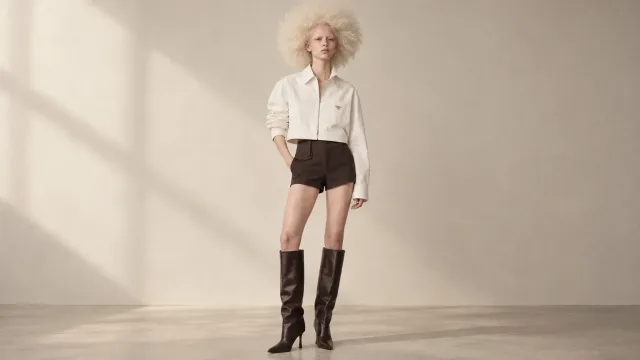
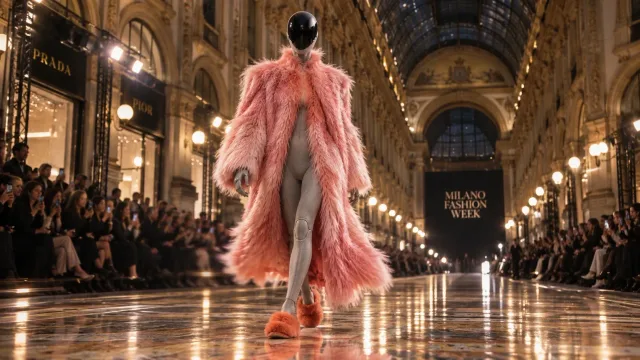
At Lyfera, this is part of the reason we work with artificial identities. The humanoid roster provides distinct visual starting points that can be explored through different roles. In the images accompanying this article, existing talents are reinterpreted through fictional costumes and settings. Those scenes are editorial concepts, but the faces and their defining structures come from identities already present in the roster.
Continuity becomes part of the design
Generative tools make it possible to explore alternatives while a character is still being defined. A filmmaker can compare a ceremonial costume with a practical one, place the character in an unfamiliar climate, or investigate how a body might change after years of use. The value of these experiments depends on whether they answer a creative question. Producing more variations does not, on its own, make a character more developed.
One useful question is whether an identifying feature remains legible when the context changes. An angular head may look distinctive against a plain background but disappear against dense architecture. A fine pattern on the skin may matter in a close-up and contribute almost nothing in a distant shot. Seeing those differences early helps an art director decide which features should carry recognition at each scale.
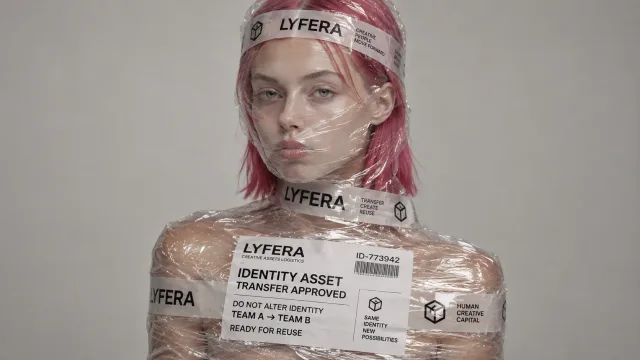
Lyfera's identity framework, including Soul, Passport and visual references, gives this work an organising principle, described in How it works. The identity provides a point of reference for subsequent representations. This should not be confused with a guarantee that every generated frame will preserve every feature: continuity still requires comparison, selection and correction.
For a production, the distinction matters because an intentional transformation and an accidental inconsistency can initially look similar. A missing facial plate might be the consequence of an event in the story, or simply a generation that failed to preserve the design. An approved reference and a record of intended changes allow the team to tell the difference. The character can evolve while the reasoning behind that evolution remains available to the people developing it.
Building a world from the character
A sufficiently specific character can begin to suggest the world around them. The construction of a body implies materials, tools and systems of maintenance. Clothing suggests a climate or a convention. Even the position of a hinge may raise questions about the spaces that body was designed to inhabit.
World building can therefore proceed outwards from the individual. Instead of designing a complete universe and then finding someone to occupy it, a creative team can examine the consequences of a character's construction. A humanoid built to operate in a corrosive environment might have protected mechanisms and replaceable outer surfaces. A being intended to endure for a century could accumulate layers of technology from different periods, making its body a record of the society that kept it functioning.
The relationship can also work at the level of visual rhythm. Inês Silveira's fluted facial structure and tall cranial elements suggest an architectural language that can be developed into columns, chambers and urban silhouettes. The contextual image in this section explores that possibility. The environment is invented for the article, rather than presented as an established part of the talent's history.
Such connections give a fictional setting a degree of internal logic. They invite the audience to believe that the body and the world were produced by related circumstances, even when neither has a real-world equivalent. For science fiction, that coherence is often more useful than accumulating unfamiliar objects simply to make a scene appear futuristic.
A new material for film pre-production
The immediate applications do not depend on the prospect of automatically generating an entire film. Artificial identities can already serve as subjects for visual exploration: character pitches, costume studies, key art, posters and images that help communicate the atmosphere of a proposed production. Each of these has a different purpose, and a useful image makes that purpose clearer.
A director may want to understand the relationship between two characters before committing to a scene. A screenwriter may find that seeing a character's physical limitations changes an action they had written. A production designer may use a concept to discuss the relationship between costume and environment. In each case, the image becomes something concrete that collaborators can inspect and disagree about.
There is a practical boundary between this work and a finished production asset. A persuasive still does not establish how a joint moves, whether a costume can be built, or whether an animated performance will remain convincing across a sequence. Modelling, rigging, performance, animation and compositing retain their own requirements. The concepts shown here demonstrate an editorial direction; they are not evidence that Lyfera delivers those production stages as a single service.
Used with that distinction in mind, AI humanoid characters can make an early creative discussion more precise. They offer a way to investigate decisions before those decisions become embedded in a much larger production.
What matters after creating a face
As convincing generated portraits become more accessible, the ability to produce an attractive face is less likely to be sufficient grounds for a memorable character. The more difficult work concerns what persists across appearances and what an audience begins to associate with that individual.
A distinctive face may create an initial impression, but a character earns a place in a story through relationships, choices and consequences. Visual design can prepare the ground for that work. It can suggest vulnerability, conceal information or make a physical change significant, provided those details remain connected to what the story is doing.
This is the possibility that interests us in artificial identities. A talent can provide a recognisable starting point for an antagonist, a traveller, a guardian or a being whose role has not yet been written. The humanoids in Lyfera's roster can be considered in that spirit: as identities from which a creative direction may grow, with the eventual character shaped by the people developing the project.
The next film hero could begin in Lyfera because the first stage of casting may increasingly involve an identity that has been created specifically to be explored. Whether that identity can carry a film will still depend on the story and on the decisions that turn a striking appearance into someone the audience wants to follow.