Artificial identities · Lyfera · 2026-09-22
An AI character needs a history it can trust
A stored conversation is not yet a reliable history. How editorial decisions help an artificial character carry its past into the next piece of work.
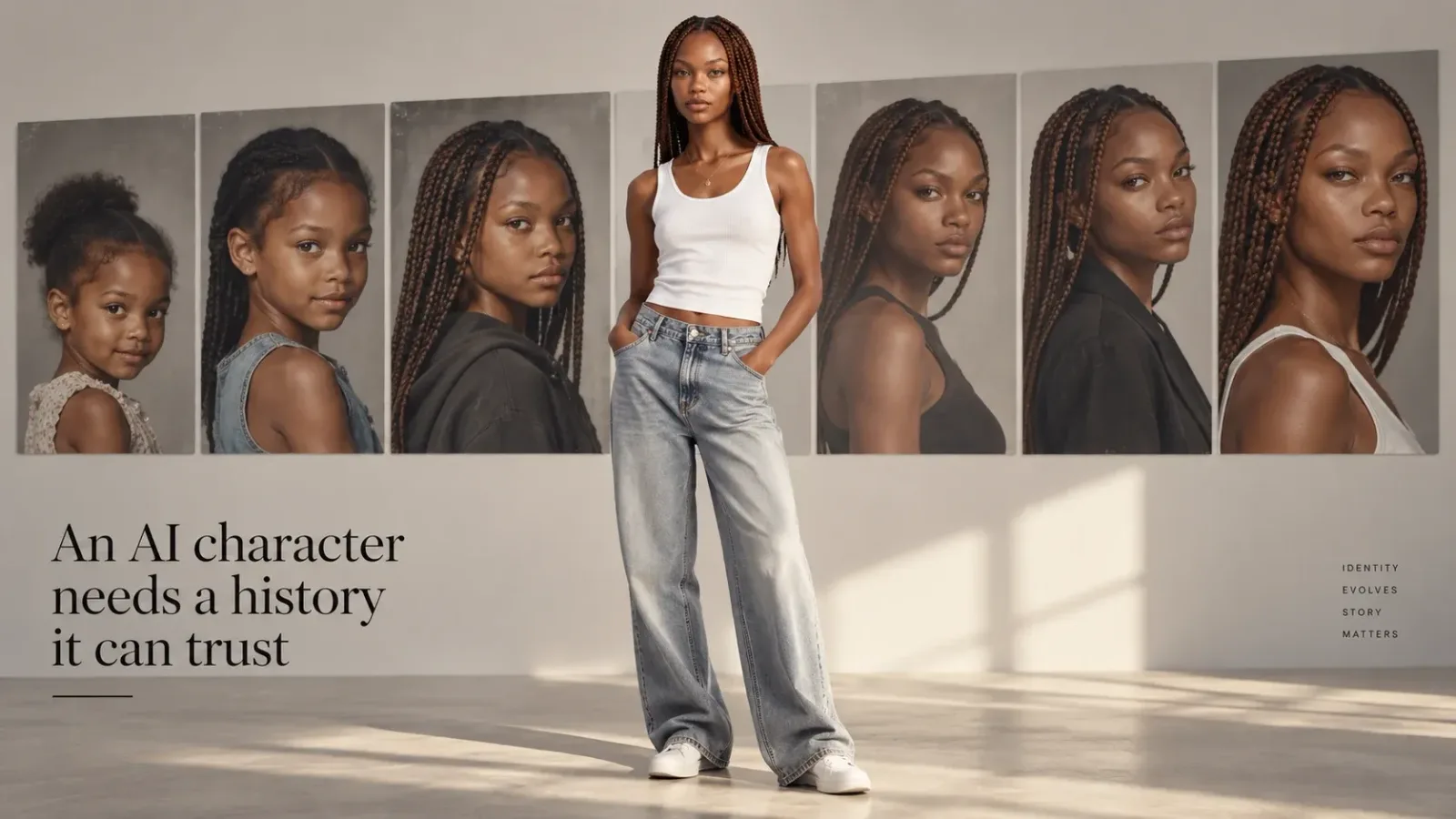
A fictional character becomes difficult to follow when yesterday's choices disappear. A place that mattered is forgotten, a preference changes without explanation, or an abandoned idea returns as something that supposedly happened. The face may remain perfectly recognisable while the person represented by that face becomes less coherent. For anyone developing an artificial talent over time, this is an editorial problem as much as a technical one: what should count as the character's history, and who decides when that history changes?
The word memory makes the problem sound deceptively familiar. In this context it describes information that software stores and retrieves, not a claim about consciousness or lived experience. A system might retain a long conversation and still bring the wrong detail into the next piece of work. It might also turn a tentative suggestion into a confident statement because both arrived as ordinary text. Giving the system more material will not, by itself, explain which parts deserve to shape the character.
A proposal can look remarkably like a memory
Consider an invented editorial brief for a talent interested in architecture. The mentor suggests a future series about railway stations, tests a portrait against a departure board, then abandons the idea. Weeks later, a caption describes the talent returning to the station where the project began. The sentence is plausible and gives the image a pleasing sense of history. It is also wrong within the fiction: the proposed series never became part of the character's story. A discarded possibility has acquired the authority of an event.
This kind of confusion is easy to miss because the output often reads better with the invented connection. The reference feels specific, and specificity is frequently mistaken for evidence. A useful editorial record therefore has to preserve the difference between an idea, an approved piece, a published piece and a correction. They may concern the same station, coat or relationship, but they are not interchangeable descriptions of what the audience has been told. The distinction has to survive when the material is summarised for later use.
The connection between memory and behaviour has a substantial research history. The 2023 paper Generative Agents: Interactive Simulacra of Human Behavior describes simulated characters whose behaviour draws on stored observations, retrieved memories, reflection and planning. It demonstrates an architecture for a research environment, rather than a guarantee about a commercial character service. Its relevance here is the separation of these operations: storing information and deciding how to use it are different parts of the work.
Continuity requires a decision about what belongs
Film production offers a useful comparison. ScreenSkills describes the script supervisor's continuity work as including a breakdown of actions, wardrobe, props and story days, alongside records that help filmed scenes fit together. The point is not to collect every possible observation. It is to retain the information needed to understand a scene in relation to the others. A glass being full or empty matters because of what happens around it.
An artificial talent benefits from a similarly purposeful record. A temporary outfit need not become a permanent preference. A single serious expression need not establish a reserved personality. A mentor's comment that an image feels too formal may be a judgement about that composition rather than a request to rewrite the character. Before carrying a detail forward, it helps to ask what kind of statement it is and how far its authority extends. Otherwise, local feedback can quietly become a rule for every future appearance.
This is why a character's history cannot be treated as a folder of equally trustworthy sentences. The account of a published moment, the wording of a rejected caption and a speculative note for next month should remain distinguishable even if they share vocabulary. The editorial question is whether a later writer can tell what the talent has actually been represented as doing. Our earlier discussion of what makes an artificial talent worth following begins with accumulating choices; a usable history gives those choices a traceable relationship to one another.
Change should leave a reason behind
Continuity does not require a fictional person to remain fixed. A character who never revises an opinion or develops a new interest can become as unconvincing as one who forgets everything. The distinction is whether the change has a place in the work. If a talent who once favoured immaculate tailoring begins collecting visibly repaired clothes, the development can be interesting. It becomes thin when the earlier preference simply vanishes and every new caption presents the new interest as something that has always been true.
Imagine developing that change through a short series. The first piece notices a repair without praising it. The next examines the care involved. A later portrait uses a repaired garment because the interest has become specific enough to affect a choice. This is a hypothetical narrative approach, not a history attributed to a Lyfera talent. It shows how change can be made legible through selection and sequence, without adding a dramatic revelation or an invented encounter to justify every adjustment.
Corrections require a different treatment. If an earlier description contains a mistake, later work should not repeat it merely to appear consistent. Nor should a correction silently rewrite the meaning of everything already published. The practical task is to identify the mistaken statement, establish what replaces it and decide whether readers need an explanation. Preserving an error and concealing a correction can both damage continuity. The record should help an editor understand the difference between development within the fiction and repair of the editorial work.
The next image does not need the whole archive
When preparing a new piece, relevance matters as much as completeness. A portrait about a garment's construction may need the talent's current interests, a stable visual reference and the approved context for that piece. It probably does not need every discarded caption or every exploratory scene. Bringing unrelated material into the brief creates opportunities for accidental associations, especially when the writer is encouraged to make the output feel personal. The more persuasive the prose becomes, the more carefully those associations need to be checked.
Visual continuity has its own version of this problem. Our article on keeping an AI talent recognisable across images considers the references that anchor appearance. A narrative record performs a related task for statements and choices, but the two should not be confused. A recognisable face does not prove that a caption is faithful to the character's history, just as a well-supported caption does not prove that the image preserves the right features. Each part needs its own comparison against the approved material.
For Lyfera, the relationship between identity and a human mentor is central to how the project works. The editorial implication is that memory should make that relationship easier to sustain: it should help the mentor see what has been established, what remains a possibility and what needs attention. These are criteria for judging the work, not a claim that a system can resolve every inconsistency automatically. Before approving the next moment, the useful question is whether its apparent history can be traced to a decision worth keeping.