Artificial identities · Lyfera Editorial · 2026-09-08
What makes an artificial talent worth following?
A face makes an introduction. The choices that follow give an artificial talent a point of view, a history and a reason to return.
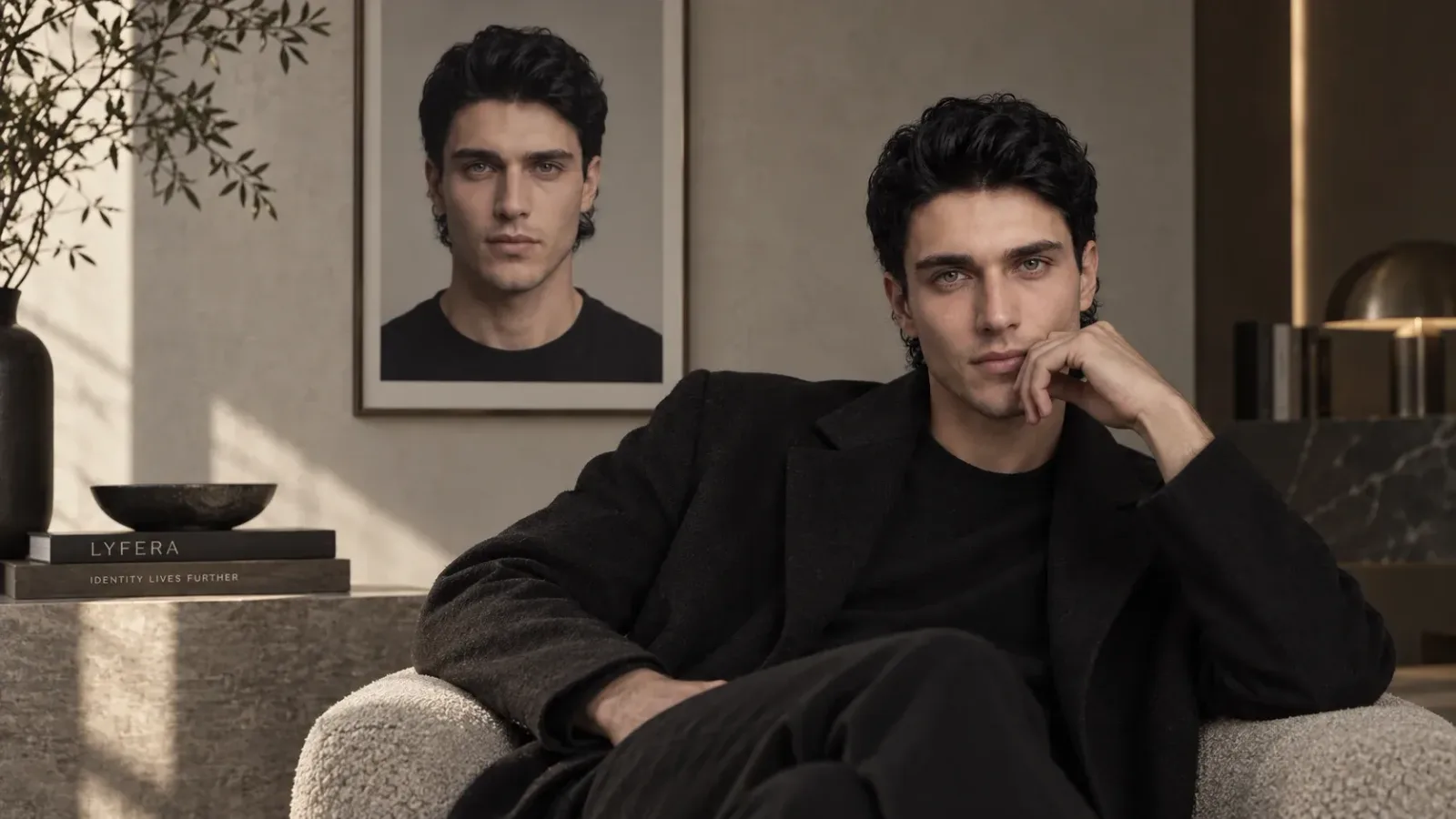
You recognise the face before you remember the name. A few days later, another image appears. The clothes have changed. The expression has softened. Something about the person still feels familiar. For an artificial talent, that second encounter is where the interesting work begins.
An artificial talent is a deliberately created identity whose appearance, voice and story can continue across different pieces of work. At Lyfera, we use the term to describe that whole identity. A portrait may introduce it, but a portrait cannot carry every choice that comes afterwards. Those choices need direction, a record and someone willing to pay attention.
That someone is the mentor. The relationship is creative: deciding what deserves to develop, noticing when an image feels wrong, and leaving enough room for the talent to become more specific over time. The aim is a life worth following. The artificial nature of that life stays visible.
Selected talents
A digital twin begins with a different promise
The language around AI fashion can make different practices sound interchangeable. A digital twin represents an existing person. An original artificial identity is conceived as a fictional subject. An AI-generated fashion image describes how a picture was made; it does not, on its own, tell us which of those subjects appears in it.
This distinction already matters in real work. In July 2025, H&M introduced images featuring digital twins, accompanied by a film about their production. The project involved models and a creative team. It offers a concrete example of a fashion brand working with digital representations of people, rather than evidence that every synthetic face belongs to the same category.
For a reader, the useful question is simple: whose identity am I looking at? For a creative team, the answer shapes the brief. A project tied to an existing person brings that person's participation and boundaries into every decision. A fictional identity needs its own clearly stated origin. Neither deserves to arrive with a deliberately vague introduction.
Specificity gives the face somewhere to go
Imagine a fictional talent who notices the workmanship inside old coats. That detail creates more possibilities than a description such as “passionate about fashion”. It suggests where their attention might land in a photograph, what they might ask a maker, and why they would return to a subject months later.
The interest should have edges. Perhaps the talent likes visible repairs but dislikes decorative distressing. Perhaps they collect references obsessively, then hesitate before choosing what to wear. A preference becomes useful when it can affect a decision. A list of attractive adjectives rarely does.
These examples are editorial inventions, not events from a Lyfera talent's history. They demonstrate a way of writing a character brief: move from a broad attribute towards an observable preference, then ask what that preference changes. If the answer is nothing, the detail may be decoration.
Avoid making every detail harmonious. A talent who always wears the right thing, visits the right place and reaches the right conclusion soon becomes difficult to distinguish from a campaign moodboard. An unresolved interest can hold a reader's attention longer than an immaculate description.
A mentor makes decisions that accumulate
Mentoring starts with selection. One face is chosen. Some details become part of the identity; others stay outside it. Later work should remember the difference. A new picture can introduce a different setting without quietly replacing the person at its centre.
There is also a less visible form of selection: deciding what never becomes public. A technically impressive image may be unsuitable for the story. A caption can sound polished while describing something that never happened. A discarded experiment should remain an experiment, rather than slipping into the talent's biography because it was written convincingly.
This is why we care about continuity at Lyfera. Appearance, voice and history need to refer to the same subject. Our public profiles offer a place to inspect the identity and its disclosed artificial origin. They should be read as introductions to that work, not as proof that every possible activity or social connection is already operating.
Change needs something stable beside it
Continuity can easily become a demand for sameness. The same pose, palette and short sentence appear until the talent starts to resemble a template. Recognition becomes more interesting when it survives variation.
A wardrobe can change while a recurring preference stays legible. A public voice can become more assured without acquiring a new personality overnight. A familiar place can appear from an unfamiliar angle. The reader needs enough continuity to understand the change, and enough change to make the next encounter worthwhile.
In practice, ask two questions when reviewing a new piece. What connects it to the existing identity? What does it add? An image with no connection may belong to a different project. An image that adds nothing may not need to be shared.
Give the reader an honest introduction
Artificial talent asks for a different kind of attention from documentary portraiture. The reader is entering a constructed life. That can be engaging, moving or visually compelling without pretending that a generated image records a person's experience in the physical world.
The introduction should say that plainly. So should the individual piece when its context could otherwise mislead. Disclosure allows the reader to spend less time solving the image's origin and more time considering its choices.
What makes the talent worth following will then be the quality of those choices: a point of view that becomes clearer, a visual identity that holds together, a story with room to develop. The face opens the conversation. The next encounter gives it a reason to continue.
Explore the Lyfera talent roster to see how an artificial identity is introduced in public.