Creative practice · Lyfera · 2026-09-22
Before casting an AI face, decide who is speaking
A digital twin, a presenter and an original character ask different things of a campaign. The role should be clear before the portrait is chosen.
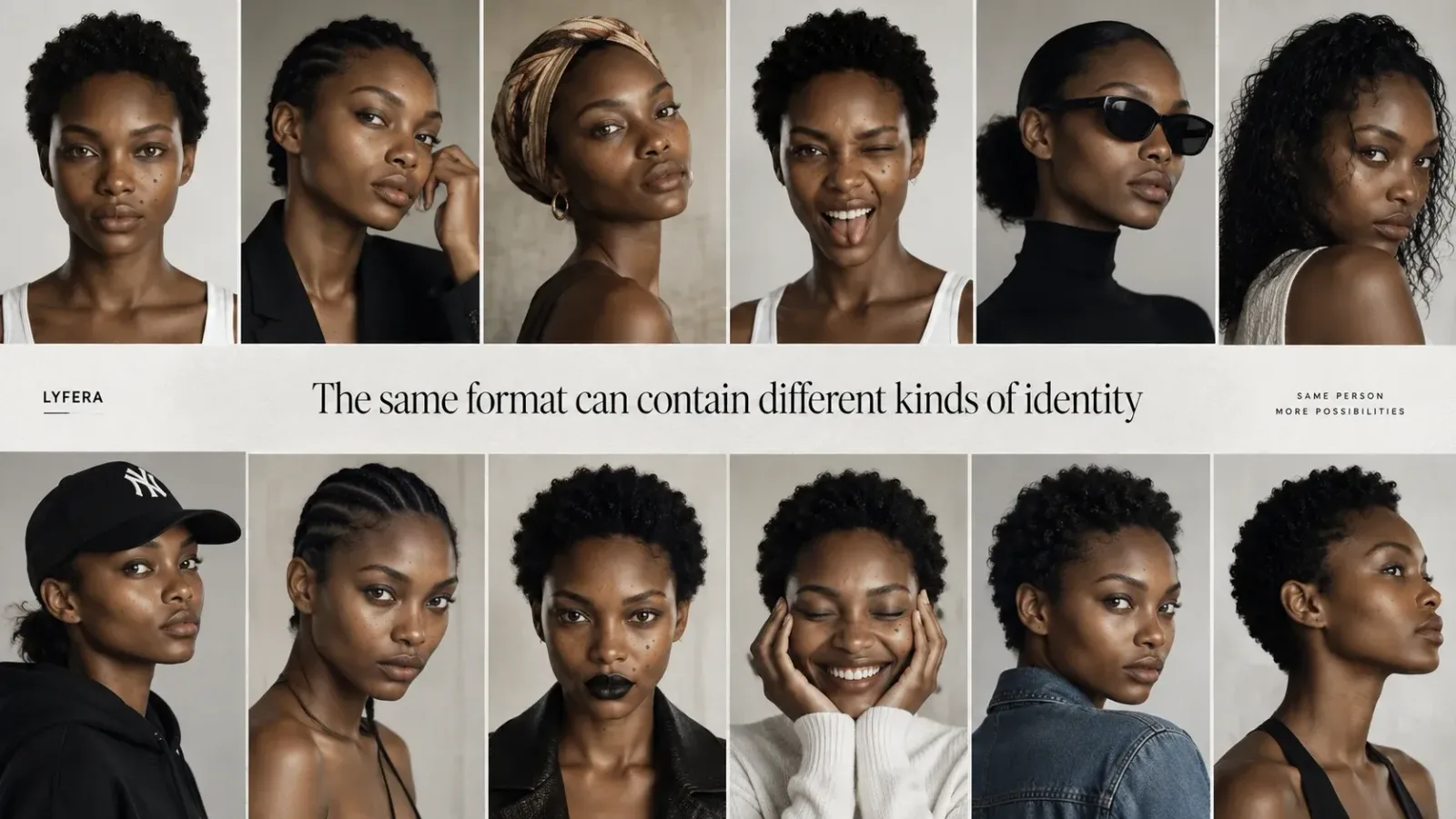
A face on a screen can perform several very different jobs. It can represent an existing person, deliver a message on behalf of a company, or belong to an original character whose identity continues beyond a single campaign. Generative imagery can make these options look similar at the point of selection. A creative team sees a convincing portrait and begins discussing clothes, lighting and delivery before settling the more consequential question of whose presence the audience is being asked to recognise.
That question changes the brief. A founder's digital counterpart carries a connection to a particular person. A presenter selected for an explainer may primarily serve the clarity of that message. An original artificial talent asks the team to develop an identity that can accumulate associations over time. Each can be useful, but they place different demands on the material around the face. Choosing between them on visual appeal alone can leave the campaign trying to establish a relationship that the character was never prepared to carry.
The same format can contain different kinds of identity
The distinction is visible in the tools available to creative teams. HeyGen's Digital Twin guidance describes a workflow based on a real person's performance. Its separate consent-video process requires the person being represented to confirm the creation of the video-based twin. The important editorial feature is the continuing connection to an identifiable individual. An image that resembles someone carries a different meaning from a fictional subject invented for the work.
Arcads presents AI actors and custom avatars within an advertising-production workflow. The Diigitals, meanwhile, describes original characters, campaign work and continuing content around virtual talent. These are descriptions of their public offers, not a comparison of output quality or a claim that one approach is universally better. They show why a broad label such as AI avatar tells a commissioner too little. The team still has to establish what the face is representing and what should persist when the immediate assignment ends.
For a short product explanation, a restrained presenter may be appropriate precisely because the audience needs to concentrate on the explanation. A fictional protagonist for a recurring editorial series needs a different kind of specificity. An unusual face can attract attention, but it does not decide what that character notices, how they speak or why they would return to the subject. Those are creative decisions that remain after a portrait has been selected. Lyfera's account of an artificial talent as a continuing identity addresses that longer relationship.
Write the role before choosing the portrait
Imagine a fictional brief for a small luggage brand. One proposed film explains the arrangement of a bag's compartments. Another follows an invented character's approach to packing for a journey. The first depends on the accuracy and visibility of the product information. The second depends on the character's choices: what they consider essential, what they leave behind and how those preferences make the bag relevant. The same face might appear in both, but the editorial burden is not the same.
If the team begins by selecting a fashionable-looking subject, it may discover too late that nobody has defined the speaker's authority. Is this a demonstration, a dramatised scene, a personal recommendation or an introduction to a fictional life? A sentence such as “I never travel without it” implies a personal history. Giving that sentence to a constructed character does not establish that history. The team must decide whether the statement belongs to an explicitly fictional narrative, can be supported in its intended context, or should be written differently.
The role can be described plainly before any casting begins. A character might be asked to draw attention to the quiet preparation before a journey, with the product supporting that idea. That description gives the art director something to evaluate: posture, pace, clothing and expression should make the preparation legible. A longer character biography is useful only when it changes those choices. An elaborate personality document that never affects the work adds administration without helping the audience understand the scene.
Recurring characters carry earlier work with them
A character used repeatedly can acquire associations that no single brief contains. A restrained portrait series followed by exaggerated promotional gestures may feel like deliberate change, or it may make the identity harder to recognise. The difference depends on what has already been established and how the new work relates to it. The relevant review therefore extends beyond whether the latest output looks polished. It includes whether the character's presence remains meaningful across the sequence.
This gives the commissioner a reason to examine previous work before writing new copy. Which subjects has the character been associated with? Which preferences were actually expressed, and which were only proposed during development? What would a returning viewer reasonably recognise? A recurring artificial talent needs room to develop, but the campaign should be able to explain the development without inventing an off-screen history after the fact. Continuity is easier to assess when the team can identify the earlier choices on which the new piece depends.
The practical value of a defined identity appears here. The people commissioning, writing and selecting images can refer to the same subject instead of reconstructing it separately for each asset. This does not remove disagreements about a performance or make every output suitable. It provides a shared basis for those disagreements. The character can be recognisable while the team rejects a particular image, and a technically impressive image can remain outside the character's public story.
Judge the casting through the work it must support
A useful casting comparison gives each candidate the same clear assignment. For the luggage example, the team could compare how different subjects communicate careful preparation in a still image, then review whether the chosen direction remains legible in a tighter crop or a different setting. The purpose would be to investigate a defined creative question. Changing the subject, lighting, wardrobe and message at once might produce attractive alternatives, but it would make the reason for selecting one of them harder to explain.
Lyfera's talent roster offers a way to look at artificial identities as subjects with distinct appearances. Choosing from an archive should still follow the intended work. A familiar face is not automatically the right speaker for a new subject, and a new face does not supply a point of view simply by being unfamiliar. Our discussion of art direction in AI fashion photography makes a related argument about images: a clear idea gives the subsequent choices something to serve.
The strongest brief leaves the creative team able to describe the relationship in an ordinary sentence. The audience is watching a company explain a feature, an existing person represented digitally, or an original character taking part in a constructed story. Once that relationship is clear, casting can become more precise. The face, voice and setting can reinforce one another because the team has decided what they are there to do, and the audience has a fair chance of understanding who is addressing them.