Culture & perspective · Lyfera · 2026-09-24
Keep the first AI suggestion open to question
A recent review of human–AI creativity raises a question for creative teams: how much room remains for alternatives once the first polished suggestion arrives?
Imagine asking an AI assistant for a campaign idea and receiving a remarkably complete answer: a location, a mood, a sequence of images and a line of copy that seems to hold everything together. The next conversation becomes easy. Change the location. Make the light warmer. Give the talent a different expression. By the end, the proposal has received considerable attention, while the question of whether it was the right proposal has barely been discussed.
This is a useful moment to examine in creative work. A finished-looking suggestion invites a different kind of response from an unresolved question. It gives the team something to improve. For someone developing an artificial talent, the cost may be a narrower search for what that identity could express. The creative decision has moved from choosing among ideas to refining the first idea that arrived in a persuasive form.
Better individual work can still become more alike
A review published on 7 September 2026 by Sara Caprioli brings this tension into focus. Drawing on research across writing, design and product ideation, it discusses gains in creative output alongside risks including convergence between ideas. It identifies the timing of AI involvement, the interaction, the task and the user's expertise as relevant conditions. This is a review of a developing field, rather than proof that one prescribed creative routine will work for every team.
An earlier experiment by Anil Doshi and Oliver Hauser, published in July 2024, makes an important distinction. Writers who received AI-generated story ideas produced short stories that readers evaluated more favourably, particularly among writers with lower initial creativity measures. Yet the AI-assisted stories were also more similar to one another. A useful result for an individual and a less varied collection can coexist. The experiment concerned short fiction; it did not test fashion campaigns or Lyfera talents.
The practical question for a creative director follows from that distinction: what are we comparing? An impressive proposal might perform well against an earlier draft while still resembling the proposals arriving elsewhere. Improving the execution of one concept cannot tell us whether the search considered sufficiently different concepts. That requires looking at the alternatives before their differences disappear beneath styling and polish.
Separate the premise from its presentation
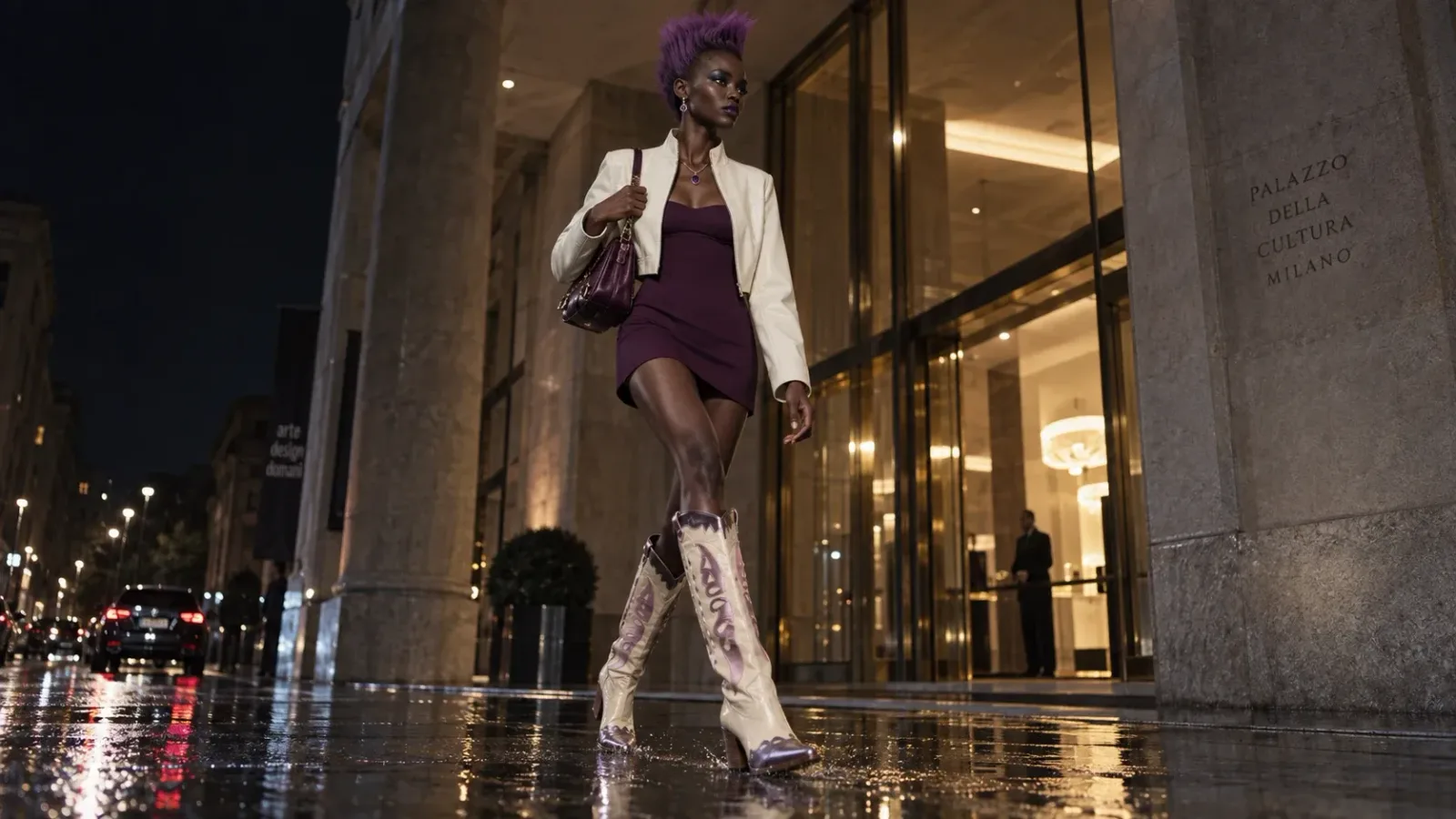
Consider a hypothetical commission about an artificial talent's relationship with evening clothes. One proposal places the talent at a grand entrance, observed by a crowd. Another imagines the clothes being handled in a quiet room before any public appearance. A third treats formal dress as something kept after the occasion, when its original purpose has passed. These are different premises because they organise attention around recognition, preparation and memory.
Now imagine three proposals that all show the entrance, each with a different building, palette and camera angle. There is visual variety, but the underlying idea remains largely the same. That distinction matters when a team asks for several alternatives and assumes that the number of outputs measures the breadth of its thinking. Count the meanings under consideration before counting the frames.
At this stage, keep the proposals comparable. A paragraph for each premise can be enough. Presenting one with a developed visual treatment and leaving the others as short notes creates an uneven discussion: the team must imagine the strengths of two options while being shown the strengths of another. Our discussion of art direction in AI fashion photography begins with making a chosen scene precise. The decision here comes earlier, while several scenes still deserve consideration.
Give independent thought a place in the process
One editorial approach is to write down initial observations before opening the assistant's suggestions. This is a proposed working practice, not a protocol validated for Lyfera by the studies above. Its purpose is modest: preserve some material that arose before the generated answer set the terms of the conversation. In a team, people could make those notes separately, then compare them before developing a shared brief.
The notes need not be impressive. A detail from a garment, a contradiction in the character or an unresolved question may be more useful than a polished campaign line. For the evening-clothes example, one person might notice how a formal jacket changes the wearer's posture. Another might be interested in the awkward interval between getting dressed and leaving. Both offer a direction that can be examined without committing to the grand entrance.
AI can then take a more specific role in the discussion. Ask it to expose assumptions in each premise, suggest what would make the options substantially different, or identify where a concept depends on information the team does not have. Its response remains material for judgement. A confident explanation of why an idea fits a talent is still worth comparing with the actual identity, including the preferences and boundaries that make that artificial talent worth following.
Reopen the choice before approving the finish
There is a point when exploration should narrow. A campaign cannot stay an indefinite collection of possibilities, and revisiting every decision can consume the attention needed to make the chosen work good. The useful check is a short return to the original question before the concept acquires final approval. Can the team explain why this premise fits the subject and the purpose, without relying on how attractive its current treatment looks?
Keep a brief account of the alternatives and the reason for the choice. In the hypothetical commission, the team might choose preparation because it allows a reserved identity to engage with formal clothes through gesture and attention. It might reject the public entrance because recognition by a crowd adds a social meaning the commission does not need. Those reasons can guide later edits more precisely than a general instruction to make the work feel distinctive.
A different team could reasonably choose the entrance. Familiar ideas remain available; novelty alone is a poor substitute for relevance. What matters is that the familiar option survives a real comparison. An AI suggestion earns its place in the brief when someone can explain the choice among plausible alternatives. The finish can then become more exact without quietly deciding what the work was supposed to mean.