Artificial identities · Lyfera · 2026-11-18
What a portrait can show from behind
Two imagined portraits of Ren Mizushima explore how a character can share a view and remain recognisable while facing away.
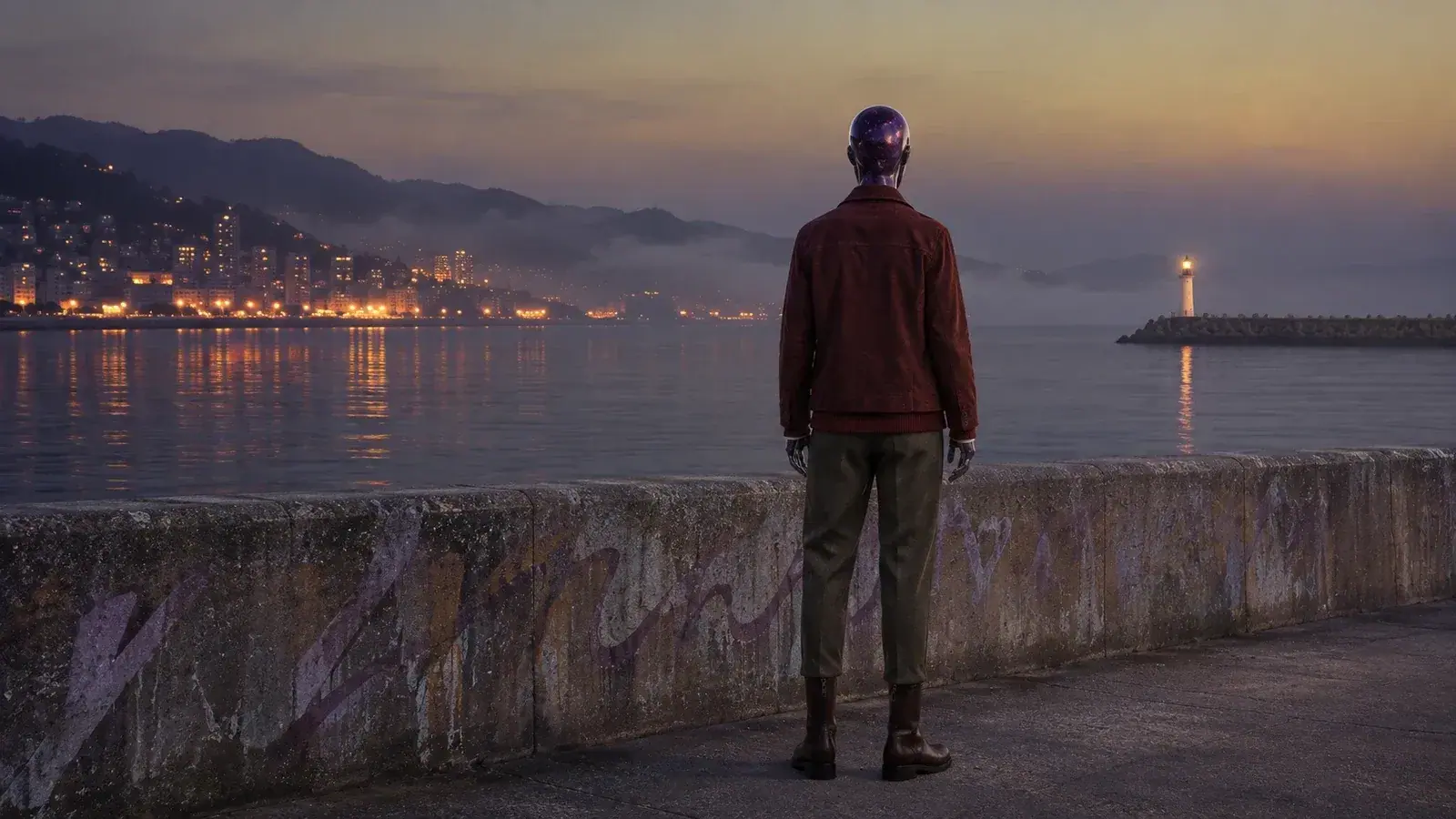
In an imagined portrait of Ren Mizushima on a quay, we see the back of his head before we notice the white beacon on the far breakwater. The violet glints at his nape give the figure a recognisable contour. His shoulders face the water. As the eye travels out past him, the distance from the quay to the far light becomes part of the portrait. The photograph gives us a good place to look from and a reason to look further.
A returning character can carry a picture with only a few visible features. Which features are enough depends on what the audience has already seen. Someone meeting Ren in this picture may first notice the particular surface of the head and the way it holds the light. Someone who knows the character can bring a memory of the face. The same photograph gives those two viewers different amounts of recognition, while both can follow the orientation of the body toward the water.
Put the destination in the frame
The Hamburger Kunsthalle’s account of Caspar David Friedrich discusses the part played by figures seen from behind. In his Wanderer Above the Sea of Fog, the figure faces the landscape and occupies a central position between us and the view. There is an interesting spatial consequence. We can look in the direction the wanderer looks, while the rock and the body keep our viewpoint distinct from his. The painted landscape offers imaginative proximity without granting the same vantage point.
That relationship can be planned in a photograph with an entirely different setting. Think of the imagined quay. If the brightest light were directly behind Ren’s head, the two shapes might collapse into a single silhouette. Moving the light’s position in the frame gives it a distance of its own. Leave enough water visible between the figure and the far end of the breakwater. Then the viewer can trace the direction of the torso, find a possible destination, and still register how much space separates them.
The Journal’s essay about what a gaze leaves outside the frame begins with a direction the eyes give us. In the portrait on the quay, the line of the shoulders does some of that work and the object of attention can be shown. A viewer who finds the beacon can share the direction of Ren’s attention while leaving his expression to the imagination.
Give the next picture a different distance
The second imagined portrait draws closer. Ren’s head turns toward a pale opening and the back of the figure gives way to part of a profile. A narrow light describes the edge of the temple and jaw. This photograph offers a cue the first cannot. It shows the relationship between the surface at the nape and the geometry of the face. There is no need to repeat the quay so long as the two images give the audience enough to recognise who has returned.
That decision is worth making before the pictures are arranged. A recurring identity can be held in the shape of a hairline, the turn of a shoulder, or the way a material reacts to light. It takes judgement to choose which clue will carry across. If the first frame reduces the figure to black and the next loses the characteristic contour, the reader may have to depend on the caption alone. A small change in light can recover a recognisable feature and leave the face in reserve.
The review can be simple. View the two frames at the size at which they will be read. In the wide picture, look for the moment your attention moves from the person to the place. In the closer picture, look for the detail that brings you back to the same person. If both movements are legible, the sequence can let Ren face the world in one picture and give the viewer a little more of him in the next.


