Artificial identities · Lyfera · 2026-11-22
Kaia’s sculpture has to make sense from the side
Tension Study asks a player to verify one wearable form in two views before committing it with a timed pin.
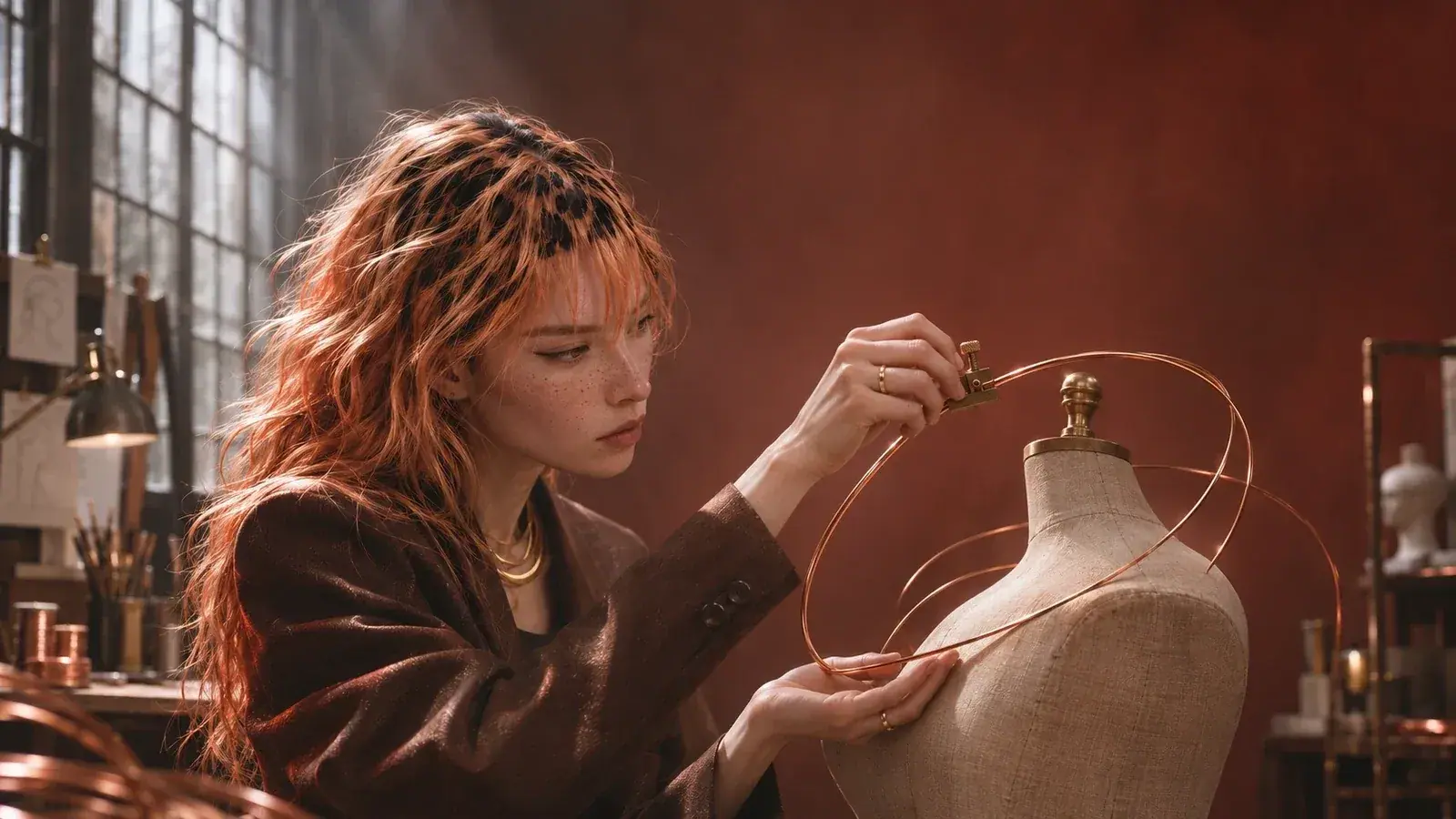
A copper curve can look right from the front of Kaia Verner’s dress form and still sit at the wrong depth. In Tension Study, front and side views measure different parts of the same wearable sculpture. The player cannot qualify the form by perfecting the most flattering angle alone.
You can play Tension Study to enter the Wire Room. The chalk path gives the armature a target, while the side profile exposes how far its fibres sit from the body.
Two views constrain one object
The front control bends the form toward its intended outline. Depth changes become readable from the side. Rotating around the bust allows the player to inspect the relationship rather than accept a flat silhouette as the whole sculpture.
Both views must reach the qualifying threshold and be observed from the appropriate position. That second requirement matters: a number attached to a view is not treated as an adequate substitute for looking at it. The task gives the object’s concealed dimension a place in the player’s procedure.
A hypothetical front view with a clean arc and a poor side fit is consequently unfinished work, even if its outline is persuasive. The correction has to address the form’s depth. Further polishing the front will not resolve the condition the side view identifies.
A pin commits a prepared form
The moving timing band becomes relevant when the player fixes the wire. A pin outside that interval spends a clasp. A proposal that lacks the required fit or view check instead explains what needs attention and preserves the clasps.
Those responses separate a preparation problem from a badly timed commitment. The player is not charged in the same way for discovering an unexamined profile as for missing the moment of fixation after the form is ready.
Later rooms move from counterbalancing curves to fans of fibre and overlapping sails. The fastening window narrows, but the sculpture can still be turned after mounting. Kaia’s work remains available as an object to inspect, rather than disappearing into a completion card. The pin is satisfying because the player has reason to believe that the shape it holds together can survive another view.


