Artificial identities · Lyfera · 2026-11-22
Zaria’s photograph remembers where the light went
A Second of Shade makes a moving mask leave a lasting exposure, so the player has to judge a whole print rather than one bright spot.
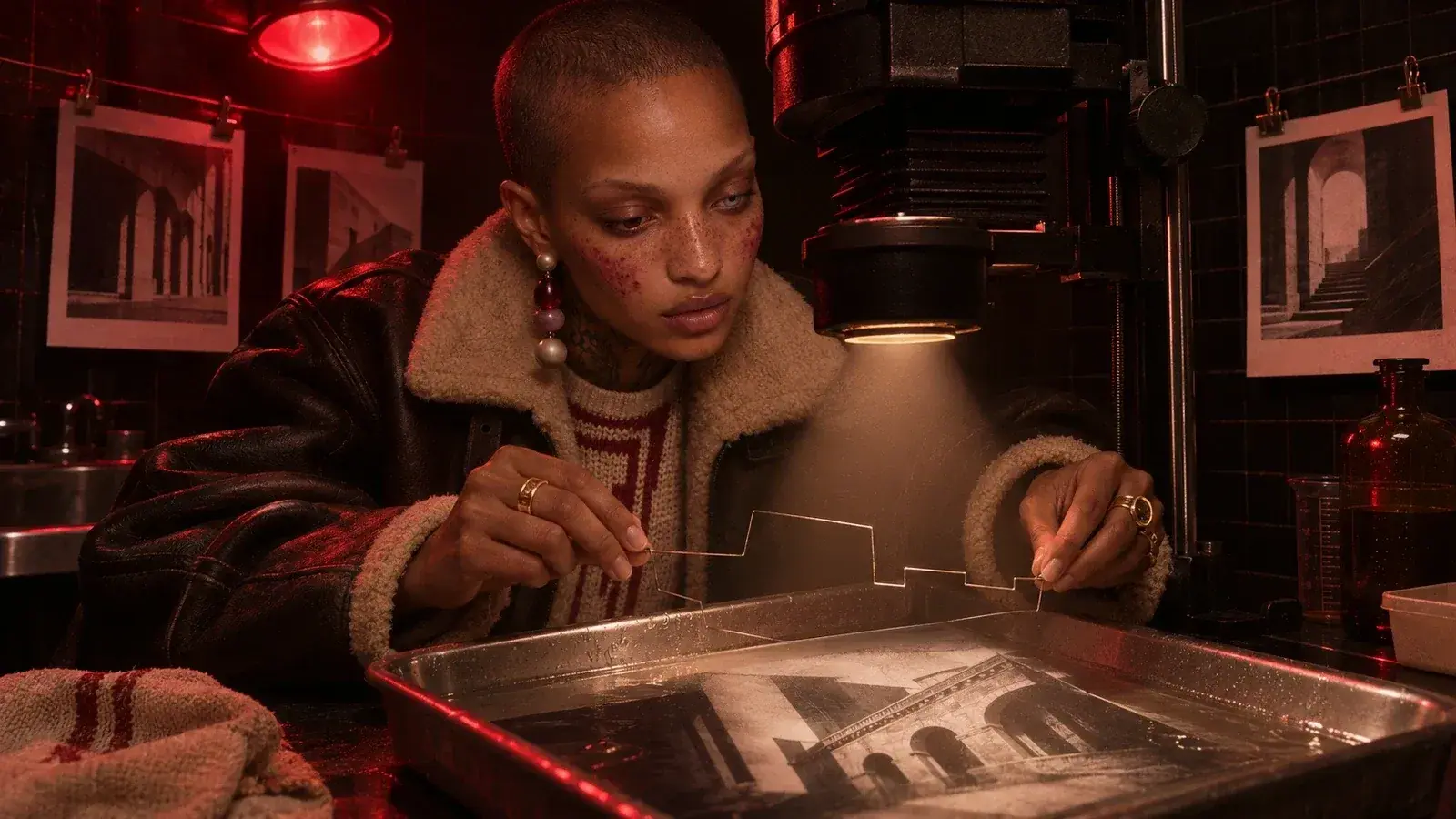
Move Zaria Monroe’s mask across the sheet while holding the enlarger pedal. When the mask moves away, the earlier exposure remains. A Second of Shade builds its printing puzzle around that persistence: light has already reached the paper, and a later position does not erase its effect.
To work with the exposure in Zaria’s darkroom, play A Second of Shade.
The laboratory game asks Zaria to prepare three photographs for an invented independent zine. A contact proof supplies the target. Clear exposes the whole sheet, Dodge shields a circular area, and Burn exposes only the selected circle. The player chooses where the light acts, how long it acts and how softly the edge falls.
A gesture becomes a map
The paper accumulates exposure over the path of the mask. In the documented revision, a horizontal pass changed intermediate points along its route while leaving distant points untouched. The movement therefore has a consequence beyond the cursor’s final location. A useful pass is a duration distributed through space.
Raising the mask changes its reach and edge softness. Half-second exposures offer discrete adjustments, while the pedal permits a continuous one. Neither control is simply a faster version of the other. A short fixed dose can isolate a local change; a moving pass can build a gradual band. The third negative makes that difference matter by asking for a continuous soft region rather than another pair of stationary corrections.
The cover’s suspended wire mask belongs to this mechanism. It places Zaria between the light and a print still being made. The image is a constructed Arcade scene, not documentation of a physical darkroom session or a promise of photographic training.
Developing reveals the whole decision
Develop print judges the sheet against the proof. The game’s evaluation considers both overall error and the worst small region, so matching a few reference points cannot guarantee that the whole image is acceptable. A poorly treated corner remains consequential even if the centre looks persuasive.
When a sheet is rejected, the diagnosis identifies a place and whether it is too light or too dark. Fresh paper gives the player a new attempt while retaining the useful correction. Later tools include saved test exposures that let different doses be compared before committing the print. The revision record traces those controls to actual exposure readings, rather than treating their appearance as evidence that printing has been understood.
Our essay on what gives a touch its weight considers how local consequences make a contact visible. Zaria’s game makes a related relationship temporal: what the hand did a moment ago remains in the work after the hand has moved.
The touch checks used emulated contacts in Chromium, including different release orders for a finger on the paper and a finger on the pedal. They support the recorded control behaviour on that setup; they do not replace a physical phone test. The valuable outcome for a reader is narrower and more tangible: a mask, a pedal and a sheet whose history can be seen when it reaches the tray.


