Artificial identities · Lyfera · 2026-11-23
The same character can need a different sentence
A translated line can preserve the facts while changing a relationship. Give the translator the encounter, then review what another reader receives.

Imagine a short scene in which an artificial character lends someone a small object. The image shows an open hand and a pause before the other person takes it. One possible line is “Keep it until tomorrow.” Another is “You may return it tomorrow.” Both leave the object with the visitor overnight, yet they offer different relationships. The first can sound generous or practical; the second can make the speaker seem to be granting permission. A translation that preserves the deadline while changing that relationship has kept the arrangement and altered the character.
For a recurring artificial talent, this is an editorial continuity question. A recognisable face can travel unchanged while the writing around it becomes more formal, more intimate or more certain. The reader encounters those choices together. When the same character appears in another language, keeping every sentence close to its original shape may protect the words less effectively than giving a translator a precise account of what the exchange is doing.
Give the translator the encounter
Translator Adriana Hunter describes a teaching exercise in a Royal Literary Fund conversation in which students receive the same dialogue with different information about its speakers and intended readership. The resulting English versions take on markedly different registers. Her example concerns literary translation, and it is an account of teaching practice rather than a controlled study. Its useful lesson for a character editorial is that the sentence alone leaves out some of the information needed to find a voice.
Consider an imagined scene featuring Lyfera talent Élise Tessier. A visitor is about to leave with a small handmade object. The writer wants Élise's line to extend the encounter without making a promise about a future meeting. A useful brief would say what has just happened, how familiar the two figures are, and whether the offer is tentative or settled. It would also identify what remains unknown. The visitor's destination need not become a fact merely because a translator finds it convenient to explain the departure.
The two English lines above are invented alternatives for discussing that brief, not translations presented as equivalent in a particular language. A translator working between the actual languages could propose different wording and explain its effect. The decision belongs in that exchange, where someone can hear both versions in context. No isolated dictionary match can settle how much permission, warmth or distance the line should carry.
Preserve the action inside the speech
A character can use language to delay an answer, offer help, refuse a request or leave something unresolved. Those actions give a revision a more useful target than a list of favourite adjectives. If the intended action is a quiet refusal, an elegant version that becomes an apology followed by consent has changed the scene. If the character offers a possibility, a version that guarantees the outcome has changed what the audience can reasonably expect.
That distinction continues the Journal's discussion of giving an artificial voice a performance. There the question is what emphasis and delivery do within a spoken line. Across languages, some of that work may move into word order, forms of address or a different choice of expression. These possibilities need review in the language being delivered; they are not universal rules about how any language or culture behaves.
BookTrust's guidance on writing dialogue treats speech as a way to reveal relationships and advance a scene. Applied to our hypothetical exchange, the practical question is whether the translated reply leaves the visitor with the same kind of opening. They might be free to accept, encouraged to linger or required to answer. The words can change while that opening remains legible.
An expression that sounds restrained in one context may sound abrupt in another. Adding a familiar address might make a line warmer, but it can also imply a closeness that the story has not established. The solution is not to make every version equally polite. It is to decide which relationship the scene needs and ask a competent reader of the target language whether the wording supports it.
Let the image keep part of the meaning
The photograph can carry information that the sentence would become clumsy by explaining. An offered object, a hand still supporting its weight and a body turned toward the exit may already establish the immediate situation. A caption that restates every visible fact can crowd out the small uncertainty that made the exchange interesting. Conversely, a translation may need a clarification when a reference that was obvious to the original audience would otherwise become unreadable.
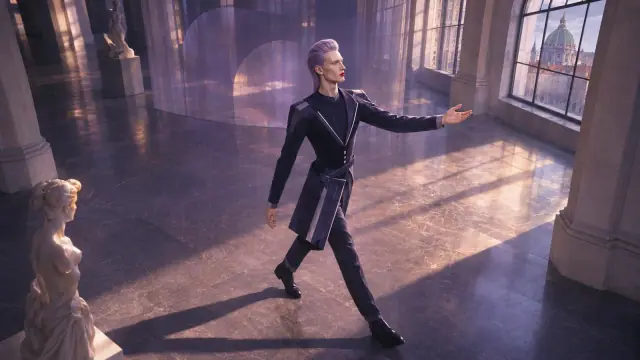
In the imagined rehearsal portrait accompanying this article, Élise's open palm gives the line room to arrive. The image is a fictional editorial study, not evidence of a recording session or of a language Élise has used. Its purpose here is to keep gesture in view while discussing a sentence. The same photograph could support several readings, so the translator needs the intended scene rather than instructions to imitate an apparent mood.
The earlier essay on leaving a character's motive open asks how a precise action can remain open to interpretation. Translation adds a further choice: preserve that uncertainty when it matters. An explanatory addition can accidentally resolve whether the speaker is joking, disappointed or simply being practical. A reader should not receive a different answer merely because the production brief failed to say that the question was meant to stay open.
Review what another reader receives
A useful review places the new text beside the image and the neighbouring lines. The bilingual reviewer can describe what the speaker now appears to want, how close the participants seem and what the reply allows next. That account may reveal a changed relationship even when the factual summary still matches. A literal return translation can help locate a misunderstanding, but a fluent result in the first language does not by itself establish how the delivered version sounds.
Keep the source line, the approved rendering and a short reason for a meaningful departure together in the editorial record. A later caption can then follow an established choice or deliberately revise it. This is a proposal for human creative review, not a claim that Lyfera automatically performs these checks or that an artificial character has lived a multilingual biography.
For the imagined offer, the final choice might be a sentence that resembles neither English alternative particularly closely. It earns its place if the reader still encounters the same offer, the same degree of familiarity and the same freedom to respond. A persistent character needs that freedom to change language without quietly becoming someone else in the exchange.