Artificial identities · Lyfera · 2026-11-22
A rider has to return to the ground
Moonfold’s articulated figures are tested through movement, mounting, a fall and recovery, beyond the pose that introduces the cast.
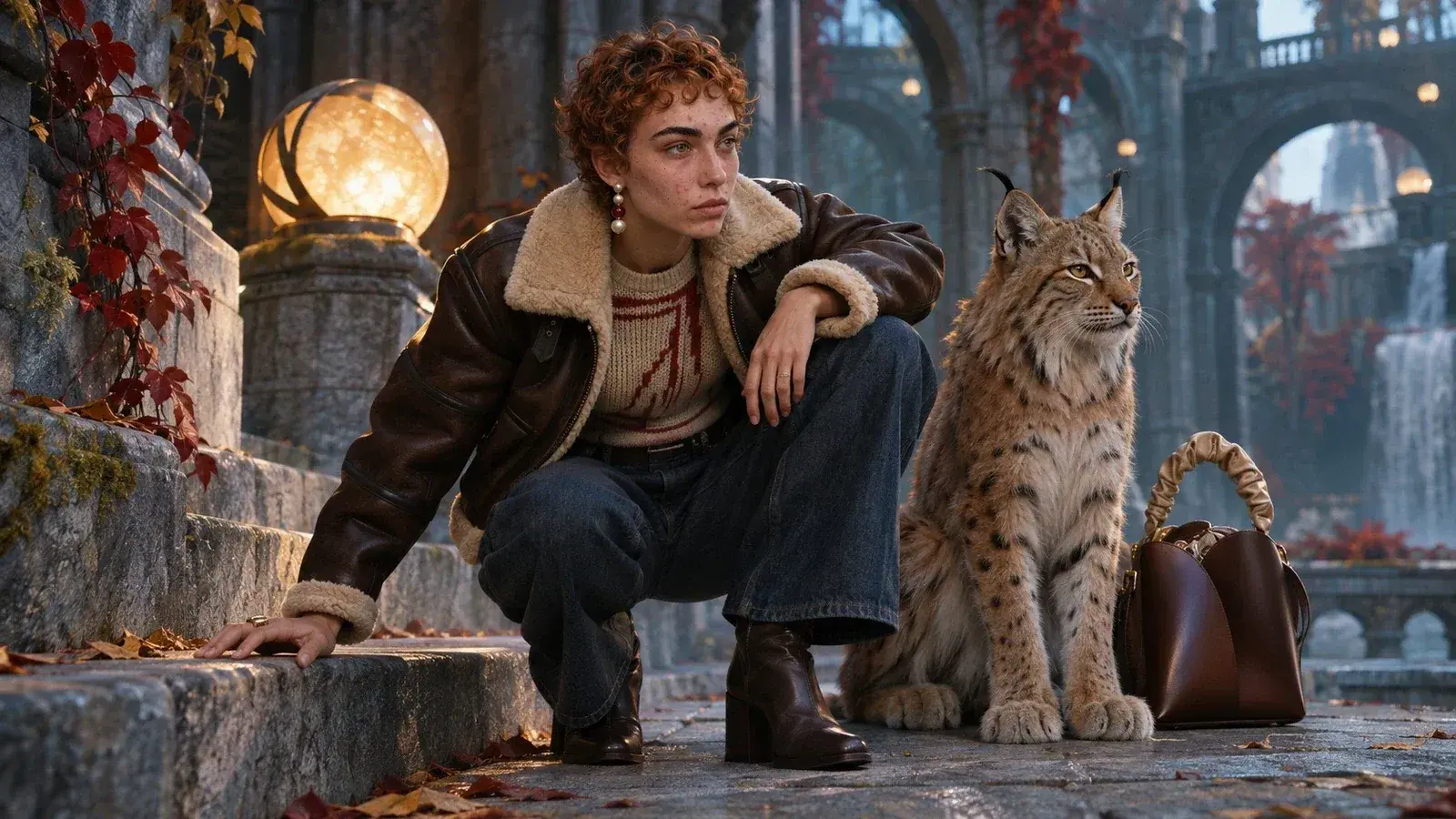
Gina Zuliani loses her balance, makes contact with the ground and gets back up. The useful question is where the figure ends after the action. A convincing opening pose would be little help if the recovery left a knee below the terrain or the next step starting from an impossible position.
To see the rider and companion in motion, play Moonfold Menagerie.
Moonfold Menagerie’s laboratory edition uses ten articulated talent models. Each is assembled from moving parts so that walking, mounting and recovery can alter the pose. The player sees one figure continuing across those actions, while the implementation has to keep its parts related to a shared body and the ground beneath it.
Contact changes what a pose means
A foot hovering above the surface may be acceptable during a step and wrong at the end of a recovery. A knee touching the ground may belong to a fall rather than a failure of the standing pose. The state of the action therefore matters when interpreting a contact reading.
The laboratory model check records sixteen articulated parts for each of the ten figures. It also records a first contact during the induced fall, followed by a recovered balanced posture. Gina’s entry identifies a left-knee first contact; several other figures record the right knee. At the final sampled balanced state, the contact list is empty. That does not mean the entire fall occurred without contact. It means the observation belongs to a later state.
Keeping those readings in sequence prevents a screenshot from supplying more evidence than it contains. A frame can show a silhouette and a relationship to the floor. A recorded transition can additionally establish that the model reached and left a particular state under the tested action.
Test the change that the player will notice
The check includes mounting, because a figure that walks successfully can still sit badly in relation to an animal. The cast’s portraits establish a visual introduction; the moving model must remain usable through the cartridge’s actual gestures. A single successful front-facing render cannot stand in for those transitions.
This is a stylised authored model, not a biomechanical reconstruction of Gina or an assertion that the simulated contact follows human anatomy with medical precision. Our essay on sculptural likeness explores the interpretive work between an image and a volume. The game adds another obligation: the interpretation must continue to make sense as its parts move.
All ten model entries were exercised in the documented laboratory run. That provides a finite set of observations, not a guarantee against every possible collision, slope or device behaviour. It is still stronger evidence than a list of model filenames, because it follows a meaningful action through a change of state.
For the player, the consequence is ordinary and immediate. After a fall, the same rider should be ready to move again. The technical work becomes useful when the body returns to a position from which the next choice can be made, and the interruption reads as something the character did rather than a figure coming apart.


