Artificial identities · Lyfera · 2026-11-19
A photograph can hold more than one speed
Two imagined portraits of a returning character explore how a still image can hold a sharp presence and traces of movement.
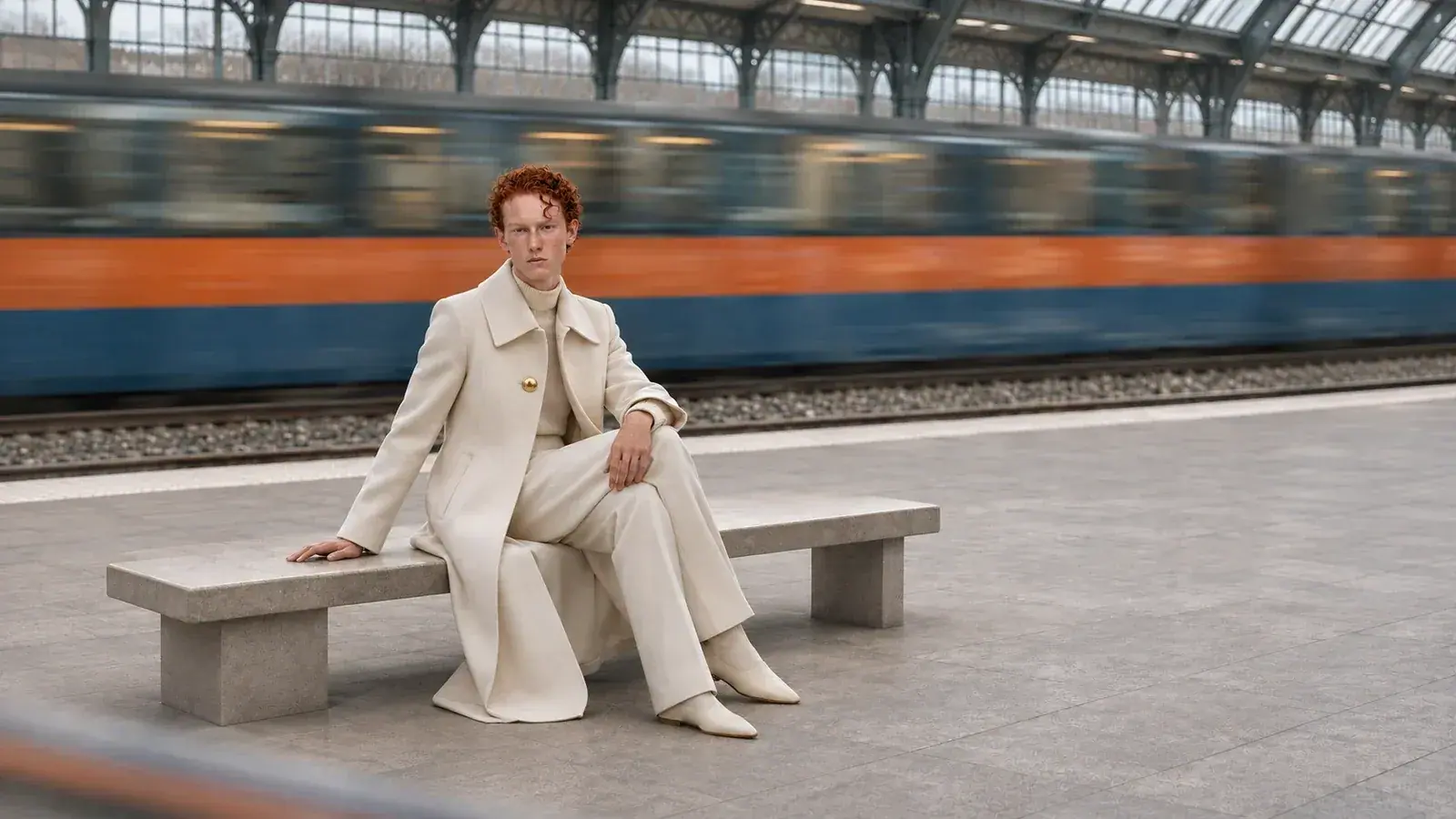
Imagine Léonie Mercier sitting on a station bench in a pale coat. Behind the bench, the windows of a passing train stretch into horizontal bands. The hand on the knee remains easy to read. So does the edge of the collar. The eye meets two kinds of time in the same picture: something passing through and someone holding a position within it.
This is a constructed portrait, borrowing the visual language of a slow exposure. There is no journey to reconstruct from it. The interesting decision lies in where the image allows detail to remain. The train can lose its separate windows while Léonie keeps a recognisable face. That unequal distribution of clarity gives the portrait its rhythm.
Let the surroundings carry the movement
A broad streak can make a surprisingly active background. Its direction matters. In the imagined station, horizontal bands cross behind an upright torso and the bench gives them another line to run against. The viewer can follow the movement across the frame, then return to the seated figure. The pale coat holds a distinct shape against the darker train, giving the eye a place to settle.
The contrast needs an anchor. If the bench, the ground and the train all dissolve in the same way, the picture can feel as though the whole viewpoint has slipped. Keep a useful edge somewhere: the front of the seat, the sole of a shoe, the place where a hand bears weight. That edge helps the passing band belong to the surroundings. It also gives the body a credible position inside the scene.
Photography has long made duration visible through accumulation. In its account of Hiroshi Sugimoto's Theaters, UCCA describes exposures lasting the length of a film. Successive projected images gather into a luminous white screen. A sequence that would take time to watch becomes one bright area within the photograph. The example opens an expressive question for a quite different portrait: which information should survive the time the image seems to contain?
For the station picture, the separate train windows can give way to a band of colour. The face needs more specificity. Giving everything equal sharpness would describe the setting differently; giving everything equal blur would change how readily the person can be recognised. A director can decide how much of each kind of information the picture needs.
Bring the movement closer to the face
The second imagined portrait lets the instability enter Léonie's own outline. A raised hand leaves soft, overlapping contours near the cheek. There is less distance between the movement and the features we use to recognise the person. The red curls, freckles and shape of the face have to carry more of that recognition while the gesture becomes harder to locate at a single instant.
This closer picture adds a useful complication. A hand can be readable as a movement even when its exact position is uncertain. The difficulty arrives when a translucent contour starts to look like another solid finger, or a shifted facial edge suggests a different person. Motion gives the image a reason for those repeated marks, but the rest of the picture must help us read that reason. Light, contrast and the continuity of the sleeve can make the gesture feel connected to one body.
The Journal's essay on a pause that gives a pose somewhere to go follows the possibility of a next action. Here, traces of an action occupy the same frame. A sequence can use both approaches: one picture lets us anticipate movement, another lets us examine what remains of it.
Decide what the returning person needs to keep
A persistent character does not need every picture to offer the same amount of facial detail. The recognisable features do need a fair chance to reach the viewer. In the wider image, that might mean keeping enough contrast around the head. In the closer one, it might mean letting a curl and the nearer eye remain distinct while the hand crosses a softer part of the frame.
Review those decisions at the size at which the pictures will be seen. A delicate motion trace can disappear when the image becomes small; several traces can merge into a heavy patch. Look at the place the eye first settles, then follow where it goes. The station portrait can send it along the passing train and back to Léonie. The closer portrait can hold it near a gesture whose beginning and end remain just beyond the image.


