Artificial identities · Lyfera · 2026-11-08
When Colour Holds a Story Together
How relationships between colour, light and materials can connect a visual story while leaving an artificial identity room to change.
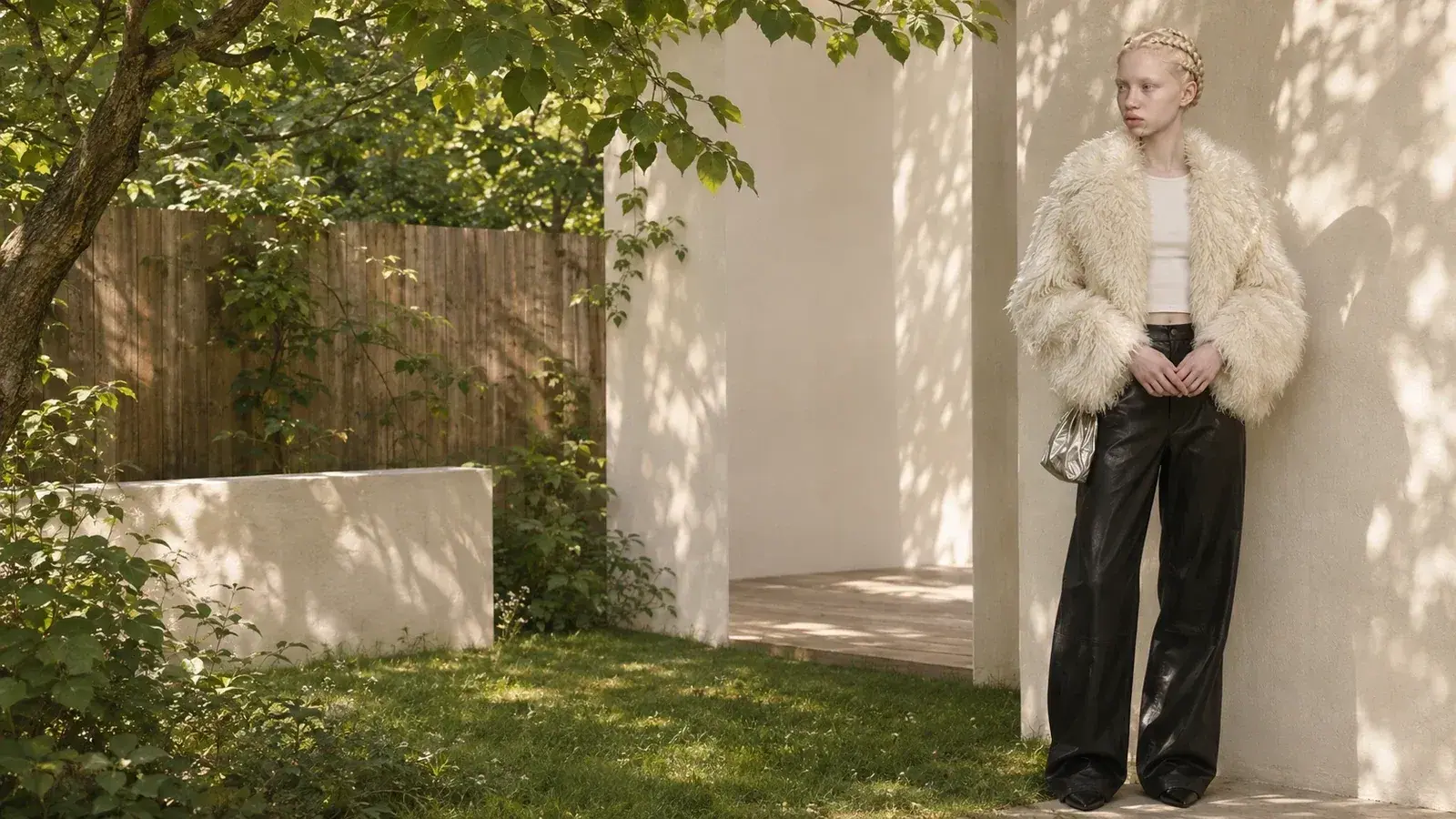
A recurring colour can make a series feel connected before anything else repeats. The more interesting choice is not a signature shade, but a relationship: one colour stays quiet while another appears at the edge of attention, then returns somewhere unexpected.
In an imagined sequence featuring Lyfera talent Signe, a soft green might first sit in foliage outside a pale room. In a later image, a trace of the same green could appear in reflected light, while the setting and styling change. Neither picture establishes that Signe visited a particular place or experienced an event. The sequence is a proposition about visual direction: a connection the reader can notice without being told what the character feels.
Build relationships, not a uniform
A palette is more than a list of swatches. The area a colour occupies, the material that carries it and the light falling across it all change its role. A warm wall can make a cool garment stand apart; the same garment against a similarly cool background might become quieter. A colour used across a whole surface has a different weight from the same colour in a reflection.
A useful starting point is to choose a dominant family, a counterpoint and a small accent. These are working decisions, not rules for how a viewer must respond. A pale ground can give an accent room to be noticed; a darker ground can pull several elements together. Change the balance between images and the series can develop without asking every frame to repeat itself.
Director Nicole Riegel described choosing a colour palette before collaborating with the production designer and cinematographer on *Holler*. Her account is specific to that film, but it shows how a palette can become a shared starting point for different creative decisions rather than a finishing filter. Read the interview.
Let the frame change the colour's job
Imagine Signe near a light wall with green leaves filling most of the frame. Green describes the setting. In a second, closer composition, only a small green reflection remains beside the same pale tones. The relationship persists, but the emphasis has moved from surroundings to detail. A third image could leave green out altogether and keep the series connected through the contrast between warm light and a cool shadow.
This is why evaluating one image alone can be misleading. Put the intended sequence side by side at a consistent size. Look for the colour that draws the eye first, the material carrying it and the amount of space it occupies. Then ask what changes when the order changes. The earlier Journal essay on what a crop lets an image say considers how the frame changes attention; colour is another decision within that frame.
Leave room for an identity to move
A recurring palette can support recognition, but it should not become a claim about personality. Red does not reliably mean confidence, nor does blue prescribe calm. Context, culture, light and a viewer's own associations all influence what a colour suggests. A visual identity can contain contradictions and still feel coherent.
Keep a small record of choices: the relationships a team wants to explore, the images used as references, and the reasons a particular treatment was selected. Record changes too. This gives the next creative decision a point of departure without turning a synthetic talent into a fixed mood board or treating an imagined scene as biography.
The point of continuity is to make room for variation that feels considered. One frame can introduce a relationship, another can interrupt it, and a later image can bring it back in a new material. What holds the story together is the attention paid to those choices.