Artificial identities · Lyfera · 2026-11-22
Cal’s receiver lets you test a theory before recording it
Ghost Band separates free tuning and comparison from the decision to commit a signal, making its radio puzzle readable without relying on sound alone.
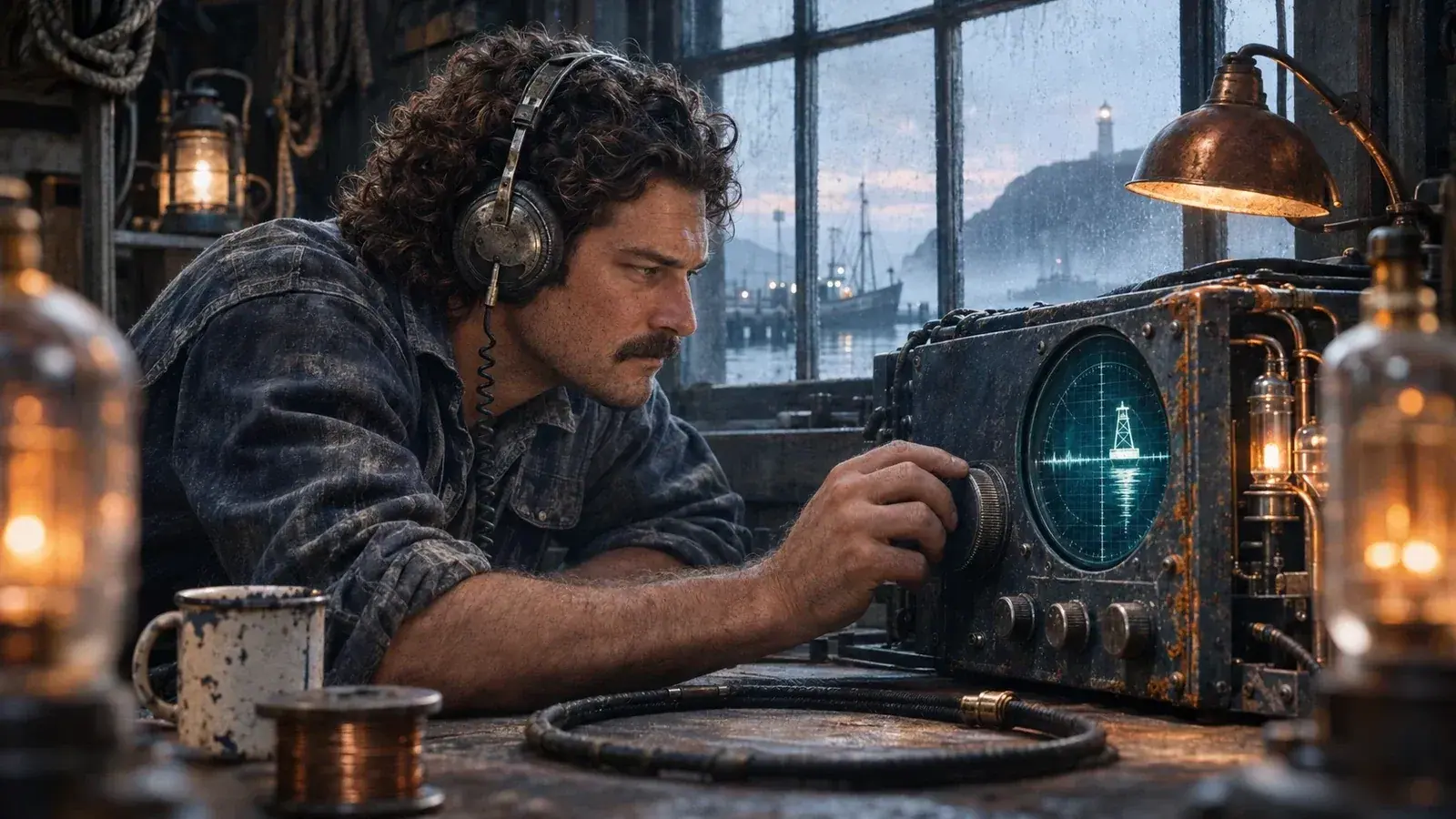
Cal Hampton’s receiver can be adjusted without immediately spending an attempt. In Ghost Band, moving the dial and running a pilot test are preparations; recording is the commitment. That separation gives the player a chance to understand a signal before asking the game to judge it.
You can play Ghost Band to follow the first transmission from the dock. Noise, wave alignment and a diagnostic display accompany the audible comparison. The game offers a visual route through the same evidence when sound is muted.
Three tapes ask different questions
The opening tape concerns a carrier frequency. The next asks the player to consider delay and the receiver’s contact setting. The last combines antenna choice, direction and a recording window. The repeated action of adjusting a value therefore belongs to different explanations as the search progresses.
The pilot test is useful because it compares a reference oscillator with the receiver’s response. It is not another attempt to submit the tape. A player can change a setting, observe the comparison and decide whether the change supports their hypothesis.
That is a different kind of pressure from the one in Berta’s comparison of two statements. Both games distinguish gathering evidence from making a supported call, but Cal’s evidence is a signal whose shape responds to a physical control. The radio’s interpretation has to remain connected to what the player can adjust.
Keep a useful reading
On the second tape, the pilot test retains the best reading of that stage, and Recall returns to it. This is a limited memory for a measurement. It lets the player explore a neighbouring setting without having to reconstruct the most promising position from recollection alone.
A failed recording burns a fuse, while further adjustment remains available as long as the session continues. The point cost and the three fuses make a premature commitment meaningful without charging for every investigative movement.
Cal’s search consequently depends on a distinction the apparatus makes visible: a signal can be present, a setting can be promising, and a recording can still be badly timed. The player is given instruments for separating those possibilities. Finding the boat becomes a sequence of supported decisions rather than a hunt for a dial position that happens to make a success light appear.


