Artificial identities · Lyfera · 2026-10-25
Let the material help invent the wardrobe
An imagined wardrobe can develop through materials, samples and rules for making. Aalto’s textile research offers a way to think beyond the next attractive variation.
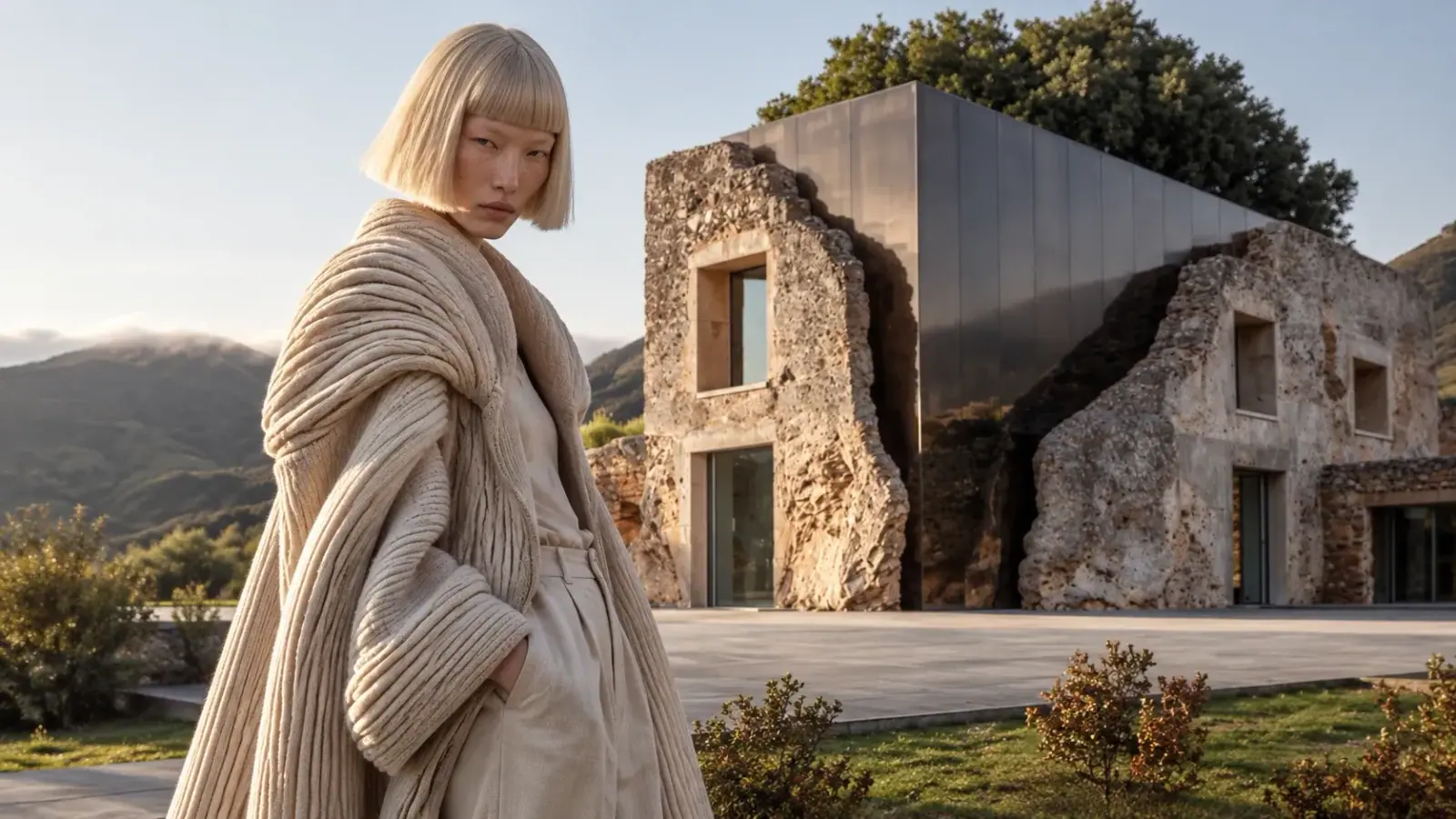
Imagine a fictional talent wearing a knitted coat whose raised lines gather around the shoulders. In a portrait, the lines catch the light and give the figure a sense of being sheltered. The image offers an appealing idea. Developing that idea could begin with another portrait, but it could also begin with a question for a textile designer: what kind of knitted structure might create that enclosure, and what would change when someone tried to make it?
For an artificial identity, an invented wardrobe can be a place to explore material possibilities. The interesting exchange begins when the clothes are allowed to develop through something other than their appearance on a screen. A fabric, a method of construction or a limited supply of yarn can introduce choices that the original image never contained. The resulting garment may look less like the first proposal while giving the talent's wardrobe a more specific direction.
There is a timely example at Dutch Design Week, whose 2026 programme runs from 17 to 25 October. Aalto University's Textile Design Meets AI, part of art-ai-fact, explores textile structures and three-dimensional knitted and woven forms through collaboration between designers and computational approaches. Its relevance extends beyond the possibility of producing an unusual surface. It invites a closer look at how the rules for making something can participate in its invention.
Bring the structure into the conversation early
A convincing illustration leaves many material questions open. In the hypothetical coat, the lines could represent coloured marks, raised ridges or the boundaries between separate pieces. Those interpretations might appear similar under one lighting treatment and imply very different work. Deciding which one matters gives the next conversation a subject more precise than making the coat feel sculptural.
Suppose the creative intention is that the shoulders should seem protected while the lower part of the coat remains open and easy. A textile designer could explore that relationship through samples, construction proposals or a specialised digital model. Each would answer a different part of the question. A surface sample could help discuss the scale of the ridges; it would leave the overall shape unresolved. The portrait could remain useful as an expression of the desired presence, with those limits understood.
This changes the direction of the exchange described in our article on garment fidelity in AI fashion images. There, an existing garment supplies the details the picture must preserve. Here, an imagined appearance starts a conversation from which a garment might develop. The initial picture can be reconsidered as the material work supplies new information.
Choose what varies, then question the rule
A related study by Severi Uusitalo and Anna-Mari Leppisaari, published in July 2026, examines an evolutionary system for whole-garment knit design. Its outputs encode knitting instructions in a bitmap; they are more than pictures of a finished look. The authors distinguish selecting candidates, steering the available variations and changing the rules that generate them. In the reported session, an experienced textile designer helped author a new procedural style, with language-model assistance for the code. Physical knitted samples formed part of the work.
That distinction is useful when a series of alternatives becomes repetitive. In the invented coat project, imagine that every proposal arranges the same dense ridges evenly across the whole garment. Selecting a quieter version might reduce their prominence without allowing the sheltered shoulder and open lower section to develop independently. The team could instead reconsider the relationship that organises the proposals: where the structure begins, where it gathers and where it is allowed to disappear.
This is an editorial application of the distinction, not a claim that a general image generator exposes the controls used in the research system. The practical conversation may happen through drawing, sampling and discussion with a maker. What matters is recognising when the available variations keep answering a question the project has already outgrown. More selections can be useful; sometimes the way the alternatives are being formed deserves attention first.
Give a sample permission to change the idea
The paper reports one analytical design session with an expert participant who was also a co-author. It does not establish general improvements for inexperienced users or guarantee that arbitrary generated clothing can be manufactured. The material constraints and specialist judgement belong to the account of the work. They should remain visible when its implications are carried into a different project.
Return to the fictional coat. Suppose a physical trial produces a shoulder that looks protective but dominates the rest of the garment. The team might soften the structure, move it towards the back or decide that the stronger silhouette is the more interesting direction. The trial has contributed to the design when the people developing it can reconsider what they wanted, as well as whether the original proposal was reproduced successfully.
That possibility changes the role of a sample. It can reveal a promising departure that would have been difficult to imagine from the portrait. A smaller ridge might make a changing rhythm more legible. A new edge could suggest where a fastening belongs. These are hypothetical observations, rather than outcomes documented by the Aalto project. They illustrate why a material experiment needs a genuine opportunity to affect the next creative decision.
The artificial talent can then be pictured again in response to the revised proposal. Art direction would consider how the new shoulder changes posture, framing and light. The material work and the image develop a relationship: each gives the other something to answer. A departure from the first portrait becomes part of the wardrobe's development instead of being treated automatically as a loss of fidelity.
Let the family resemblance come from a way of making
Once the hypothetical coat has a direction, the same interest could lead to another piece. A scarf might gather structure around the neck and leave its ends comparatively open. A shorter garment might explore the transition at a different scale. They would need their own development, but the relationship between shelter and openness gives them a shared question. Repeating the first coat's colour or copying its surface everywhere would offer a different, narrower kind of continuity.
For a mentor, that shared question can help an invented wardrobe acquire specificity without making every appearance identical. It remains a creative proposal. Until material development has taken place, the images should be presented as imagined clothing, with no claim about comfort, fit or availability for purchase. Lyfera's artificial identities provide subjects for such explorations; the textile research does not establish a manufacturing service within Lyfera.
The next useful brief might therefore place the original portrait beside a revised drawing and a sample, with a short account of what changed between them. The coat's first image supplied an atmosphere. The developing material gives that atmosphere consequences: a different shoulder, a different gesture, another way for the character to occupy the frame. The wardrobe becomes more interesting because its invention has been allowed to meet something that can answer back.