Artificial identities · Lyfera · 2026-11-12
A reflection can hold two views at once
How reflections shape a portrait and make the relationship between character and space visible.
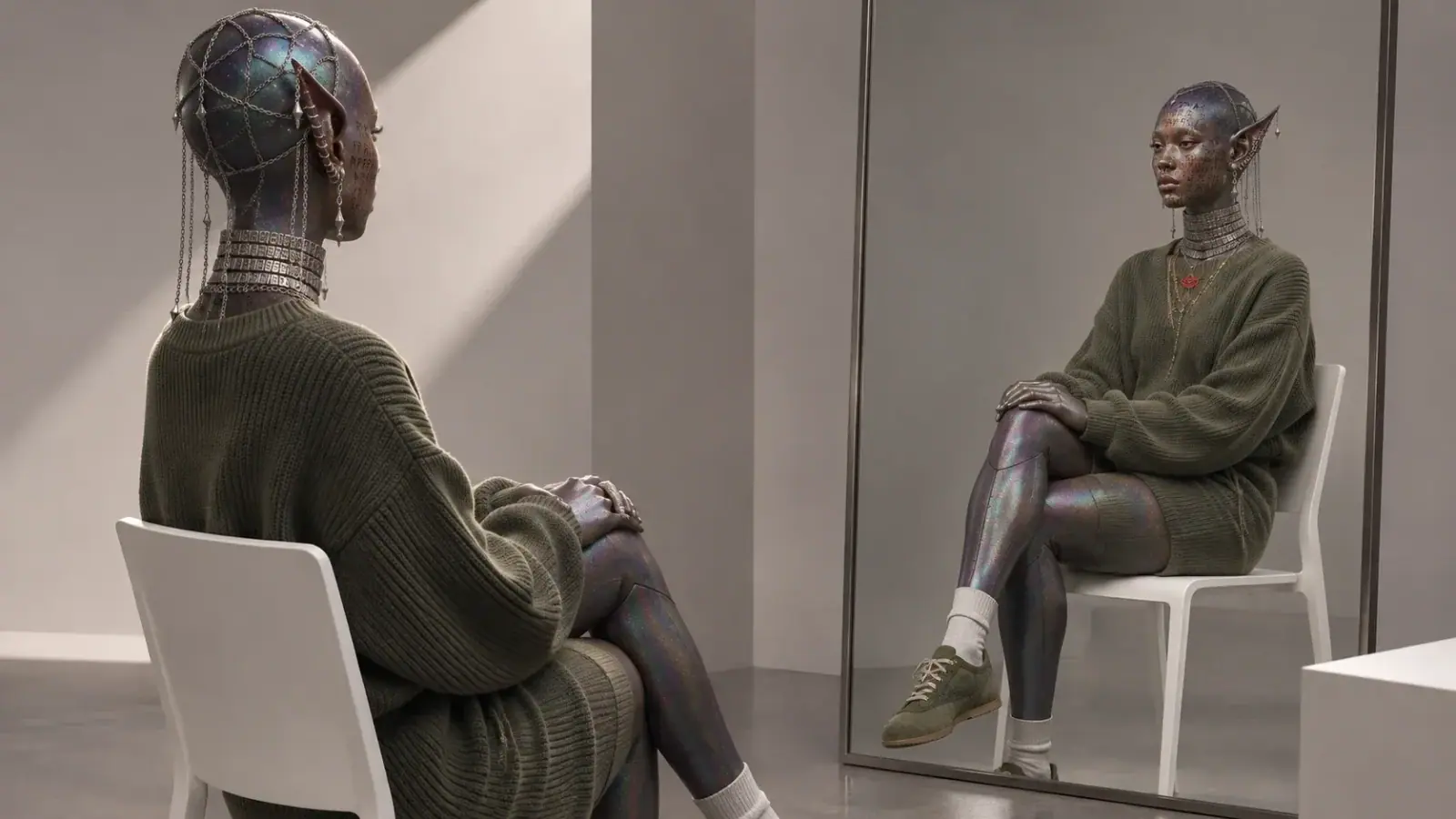
A mirror changes the shape of a portrait without adding another person. It can bring a profile into the same frame as a direct gaze, reveal a corner behind the camera, or leave a sliver of the room that the main view conceals. For a character who returns across images, that second view can make a familiar identity feel situated in a particular space. The reflection earns its place when it changes what the viewer can understand.
In Ilse Bing's *Self-Portrait with Mirrors*, held by the Cleveland Museum of Art, a reflection places the photographer and camera within a carefully arranged image. The work does not need to be read as a model for a synthetic portrait: it offers a useful example of how a reflective surface can make the act of looking part of the composition. A reflection is a visual relation, not an automatic revelation of a character's inner life.
A second view needs a reason
Imagine a portrait of Lyfera talent Céleste Gagnon beside an angled mirror. In one possible composition, the direct view gives the viewer a clear encounter with the character, while the reflection shows the side of the face and the fall of light across a metallic surface. The two views would add information without suggesting that an actual encounter took place. Move the mirror or the camera and the meaning changes: a reflection that opens the room gives context; one that contains only a fragment can make the edge of the image more important.
The challenge is deciding which relationship matters. If the mirror merely repeats a face at the same scale, it can divide attention without contributing a second point of view. If it shows a part of the set that could not be visible from its position, it can pull attention toward an unintended puzzle. The angle of the surface, position of the subject and camera, light direction and object placement all contribute to the result. A photograph may choose ambiguity deliberately, but the choice needs to belong to the image rather than arrive as an unnoticed accident.
The Metropolitan Museum of Art's discussion of a mirrored portrait shows how a reflected artist can open several interpretations of a painting's relationship to its making. Those interpretations belong to that historical work. The broader lesson for a new image is that a reflected figure can change the viewer's sense of who is present and where the picture is made.
Continuity is more than resemblance
For an artificial talent, two recognisable faces are not enough if their gestures contradict one another. Compare head angle, hands, clothing, characteristic details and the places where the reflected body meets its surroundings. A mirror can alter apparent perspective, and some features will be hidden, but an independent pose or an accessory that appears only in one view changes the relationship the image asks the viewer to believe.
This matters especially when a persistent identity has distinctive marks or materials. Preserve those features as part of the person being portrayed; they are not visual noise to clean away. The existing discussion of keeping an AI talent recognisable considers continuity across images. A reflection adds a narrower challenge: two views must make sense together within a single frame.
A reflective surface can also show less. It might catch a shoulder, a patch of light or an empty part of the room, leaving the subject's full reflection outside the frame. The choice gives the art director control over what is confirmed and what remains unseen. A portrait becomes richer when every visible view has a reason to be there and the viewer can understand the relationship among them.