Artificial identities · Lyfera · 2026-11-17
What the coat allows
Two imagined portraits of Yu-ting Hsu explore how a coat’s fastening can shape a character’s movement and make a small decision visible.
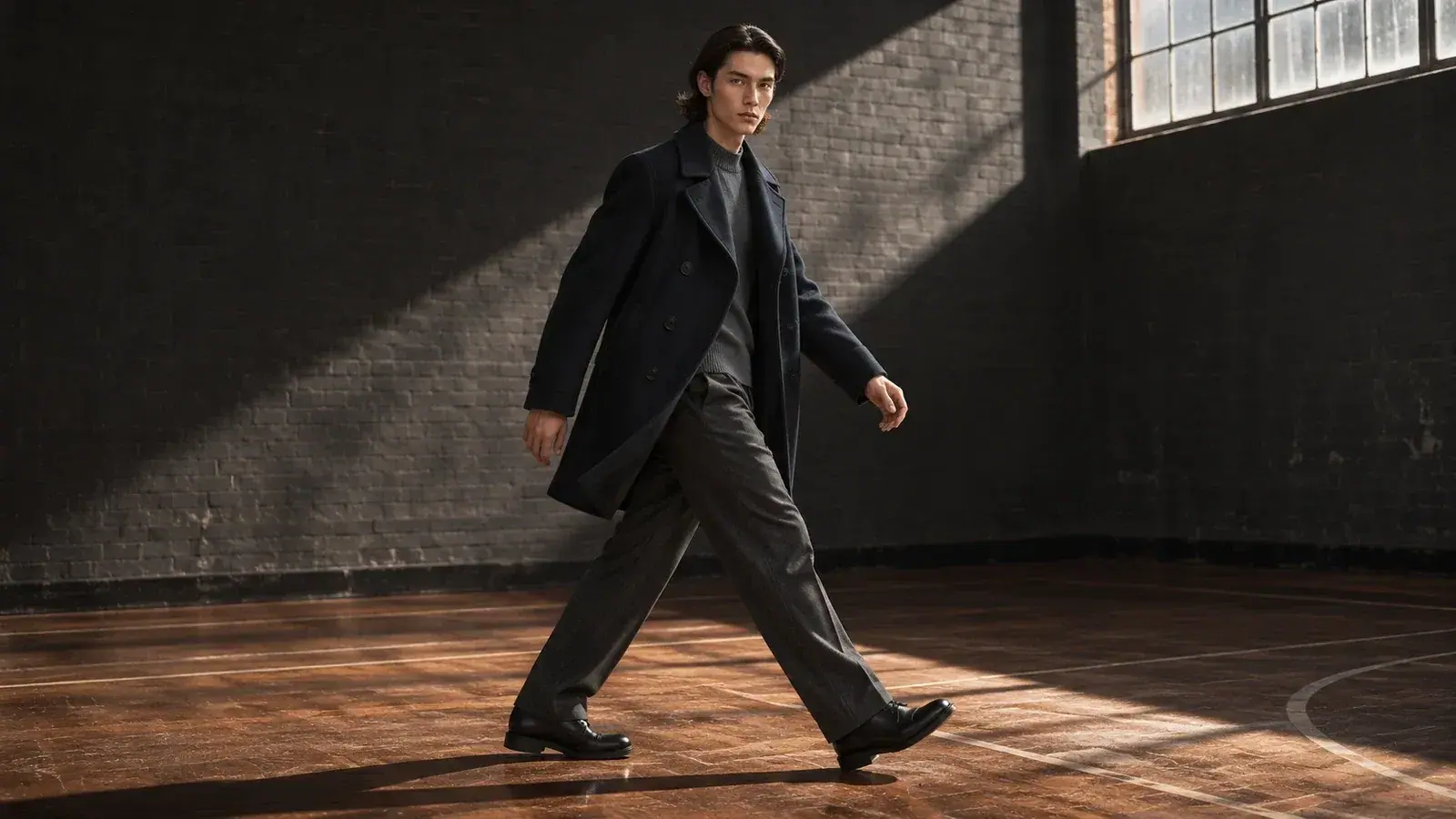
In an imagined photograph, Yu-ting Hsu takes a long step across a gym floor. Light runs across the boards, and the two fronts of his open coat move apart. The opening tells us something about the stride. It gives the movement a width the dark outline of the coat would otherwise hide. Fasten the same coat, keep the stride, and the fabric would have to accommodate it differently. A portrait can make that small decision legible.
When a garment enters an image, it brings conditions with it. A coat has a closure, an overlap, a hem and seams that sit at particular places on the body. For a stylised picture, those details shape the silhouette. For a character about to do something, they also shape what the viewer can believe about the action. A garment can help us read how easily a person moves, what they are trying to protect or what they might be willing to interrupt.
Dress for the action
Imagine the same character approaching a bench to sit down. If a longer coat has been fastened low, it might be more comfortable to release a button or pull the hem clear before sitting. The precise effect depends on the cut and how much room there is around the hips. That small preparation gives a director an action with a beginning, a purpose and a point at which it is done. The coat has earned its place in the scene.
There is a useful precedent in the National Art Center, Tokyo’s account of Issey Miyake’s garment pleating. The exhibition describes how Miyake pursued freedom of movement with pleated clothes and first tested his approach with William Forsythe’s Ballet Frankfurt. The conditions of the movement mattered to the design. A director can ask a smaller version of that question while planning a portrait. What does this construction let the character do, and how will viewers see it happen?
Give the fastening a moment
In the second imagined portrait, Yu-ting holds the two fronts of the coat close together. The framing is tighter and the floor disappears. At this distance, the small amount of attention he gives the fastening matters. The hands gather the fabric and the elbows draw in. A viewer can see how the wide shape that accompanied the stride could become narrower. The photograph leaves the eventual decision open.
A useful test is to plan two frames with the same garment and one change in how it is worn. In one, the fronts hang loose. In the other, they are brought together as the character prepares for whatever happens next. Keep the initial direction of the body and the position of the closure clear in both. A hand that appears to pinch air tells a different story from a hand moving a panel of heavy cloth. So does a fold that starts on the far side of the coat without any visible reason for the pull.
The Journal’s piece on AI fashion images and garment fidelity asks which details should survive an image. Here the fastening survives and becomes the detail that can be used. For a recurring artificial talent, it can be worth recording which choices belong to a particular scene. A later portrait can return to the coat and give the same closure another purpose, while the shape of the lapel and the way the fabric hangs still belong to a garment the viewer can recognise.
Leave room for the character
The imagined gym portrait takes advantage of a place with room to stride. The closer portrait gives all that space back to two hands and a decision. In a series, a viewer may see either image first. Each should offer enough information to read the movement at its own scale. Together they suggest that the coat is something this character can use, arrange and make room for.
A good direction for the next portrait might be as small as asking Yu-ting to let one front go. It would change the weight of the garment in the picture. It would also give the audience something to watch for before the next step.


