Artificial identities · Lyfera · 2026-10-13
A generated gesture is a reference, not a rehearsal
A synthetic pose can suggest an idea without prescribing a human performance. How to translate a generated gesture into a brief that leaves room for interpretation.
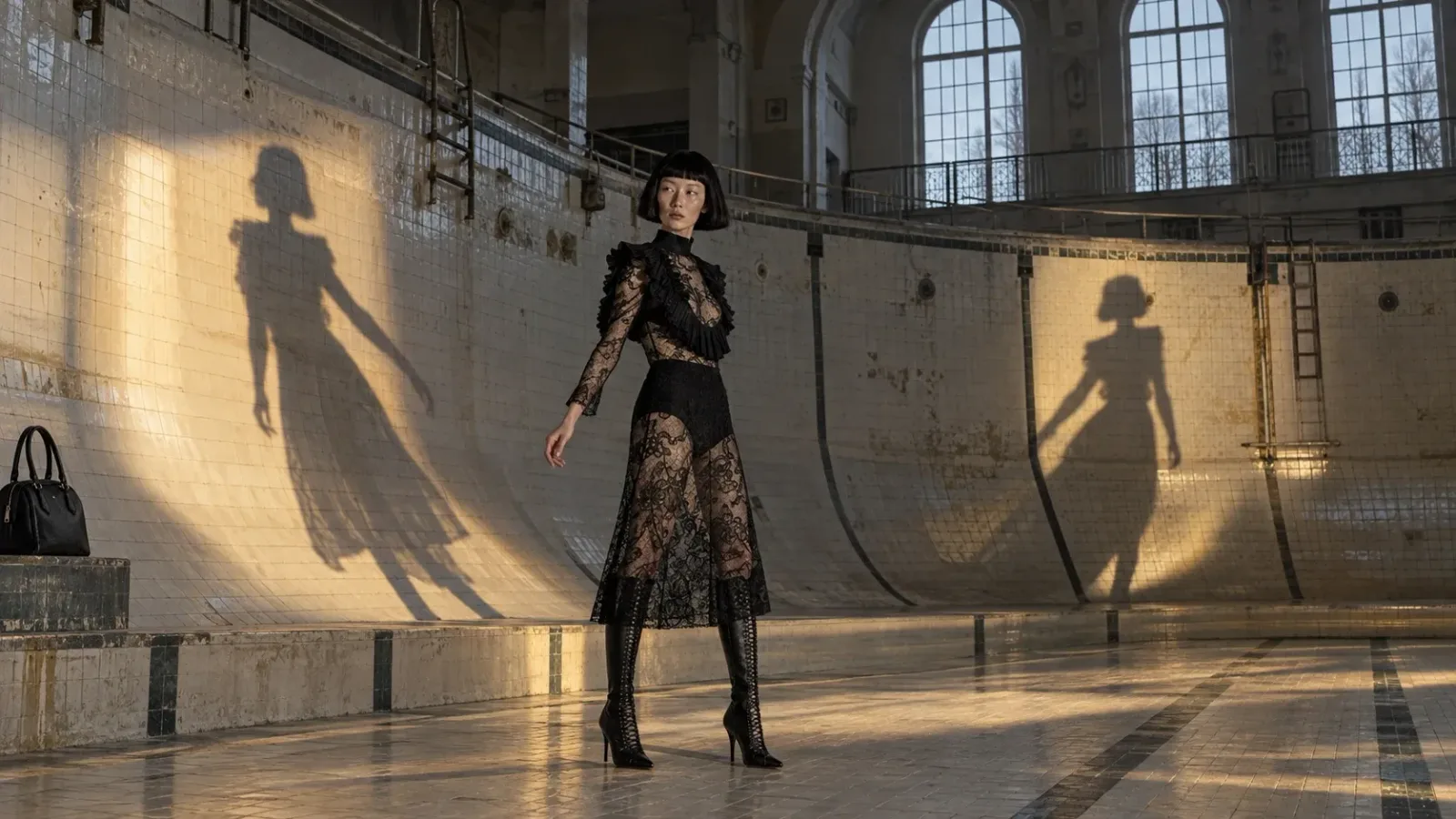
An artificial figure turns away while its coat seems to remain suspended behind it. The frame is striking enough to enter a campaign moodboard. Later, a performer is asked to reproduce the gesture. Somewhere between those two moments, an image has become an instruction, although nobody has established how its apparent action could take place. The creative team needs to decide what it actually wants to carry across: the shape, the attitude, the interruption, or the movement itself.
This is a hypothetical commission, but it describes a useful change of direction in artificial character work. We often ask whether a synthetic figure can resemble a human performance. The reverse question deserves attention too. When people take a generated image as their reference, which parts of that image should become expectations of a real performer?
A current museum programme approaches that reversal through fiction. The V&A lists Nina Davies's Image Syncers for 12–18 October 2026. Its description connects the work to people imitating AI-generated dances and presents a fictional collective attempting to transform themselves into generated figures. This is an artistic investigation described by the museum, rather than a study measuring the prevalence or effects of that behaviour. It makes a pertinent question available to a creative director: who is being asked to resemble whom?
Identify what makes the reference useful
Return to the invented coat image. The raised fabric might produce a sense of delay, as though the clothes have responded later than the person wearing them. That relationship could be the valuable part of the frame. An instruction to reproduce the exact pose would leave the relationship unexplained and make the performer responsible for resolving whatever the image has invented.
The brief can instead describe the desired reading: a person changes direction while something about the clothing seems reluctant to follow. A movement director, performer and stylist could then investigate ways to express that idea through their own materials. They might find a smaller turn, a different garment or a sequence of two actions more useful than the original silhouette. These are possible directions for the hypothetical commission, not demonstrations of a particular technique.
That translation starts by separating what can be seen from what has been inferred. A still shows an arrangement at one instant. It leaves the approach to that arrangement and the departure from it unresolved. A generated clip supplies more frames, but the team still needs to examine the relationship between them before treating the sequence as a performance reference. Apparent ease in the image does not establish what a person was asked to do, or whether anyone did it.
The distinction also applies when the work remains entirely digital. Our discussion of giving an AI character time to react concerns the intervals that make an action readable. Here the earlier decision is what the reference contributes to a new production. Its visual appeal can open that discussion without settling the movement.
Let the performer change the proposal
A reference can enter a room with more authority than its maker intended. Its finish gives the team a shared target, and departures from it begin to look like shortcomings. In the hypothetical coat commission, a performer might find a gesture that communicates the intended reluctance through a pause in the hand. If the team evaluates only the resemblance to the suspended coat, it may reject the more intelligible performance.
A useful comparison returns to the agreed meaning. Does the new gesture make the interruption apparent? Does it give the clothing a role? Is the relation between the turn and the pause available to someone watching? Those questions allow the performer to contribute interpretation. They also make disagreement specific: a proposal might preserve the idea but lose a silhouette that the campaign actually needs, in which case the team has a production choice to resolve.
The original image should remain available beside the revised proposal, with the reason for the change. This preserves the creative starting point without making it the final authority. A collaborator joining later can understand that the raised fabric suggested an idea, while the movement developed through a separate encounter with the person performing it. The revision becomes part of the work's authorship rather than a defect concealed by the edit.
Make artifice a deliberate production choice
Davies's own account provides a more concrete perspective on that encounter. In an audio-guide transcript published by the Henry Moore Institute, she describes working with performers in Vancouver to create the appearance of deepfake movement. She also discusses face choreography and sculptural hand props used to suggest generated hands. The transcript accompanies an earlier exhibition and describes a project begun in 2025; it is context for the current V&A presentation, not a newly invented method or a report of its audience response.
The relevant distinction is that the appearance was developed through performance and objects. A visual irregularity had become material for an artistic decision. For our invented commission, a similarly deliberate approach could explore a discontinuity through costume, staging or editing, with collaborators deciding what each contributes. The intended effect would then have an account in the production, instead of depending on a performer somehow matching an unexplained image.
This leaves room for work that openly explores synthetic aesthetics. An artificial talent does not need to conceal its construction, and a human performer may choose to engage with that construction as a subject. The brief still needs to name the choice. A distorted hand left unnoticed in a reference and a prop developed to investigate distorted hands can lead to superficially similar pictures while representing very different work.
Decide what the finished image asks of its audience
The reference can acquire another role after the campaign is finished. Suppose the hypothetical coat sequence becomes a short invitation for viewers to try the character's turn. The work now addresses people outside the production room, who may encounter only the final edit. A constructed visual effect would provide a poor account of what they are being invited to reproduce if the invitation implied that the pictured action was an ordinary, unaltered performance.
The team can keep the public invitation within the part of the work it can explain. It might ask viewers to interpret the idea of hesitation in their own way, or present the sequence simply as an imagined fashion scene. That choice concerns the meaning of the invitation, without assuming how viewers will respond. As our article on reading an AI fashion image explains, the surrounding words help establish what the picture represents.
These are proposals for commissioning and presenting creative work, rather than a description of a Lyfera rehearsal service. For a mentor developing an artificial identity, the enduring question is which authority to give its appearances. A generated gesture can offer a compelling starting point. When that gesture crosses into work with real people, the next valuable contribution may be the interpretation that changes it.