Artificial identities · Lyfera · 2026-11-15
The seat that breaks the pattern
How a slight shift in position changes the way a portrait reads against repeated seats or columns.
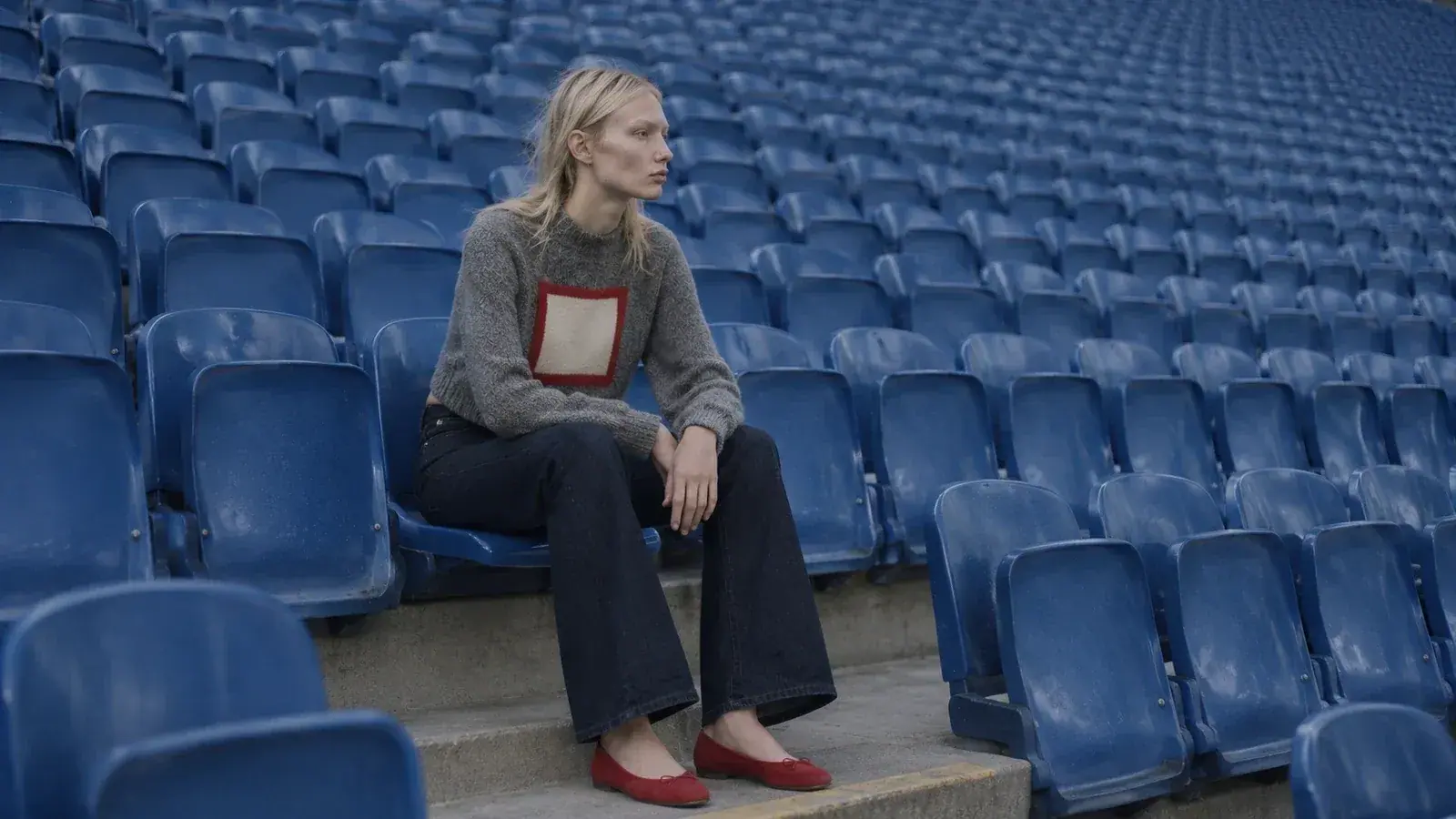
Imagine Signe Haldorsen sitting in an empty stadium. The backs of the blue seats repeat from one side of the photograph to the other. A person sitting squarely in the middle might make the rows read as a backdrop. Set her slightly off centre and turn her along the row, and the photograph asks a different question. The stadium offers hundreds of places to sit. What does it mean to occupy this one?
Give the eye something to expect
In the photograph Harry Callahan titled Multiple Exposure: Green Windows and White Bars, Chicago, window frames and stonework share the frame with a bright set of bars. The National Gallery of Art dates the image to 1950 and the print to 1979. Look at how a shape can belong to the grid in one place and interrupt it in another. The interest comes from being able to read both arrangements, even where they overlap.
A portrait can work with that tension without using multiple exposure. Rows of seats establish an interval. A face, a shoulder or a pair of shoes turned across the row introduces a direction the other shapes do not have. Keep a few repeats visible on either side of the figure. If the frame isolates a single chair and a face, the choice of seat becomes hard to see. If the camera moves so far back that the person turns into a spot of colour, the picture loses the angle of attention that made the placement matter.
Let the interval change
Imagine the same character in a columned hall. The columns now mark distance from the camera. In a head-on view they might seem to lead directly to the far end. Seen from the side, one larger gap lets the eye enter the hall at an angle. Place the figure beside that gap and her stillness can make it feel as though she has stopped to consider a turn. The space around her makes that reading possible before anyone assigns a motive.
For the two imagined settings, consider what would happen if you moved Signe one seat or one bay over. The stadium might make her less solitary if she sits close to an aisle, where someone could join her without passing a row of empty seats. In the hall, moving her ahead of the gap might make the open route look like somewhere she has already decided to pass. The changes are small enough to compare without changing the character, the outfit or the expression.
Our essay on how foreground shapes place the viewer considers what a nearby surface can hide. Here, it helps to keep the repeated elements legible. When a frame is destined for a narrow screen, check whether enough of the seats or columns survive for the position of the figure to carry meaning. A crop that preserves the face may still take away the evidence that she chose a particular place.
A recurring artificial talent gives the human director a person whose visual identity can carry from one image to the next. The setting can do more of the changing. One photograph puts a figure among seats made for a crowd, while another gives her a moment at the point where a hall opens out. The audience has room to develop a reading from what the figure does with the space she has.