Artificial identities · Lyfera · 2026-11-22
Brian’s boat has to arrive with its momentum under control
Brasswater Pilot makes docking depend on route, heading, speed and the final held line, rather than proximity to a pier alone.
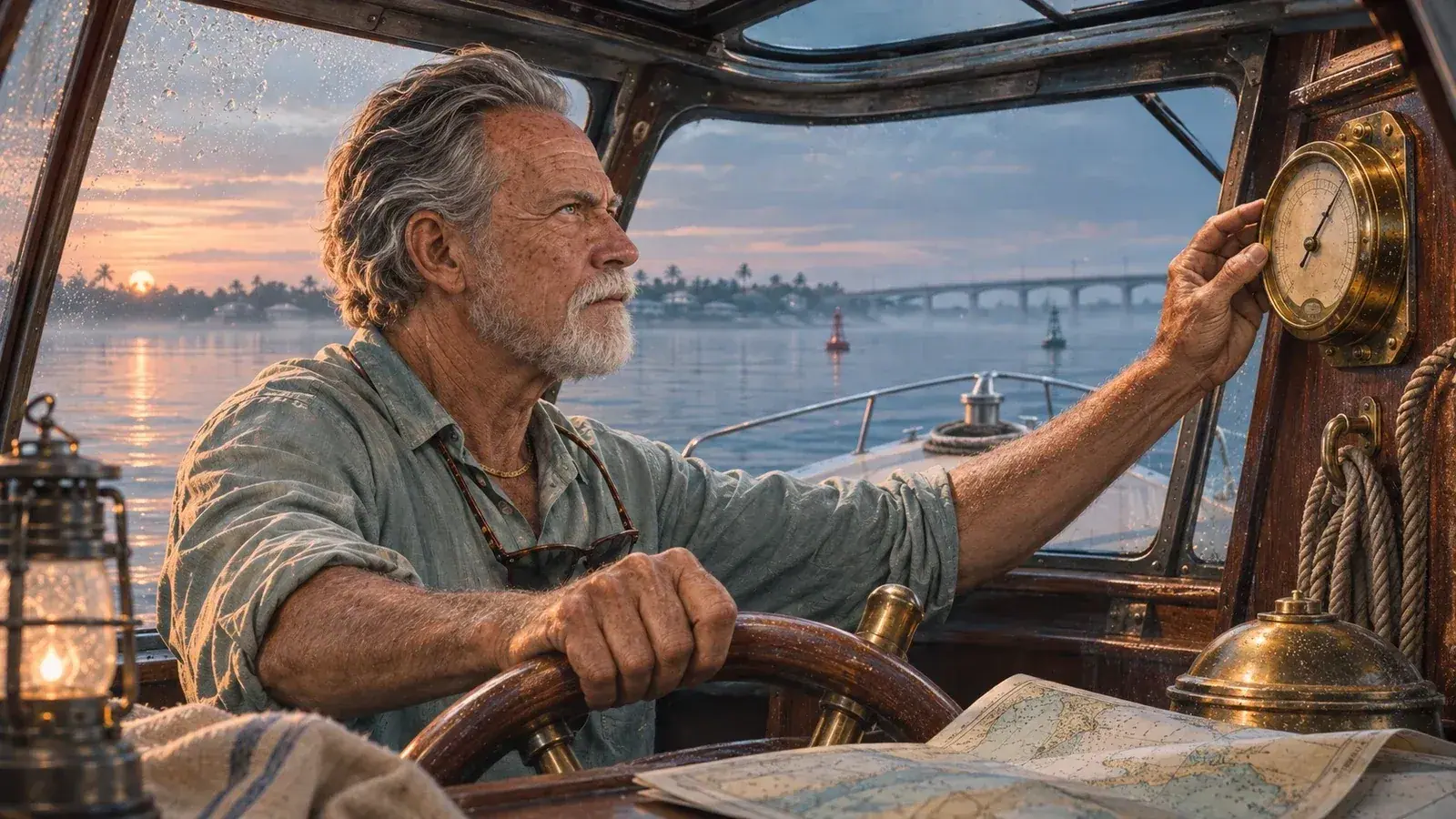
Brian Heder’s boat can enter the marked water beside a pier without completing its arrival. In Brasswater Pilot, the bow must also point along the requested heading, speed must fall below 1.6 knots, and the player must hold the line for a second. The destination is a condition the boat must settle into.
You can play Brasswater Pilot to make the first approach at Stock Island. Two numbered pairs of buoys establish the route before the docking area opens. Their shapes and labels provide information alongside colour, making the crossing legible through more than a red-and-green distinction.
Steering does not cancel a current
The twin engines let the cabin boat rotate even while nearly stationary. That makes a useful distinction between changing the direction of the hull and moving the hull through the water. A player can improve the bow’s alignment while still needing to manage the movement produced by the current.
The three charts give that distinction different consequences. The opening landing offers relatively calm water. Mangrove Cut introduces a northward current and an oblique quay. Seven Mile Reach adds a bridge and gusts that matter before the boat reaches its final approach. Repeating the same steering input cannot guarantee the same path when the water is pushing sideways.
Brian’s barometer becomes useful because it can explain that next push. The Read glass action interprets the instrument for the current situation. It turns an apparently decorative object associated with the protagonist into information the player can use to choose a heading.
The last metre belongs to the approach
Reverse thrust offers a way to reduce speed, but braking late leaves less distance in which to correct an angle. Consider a hypothetical approach that reaches the pier quickly and then overshoots its docking outline. The failure does not imply that the earlier route was irrelevant; it shows that the route delivered the boat with more motion than the final operation could accept.
The hold on the line makes that final operation deliberate. Passing briefly through a valid pose does not instantly count as mooring. Position, direction and speed must coexist long enough for the player to finish the action.
Brasswater Pilot’s coastal charts are stylised game spaces, with fictional passages and scoring. Within that bounded world, however, the boat gives an unusually clear answer to why arrival is more than a point on a map. The whole approach determines whether the final second is possible.


