Artificial identities · Lyfera · 2026-11-22
Malik measures the space a coat leaves around the body
Silhouette Studio turns three seam placements into a visible shape, letting the player compare a garment with the space its brief requests.
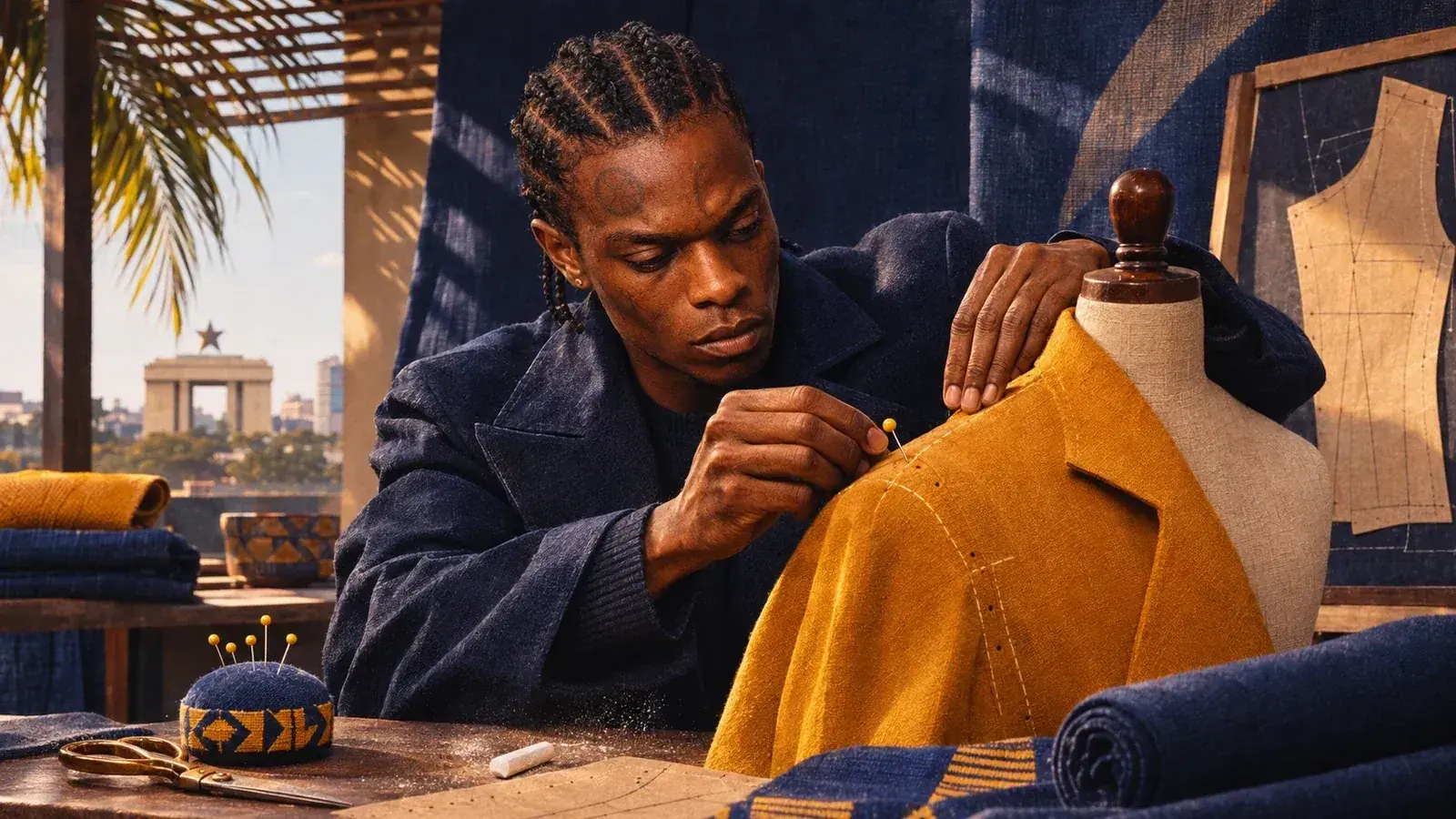
Stop Malik Adeyemi’s chalk at a different point and the coat changes shape. Silhouette Studio makes the player fix shoulders, waist and hem against a moving measure. The resulting line belongs to a garment the player can see, rather than a score that appears beside an otherwise unchanged model.
You can play Silhouette Studio to enter the first fitting. Three looks develop from nine seam decisions. Their details differ, from a jacket’s lapels and pockets to a belted coat and a flared cape.
The gap is part of the silhouette
The useful comparison concerns the space around the garment as well as the cloth itself. Measure slowly reduces the chalk’s speed and reveals a comparison in pattern units between the current space and the brief. That makes an apparently abstract difference in proportion into something the player can inspect before placing the pin.
A shoulder, waist and hem do not contribute interchangeable errors. Each changes a different part of the outline. A hypothetical player who gives a coat a broad shoulder and a narrow hem has made a different silhouette from one with the same total width distributed lower down. The visible pattern gives those decisions a place in the object.
Timing determines where a seam is fixed, but the ruler supplies a reason to favour one moment over another. The bright target bracket identifies the requested measure. Without that reference, stopping a moving mark would be a reaction exercise with a fashion illustration behind it.
Undo keeps the last question open
Unpin last gives one correction per look. It does not erase the entire fitting or grant an unlimited search through every possible shape. The player can reconsider the most recent commitment after seeing how it affects the whole.
Later looks introduce additional ways to manage the chalk, including a notch and a brief hold. Their purpose is to support a more deliberate placement as the silhouette becomes more demanding. The garment remains the subject of the decision; the instrument becomes easier to read with experience.
Malik’s game treats a recognisable identity and a designed outline as related, distinct things. The performer supplies continuity while each set of seams changes the space the clothes occupy. The fitting becomes successful when those changes answer a specific brief, rather than merely producing a neatly dressed figure.


