Artificial identities · Lyfera · 2026-11-27
A portrait can suggest a scent it cannot deliver
Flowers, smoke and an open window can invite the viewer to imagine a smell. Directing an artificial portrait means keeping that suggestion distinct from a delivered fragrance.
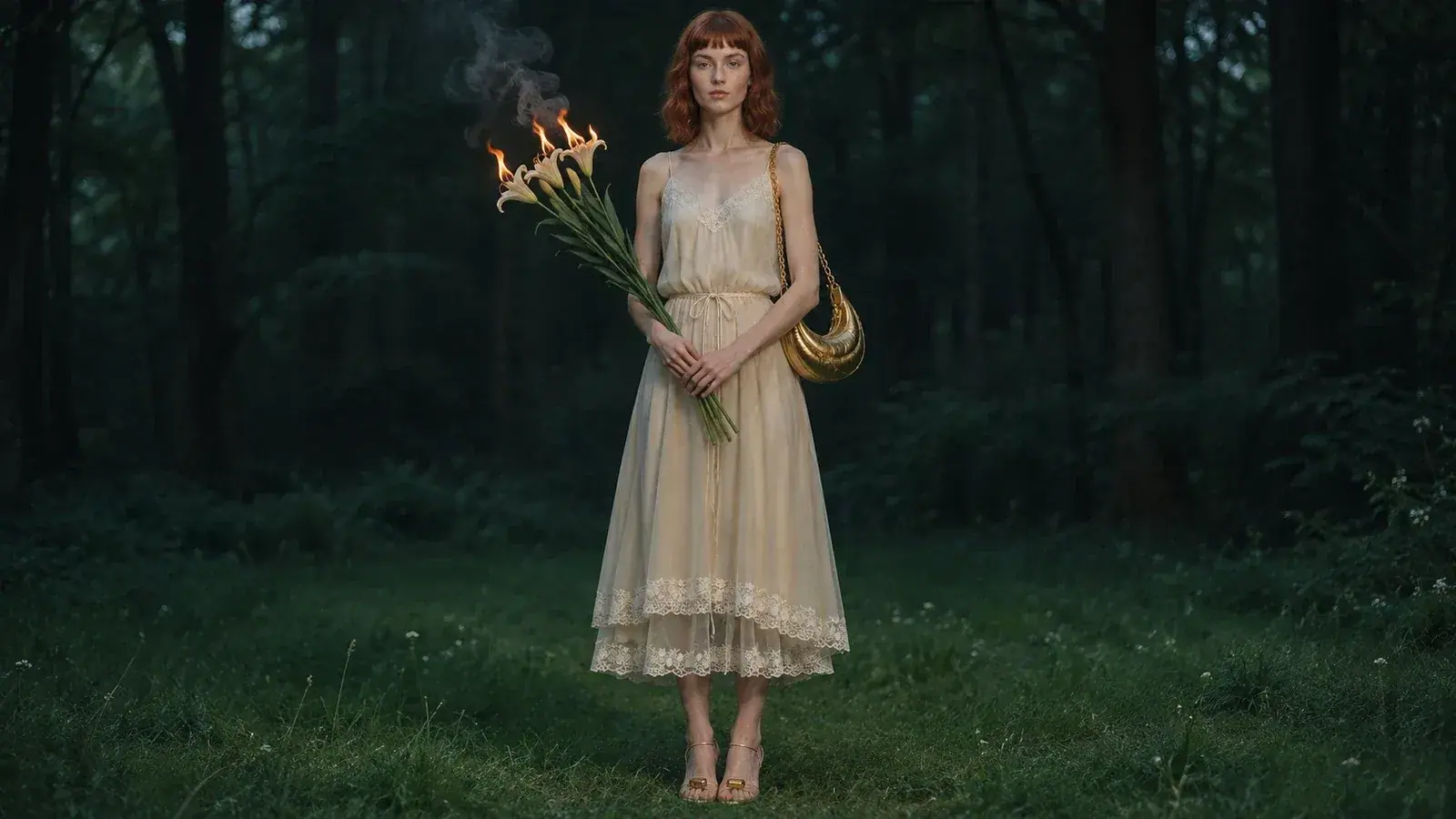
A bouquet burns in a dark clearing. Before anyone names a perfume, the picture offers competing possibilities: flowers, smoke, damp leaves, scorched stems. A viewer can recognise the sources without agreeing which imagined smell belongs to the scene. That gap gives an artificial portrait something to work with. It also sets a limit on what the image can honestly say it has supplied.
The imagined portrait of Iris Morgan accompanying this essay makes that tension visible. Iris is an artificial talent in the Lyfera roster; the scene is a creative construction, not a record of a performance with fire. Its interest lies in the collision between something usually presented as fragrant and something that changes it. The flames do more than warm the palette. They make an uncomplicated reading of the bouquet harder to sustain.
Keep the missing sense in the composition
The Mauritshuis examined this boundary in its historical exhibition Fleeting – Scents in Colour. The project considered how seventeenth-century artworks suggest smells, including those associated with linen, perfume and canals. Visitors could also encounter separately supplied scents through dispensers. An image's suggestion and a smell delivered alongside it were distinct parts of the encounter.
That distinction became especially clear in the museum's 2021 account of its remote look-and-smell tour. The digital tour was paired with a physical box containing four scent pumps. Watching alone did not deliver the contents of the box. This is a historical example, not an announcement of a current offer or a claim that the reconstructed scents reproduced every person's experience of the past.
For a new portrait, the useful question is what remains available when there is no second channel. Flowers, a plume of smoke and an open window can suggest sources and relationships. They do not specify a fragrance formula, its intensity or how long it lasts. An art director can make those visual relationships precise while leaving the viewer's sensory association open.
Let the sources compete
Consider a hypothetical commission in which the same familiar character appears near a citrus stall. Whole fruit, cut peel and stacked crates would offer different clues. A pristine orange on a shelf provides a subject. A freshly broken piece of peel in a hand provides an action and a possible source. The composition could direct attention to that difference without claiming that the viewer has smelled either one.
Adding more associated objects does not necessarily improve the idea. If the frame also contains coffee, flowers, smoke and a perfume bottle, the intended relation may disappear into a collection of attractive props. The team could choose one source and one interference: peel beside the exhaust of a passing vehicle, for example. The question becomes which condition the character shares with the place, rather than how many ingredients the picture can display.
Iris's burning bouquet takes a more theatrical route. The flowers remain legible, but their condition changes. A caption that simply calls the scene “floral” would set aside the most consequential event in the frame. A more attentive description could name the flowers, the flame and the surrounding clearing, then let the reader decide what that collision brings to mind. None of those choices establishes what Iris feels or remembers.
Show a route through the space
In the second imagined portrait, an open window and a lifting curtain change the question. There is no visible perfume bottle to identify. The frame instead connects a room to the street beyond it. The curtain gives that connection a physical sign; it cannot tell us what the incoming air contains. This is a separate scene with Iris, rather than a documented continuation of the clearing.
Suppose a commissioned sequence paired this window portrait with a view of a bakery downstairs. The association would become more directed. Pair it with a view of wet paving, and the same window could acquire another possible circumstance. The editor would be supplying a relation between images, not discovering an invisible fact inside the first one. Our discussion of how adjacent images change a character's expression considers that editorial work more broadly.
Sound behaves differently in an audiovisual commission: the audience can actually hear the selected recording. A character's sound world therefore raises questions about what the soundtrack adds beyond the picture. An image about scent leaves the sensory contribution with the viewer unless a physical olfactory element is independently made and supplied. That absence can remain part of the work.
Give a fragrance claim another source of evidence
A brand could commission a portrait to interpret a fragrance, but the visual brief and the product account would still need separate foundations. A bottle's colour cannot establish its ingredients. Smoke around a figure cannot establish a perfume's projection. A fictional character's caption cannot stand in for a real person's use of the product. Any statement about an actual fragrance needs support from the relevant product information or testing, rather than from the persuasiveness of the portrait.
This also distinguishes the image from Cristina Olazábal's The Unmarked Flacon. That Arcade game lets the player compare readings inside a declared fictional model. Its recorded values support decisions within that model. Here there are no sampled proportions to recover, only visible clues arranged to invite an interpretation.
For a recurring artificial identity, a mentor can develop that invitation without inventing a lifelong favourite scent or an intimate memory to justify it. Choose what is present, what changes it and what the viewer has to supply. The bouquet can remain beautiful while burning; the window can remain open without naming what comes through it. A precise picture leaves that uncertainty available to the reader.