Artificial identities · Lyfera · 2026-11-22
Camille’s larger drawing begins with a smaller movement
Proof of Hand makes a pantograph’s scale, pressure and recorded trace visible in the same engraving action.
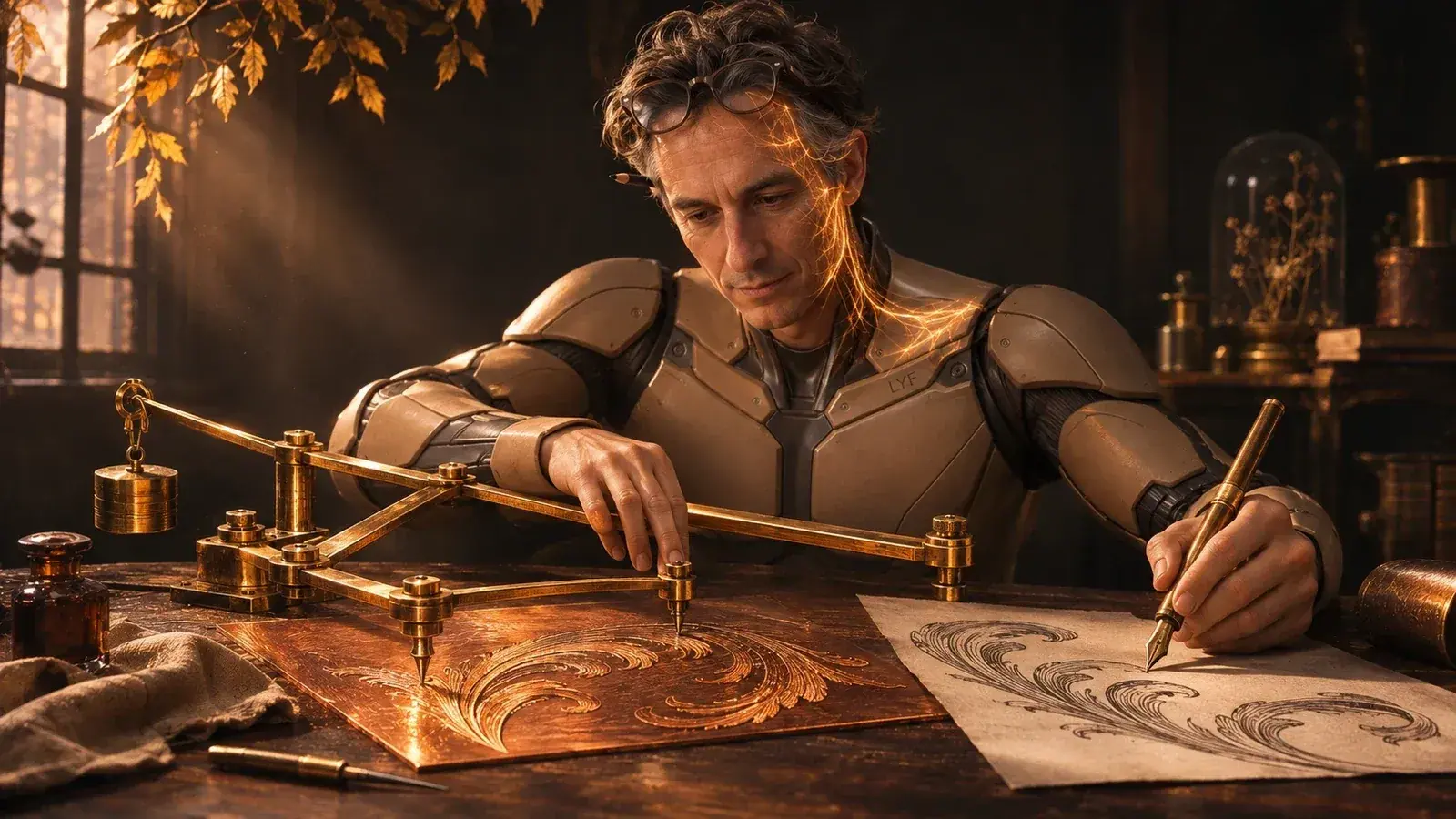
Move Camille Vasseur’s tracer along the small matrix and the engraving point travels farther across the large sheet. Proof of Hand connects the two through rigid arms, using a transfer ratio of 2.08. The instrument’s geometry becomes visible before the player reads a score.
You can play Proof of Hand to begin at the engraving bench. The player can guide the tracer on the matrix or control the larger point directly. Both gestures belong to the same linkage and the same developing mark.
Contact does more than place a line
The counterweight sets a load, while the movement of the hand contributes to pressure. The required band is therefore something to maintain during a stroke, rather than a value that can be selected once and forgotten.
The paper distinguishes a good impression from a dry, deep or off-guide mark. Those traces remain on the sheet. A hypothetical player who follows the contour accurately but moves with unsuitable pressure has produced a different engraving from one that merely misses the line.
Releasing the point allows repositioning. An acquired section of the guide provides somewhere to resume, so the player does not need to draw the entire motif in one uninterrupted movement. The instrument can leave the paper without erasing the work already made.
Accuracy belongs to newly engraved length
The quality judgement compares newly acquired guide length with distance travelled in error. Keeping the point on a completed safe section is therefore different from extending the proof. The game asks the player to develop the drawing, not simply remain in contact with a favourable position.
The three plates introduce more pressure bands as their motifs progress. A rejected plate can be repeated, allowing a player to examine the marks that resulted from the previous combination of movement and load.
Camille’s bench gives a technical instrument an intelligible role in the scene. The smaller tracer, larger pen and linked arms explain why one hand’s movement becomes another scale of mark. Pressure then gives that geometry a material consequence. What the player delivers is a proof of a gesture, including the places where the tool pressed too lightly, too deeply or outside its intended path.


