Artificial identities · Lyfera · 2026-11-10
The shadow that gives a scene its edges
How cast shadows can connect a portrait to its setting and leave space for interpretation.
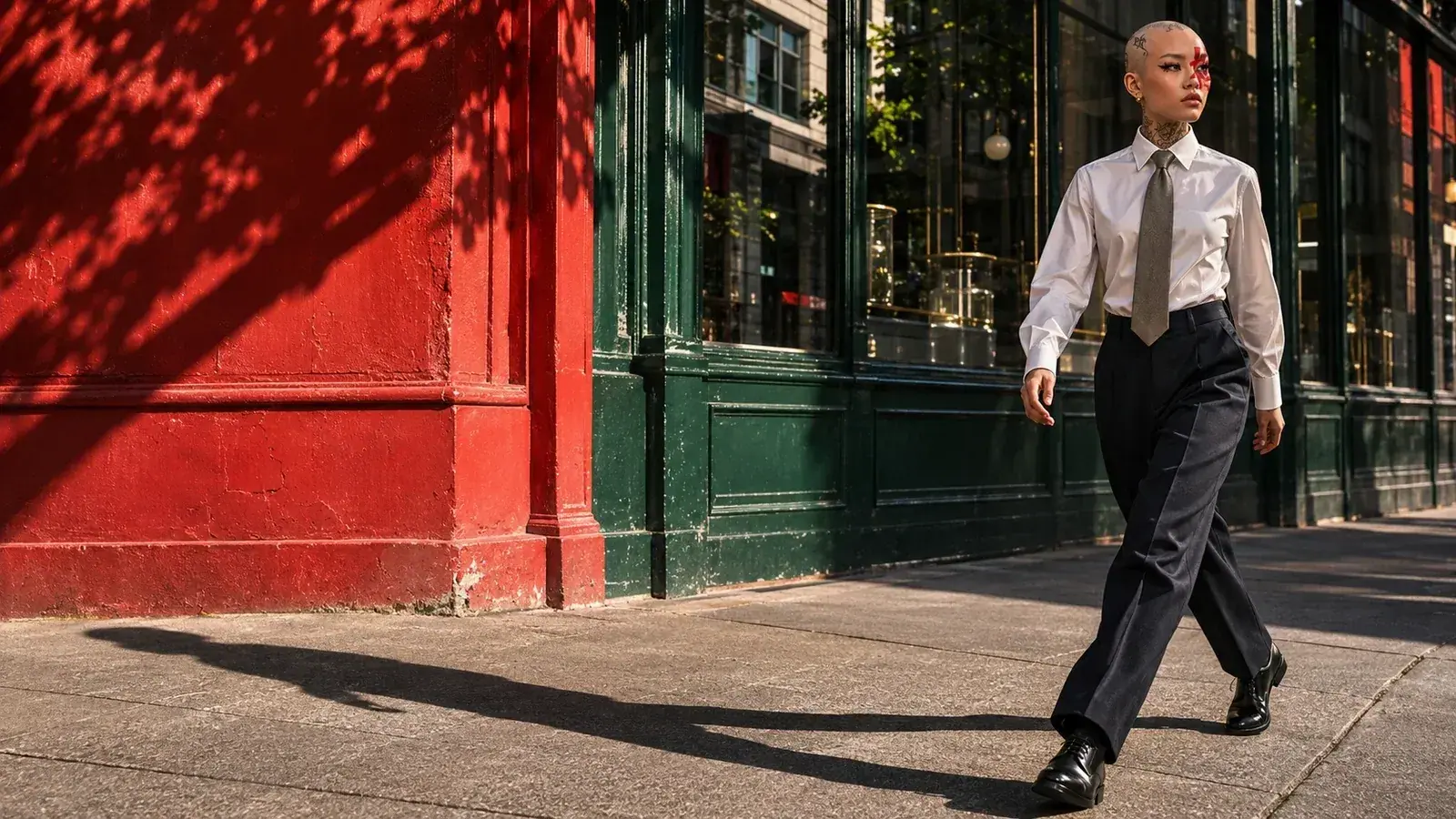
A shadow can tell us where a body meets a place. It can stretch across a pavement, break against a wall or disappear beyond the edge of an image. In a portrait, that second shape gives the viewer another way to read the scene: not a factual account of what happened, but a relationship between a figure, a light and a space.
Imagine Mai Yoshida standing in a city street under a low sun. Her shadow reaches farther than her body does. The composition can make the street feel open, or let a strip of darkness connect her to a building outside the frame. Neither reading requires a biography for the person in the picture. It starts with visible choices.
A second figure in the frame
The shape of a shadow depends on where light comes from, the subject that interrupts it and the surface receiving it. Move the light or turn the body and that relationship changes. A close, soft outline may sit quietly beside a figure; an elongated one can occupy a surprising share of the frame. These are possibilities for direction, not a fixed visual language with a single emotional meaning.
The imagined portrait of Mai in this story uses shadow as a compositional partner. Its city setting is a constructed scene, not a record of an event. Looking at the shadow as well as the face makes it easier to ask whether the image has enough space around its subject, and whether the surroundings are doing useful work.
What the edge leaves open
A shadow can also point towards a light source the viewer cannot see. An interrupted shape can suggest that the world continues past the picture without specifying what is there. That is a different question from what a gaze leaves outside the frame: a gaze directs our attention, while a shadow describes an encounter between light, a surface and a body.
Cinematographer Sean Bobbitt has discussed how light and space contribute to a film’s visual language in an interview about his work. The conditions of a still portrait are different, but the attention to spatial relationships is useful: what lies outside a shot can matter to how the visible part is organised.
Leave room for the image to breathe
In an AI-generated scene, a person directing the image can examine whether the shadow belongs to the intended light and pose. A direction that asks for a beautiful silhouette may not need a dramatic shadow at all; a quieter shape may give the figure room. Consistency matters when the image depends on a legible physical relationship, while ambiguity can be a deliberate choice in a more abstract scene.
The final decision is not whether the shadow explains everything. It is whether it adds something the portrait would otherwise lose. Like colour across a sequence, it can carry continuity without becoming the whole story. A small edge of darkness may be enough to let a figure belong to a world.