Artificial identities · Lyfera · 2026-10-14
What changes when an artificial talent enters a book?
A book gives portraits new relationships through facing pages, folds and return visits. What changes when an artificial identity becomes something a reader can hold?
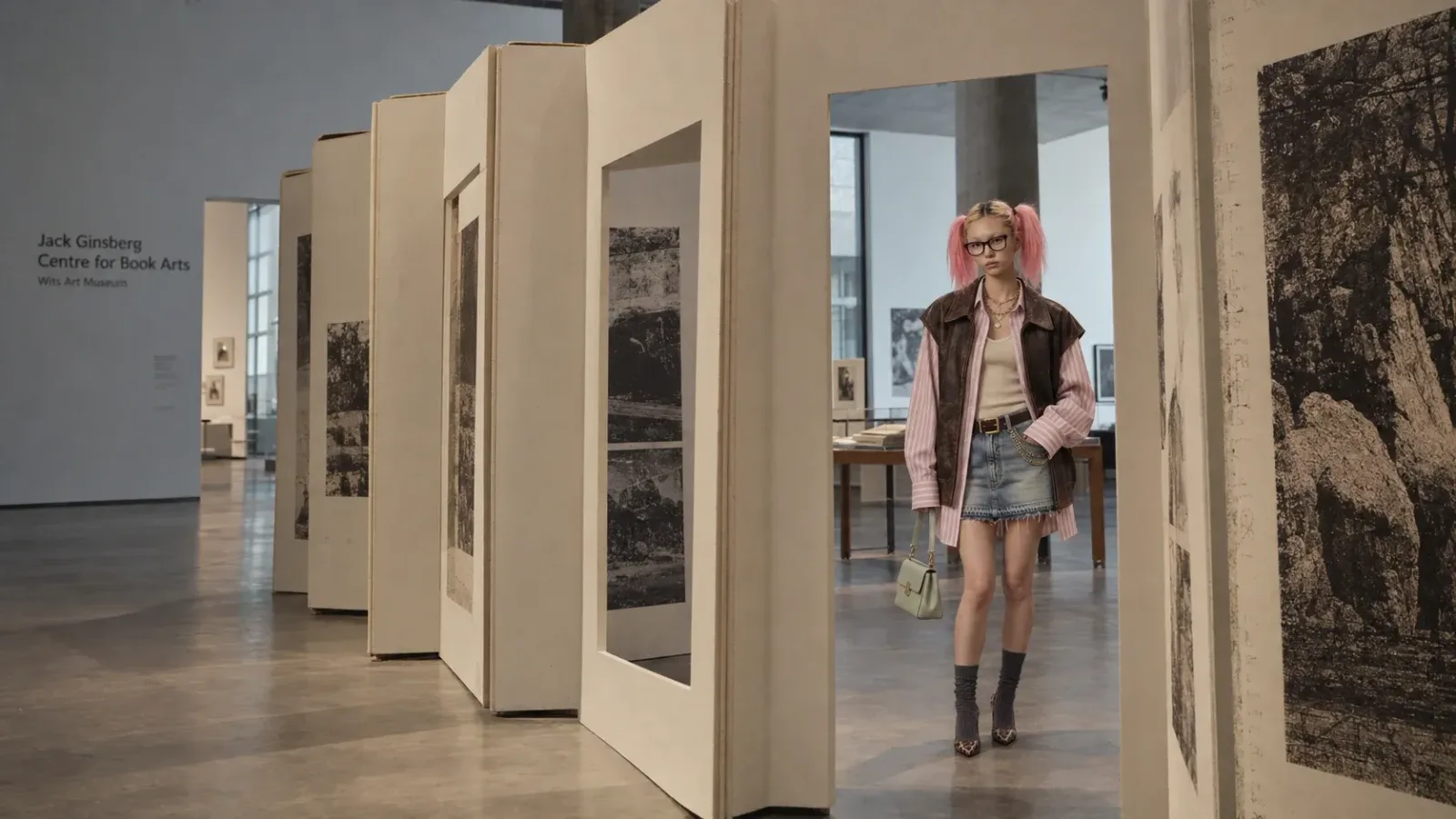
An artificial figure appears on the right-hand page, standing in a narrow entrance. Across the spread, an empty room occupies the left. Seen separately, the pictures offer two settings. Seen together, they raise a question: does the figure belong to that room, wait outside it, or stand somewhere else entirely? A printed sequence has given the images a relationship that neither file contains on its own.
For a mentor developing an artificial talent, a book can offer another kind of encounter with the identity. Its pages bring appearances into proximity, conceal some material until a turn and let the reader return to an earlier view. The useful creative question is what those actions contribute. A collection of successful portraits does not settle how someone should move through them.
A current exhibition makes that question especially pertinent. Wits University lists Technics of the Page / The Last Human Reader at the Jack Ginsberg Centre for Book Arts, Wits Art Museum, from 8 October 2026 to February 2027, with a curator-led walkabout scheduled for 17 October. Its programme places artists' books alongside artificial intelligence and asks what remains material when books and archives circulate as data. The description draws attention to handling, unfolding and other acts of reading. This is a curatorial proposition, rather than evidence that a printed book necessarily creates a better experience than a screen.
Give the spread a reason to exist
Consider a hypothetical book about a fictional talent's interest in overlooked entrances: small vestibules, passages and spaces that people usually cross without stopping. The project begins with several imagined portraits. Selecting the most attractive six would provide material, but the editor still needs to decide what a reader can discover between them.
One spread might place a distant figure beside a close view of the same entrance. The reader could examine a relationship between bodily scale and architectural detail. Another might put two almost identical passages together, with the figure present in only one. That arrangement invites comparison rather than establishing a sequence of events. If the rooms are intended to be different, a caption or a visible distinction needs to keep that intention available.
Adjacency also changes the words. A first-person sentence printed opposite an empty room could seem to describe the room, even if it originally accompanied a different portrait. Bringing old captions into a new layout therefore requires another reading. The page has become part of what the sentence points towards. A line that was accurate within one fictional scene may suggest a different connection beside another image.
The V&A's account of the book as an artistic idea discusses works in which sequence and physical structure contribute to meaning. Its example of Ed Ruscha's Twentysix gasoline stations, first published in 1963, treats the repeated photographic sequence as part of the concept rather than simply a container for pictures. This is historical context for the present question. A book featuring an artificial identity can similarly ask its form to carry an idea, without borrowing the appearance or authorship of those earlier works.
Decide what the turn reveals
Return to the invented entrance study. Suppose the right-hand page shows a figure looking towards an edge of the frame. The next spread reveals a wider space. A page turn now participates in the proposal: the reader encounters something that was previously withheld. The effect depends on what the first spread makes available and what the second actually adds.
If the new spread merely repeats the portrait at a larger size, the turn may offer emphasis but little discovery. If it exposes a previously hidden relation between the figure and the entrance, it can change the earlier picture's meaning. Neither arrangement is intrinsically preferable. The editor should be able to explain why this particular change belongs to the subject, rather than treating every new page as another opportunity to show an attractive image.
A fold could extend that idea. In the hypothetical book, an unfolded sheet might place several entrances beside one another so that the character's small presence becomes part of a larger pattern. That requires a design which can actually be handled and read. A digital mock-up showing the whole sheet at once would not establish what the reader sees while opening it, or whether the printed fold interrupts a detail that matters.
There is also value in an ordinary page turn. Elaborate construction can introduce another subject into the work: the ingenuity of the object itself. For a quiet study of entrances, a simple binding might leave the visual relationships easier to consider. The physical choice earns its place when it changes the encounter in a way the project needs.
Let the reader set the pace
Our discussion of giving an AI character time to react concerns a sequence whose intervals are composed for playback. A book gives the reader more control over those intervals. Someone may linger over a spread, turn quickly, move backwards or inspect the end first. The arrangement offers a route without ensuring that everyone follows it at the same speed or in the same order.
That freedom can shape the entrance study. If the final spread changes how the earlier rooms are understood, the book can reward a return through them. A repeated detail may become noticeable only during that return. The work need not announce every connection immediately, provided the relationships remain available when someone looks again.
The writer should also examine passages that depend on a tightly controlled reveal. Suppose a caption assumes that the reader has not yet seen the last image. That sentence may work during a first linear reading and become awkward when someone starts elsewhere. The team can decide whether the dependence is essential, whether the writing needs adjustment or whether the book deliberately asks for a particular route. Reader freedom creates a compositional question, rather than a defect to eliminate.
Review the object as another appearance of the identity
Before committing to the imagined book, the team could make a modest physical dummy using ordinary paper and provisional images. Opening it would make the facing pages, concealed areas and position of the binding available for discussion. Reviewing a contact sheet remains useful for selection; reviewing the dummy asks whether the selected images work in the object being proposed.
The talent needs that review too. A face near the binding might lose an identifying feature when the spread opens. A small portrait that looked clear on a monitor might no longer carry the detail on which recognition depended. The concern explored in keeping an artificial talent recognisable continues here, but the comparison now includes the scale and physical arrangement of the printed appearance.
These are proposals for a separate editorial production, rather than a claim that Lyfera supplies a book-making service. The mentor brings a continuing identity and a developing point of view to the commission. The book gives those appearances another set of relationships to inhabit. It becomes worth making when someone can say what is gained by holding these pages together, turning one and choosing to look back.