Artificial identities · Lyfera · 2026-11-16
Who is the portrait waiting for?
Two imagined portraits of Camila Vergara explore how a room suggests who might be watching.
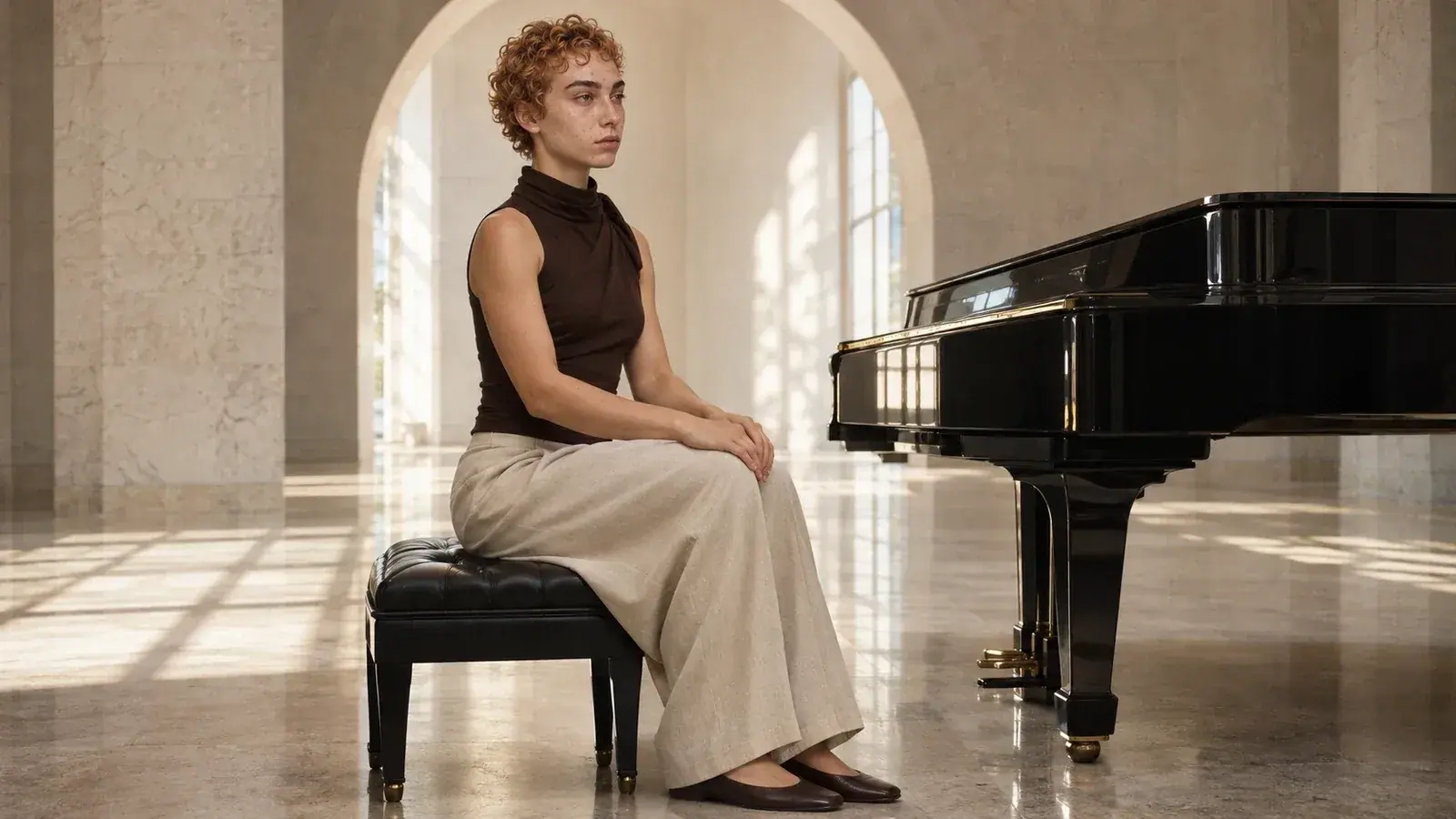
In an imagined portrait, Camila Vergara sits beside a grand piano in a bright lobby. Her hands are folded on her knee. Beyond the bench, a sweep of stone floor and a tall arch leave space for other people to arrive. The lid is closed. The longer we look at her stillness, the more the room seems capable of turning it into a prelude.
A second portrait puts Camila beside an upright piano in a dark, wood-panelled room. Her posture is familiar. The camera is closer, and the edge of the keyboard and the light from a low lamp give the seat a more private scale. There is room to imagine someone else here too, but it would be a different kind of encounter. Who might be present changes what the figure seems to be doing in both scenes.
Give the absent people somewhere to stand
In Edward Hopper's 1939 painting New York Movie, a central wall divides the cinema interior. The film and its audience occupy one side. An usher stands apart in the light of the aisle. Hopper gathered elements from several cinemas in preparatory studies, as the Whitney's account explains. The theatre holds two uses of the same space. People watch a film and someone whose work brings her there stands just apart. Even the part of the theatre that surrounds the usher helps make that division legible.
In the lobby portrait, the opening in the architecture makes it possible to imagine an approach. A person could come in from the light, cross the polished floor and see Camila from several metres away. Her gaze passes the camera, leaving the photographer outside that possible encounter. Crop the scene close to her shoulders and the face is still there, but there is less evidence that being seen could be part of the situation.
By the upright piano, a nearer camera can feel like someone already admitted to the room. It lets the fabric, folded hands and lamplight carry as much weight as the space around the instrument. A glance to the side might acknowledge someone just outside the picture, or simply leave Camila's attention with the room. The view gives the audience a place to imagine being. It leaves the relationship open.
Decide how close the viewer can come
Imagine shifting the camera in the dark room far enough back to include an open door and a view from the passage. The same face and folded hands could then belong to a scene observed in passing. Put the camera where a guest would sit and the gaze just past the lens can acknowledge somebody nearby without turning into a greeting. In the lobby, moving the camera into the figure's path of attention would give an entirely different kind of access. The difference belongs to where the audience is placed, even if the pose stays the same.
Our essay on what the foreground lets you see considers how a near surface can establish a viewpoint. For a portrait that depends on an absent audience, set the viewing position before choosing how much of the room to show. Decide which cues would survive at the size the reader will see. An arch can establish a route into a room. A strip of reflected floor on its own may only look like light.
For a recurring artificial talent, this is a way to direct an appearance without writing an unseen event into the character's history. Across the imagined piano portraits, the same person can seem available to a public gaze in one room and occupied with a thought of her own in another. Leave the reader enough of the space to sense who could come closer.