Artificial identities · Lyfera · 2026-10-20
A group portrait needs something between its faces
A shared frame creates relationships that individual portraits leave open. How attention, gestures and distance give a fictional group something to do together.
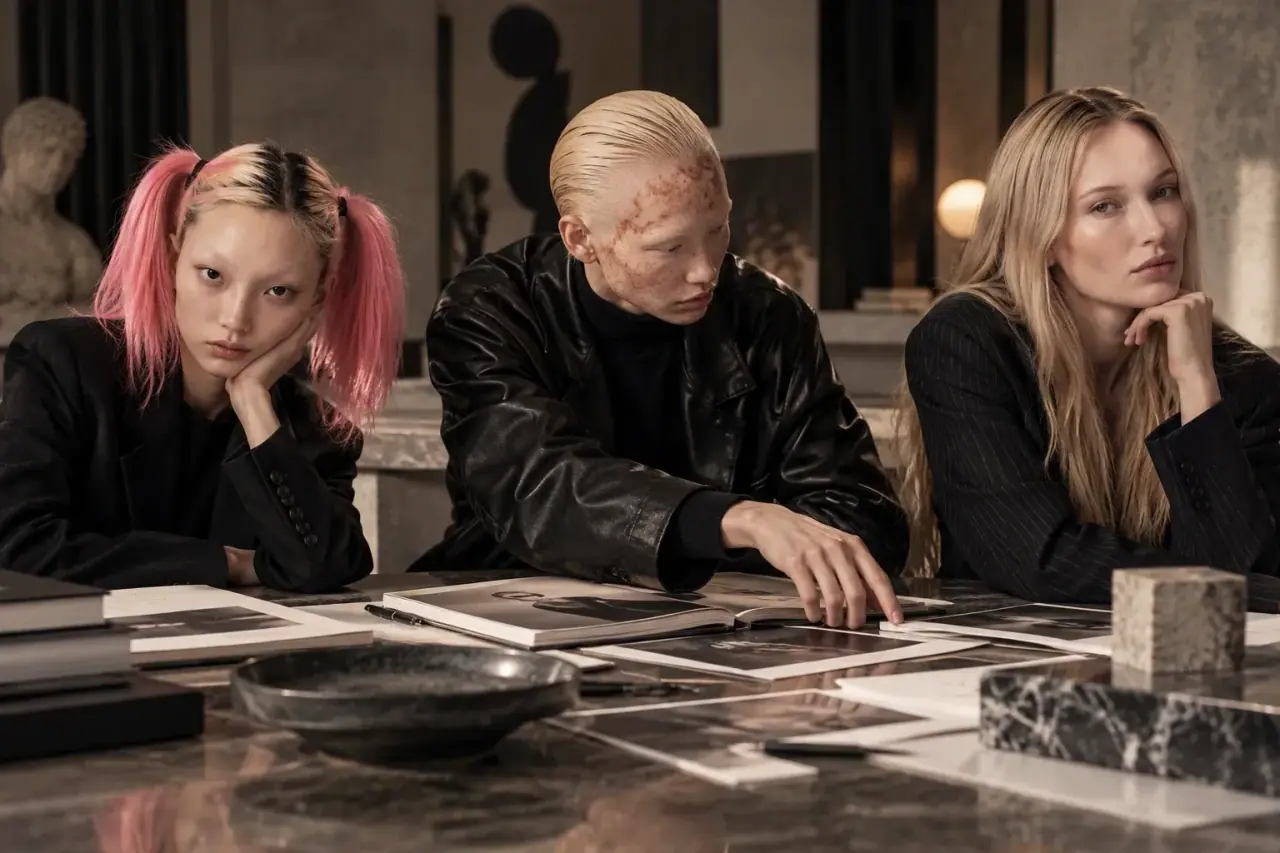
Three fictional talents sit around a table. Each face is recognisable, each outfit carefully considered. Yet the picture feels like three separate portraits occupying the same room. Nobody seems to notice what anyone else is doing. The team has assembled a cast; the scene still needs a reason for these particular people to be together.
This hypothetical image raises a question that a successful individual portrait leaves open. What changes when another character enters the frame? A shared setting creates possibilities for attention, disagreement and companionship. Those relationships have to be composed. They cannot be supplied by the quality of the faces alone.
A current exhibition gives the question a timely starting point. Gallery byGRIDA lists Faces at ASIA NOW in Paris for 20–24 October 2026. Its curatorial statement brings virtual figures into a wider account of portraiture that includes communities and collective urban life. This is the organiser's interpretation of the work, rather than a finding about audience response. It invites a useful shift in emphasis for artificial character work: from how an individual appears to what becomes visible among several individuals.
Give the group a shared situation
Return to the invented table. Suppose a coat has been placed across an empty chair. One character smooths its sleeve, another watches the hand, and the third looks towards the doorway. The objects and gestures now offer something to consider together. Is someone about to leave? Are the others waiting for an arrival? The image can leave that question unresolved while making the situation specific enough to hold attention.
The brief needs to decide how much uncertainty belongs there. If the commission concerns a departure, the coat, chair and doorway can help carry it. If it simply introduces three members of a fictional cast, those same details might suggest a story the team never intended. An attractive prop has become a point around which relationships form. Keeping it requires understanding what it adds.
This has a long history in portraiture. The National Gallery describes conversation pieces as relatively informal group portraits of family or friends, often in domestic or rural settings, without requiring the subjects to be talking. That historical category offers a useful distinction for a new commission. Togetherness can become legible through an arrangement of people and things before anyone is given a line of dialogue.
For the hypothetical table scene, a small shared action may therefore be enough. The composition could centre on making space for the coat, with each character responding differently. One moves an object out of the way, one keeps watching, one remains absorbed elsewhere. Their differences become available through a common situation, rather than through three biographies attached to three otherwise disconnected poses.
Attention gives the picture a structure
Where each figure looks deserves its own review. In our invented scene, directing everyone towards the person handling the coat could make that person the centre of the encounter. Letting two characters look at one another while the third looks away could suggest a smaller relationship within the group. These are possible readings for the team to examine, not rules that determine how every viewer will respond.
The distinction matters because the most visible person and the most consequential person need not be the same. A figure at the edge might supply the gesture to which everyone else responds. Someone nearest the camera might receive little attention from the others. A composition can use that difference deliberately, but the reviewer needs to see it before approving three individually successful expressions.
Try reading the invented portrait without its caption. Describe where attention travels and where it stops. If the team intended a quiet exchange but every figure appears to address the viewer, the image may be offering a collective introduction instead. That can be a worthwhile direction. It changes the encounter from watching a group to being addressed by it, and the writing should develop the direction actually present.
Our discussion of art direction in fashion images begins with the relationship between subject, clothes and setting. A group adds relationships among subjects, including the attention withheld from someone. The space between two chairs can carry as much of the proposal as the expression above either one.
Let each identity remain particular
A group can become visually coherent by making everyone behave alike. Matching clothes, parallel poses and a shared expression may suit a formal introduction. They may also remove the differences that made the cast interesting. Before treating uniformity as a solution, ask what each character contributes to this particular gathering.
In the hypothetical coat scene, one talent's attention to small details might become visible through the hand at the sleeve. Another could notice the person rather than the object. The third might attend to the space beyond the room. None needs an exaggerated signature gesture. Their distinct interests can shape modest differences in what they notice, while the shared scene gives those differences a relationship.
Keeping the talent recognisable remains a separate judgement. The faces and physical identities still need comparison with their approved references. Once that comparison is satisfactory, the group deserves another reading as a group. Three accurate identities can participate in a confused scene; a persuasive scene can also contain a face that no longer belongs to the cast. One successful judgement should leave room for the other.
The surrounding story should be equally deliberate. Placing fictional talents together does not require inventing years of friendship to justify their proximity. They could be meeting for the first time within the scene. A shared interest might bring them together briefly. The caption can establish the intended fictional relationship without turning an arrangement made for one editorial into an unexplained permanent bond.
Review what survives the crop
Now imagine the table portrait used in a narrow placement. The doorway disappears, leaving the third character apparently looking at nothing. A crop closer to the coat removes the watching figure and makes the hand seem occupied in private. The source composition has stayed intact, but the published image tells a different part of the situation.
Each required crop therefore deserves a reading of its own. The team might preserve the exchange in a wider placement and choose a separate individual portrait for the narrow one. It might instead redesign the group around a gesture that remains visible at the required scale. The appropriate choice depends on what the placement is supposed to introduce. Fitting all three heads into the available space does not settle whether their relationship survives.
These are proposals for a separate creative commission, rather than a claim that Lyfera automatically produces group scenes or supplies their relationships. A mentor brings a continuing identity to that commission and remains responsible for deciding what the appearance adds to its story. The final review can return to the table: what passes between these figures that would be lost if they were shown alone? A group portrait becomes worth keeping when its answer can be found in the picture.