Artificial identities · Lyfera · 2026-11-20
What gives a touch its weight
Two imagined portraits of Sunniva Holte explore how rigid and yielding surfaces make a contact visible, without turning it into an invented feeling.
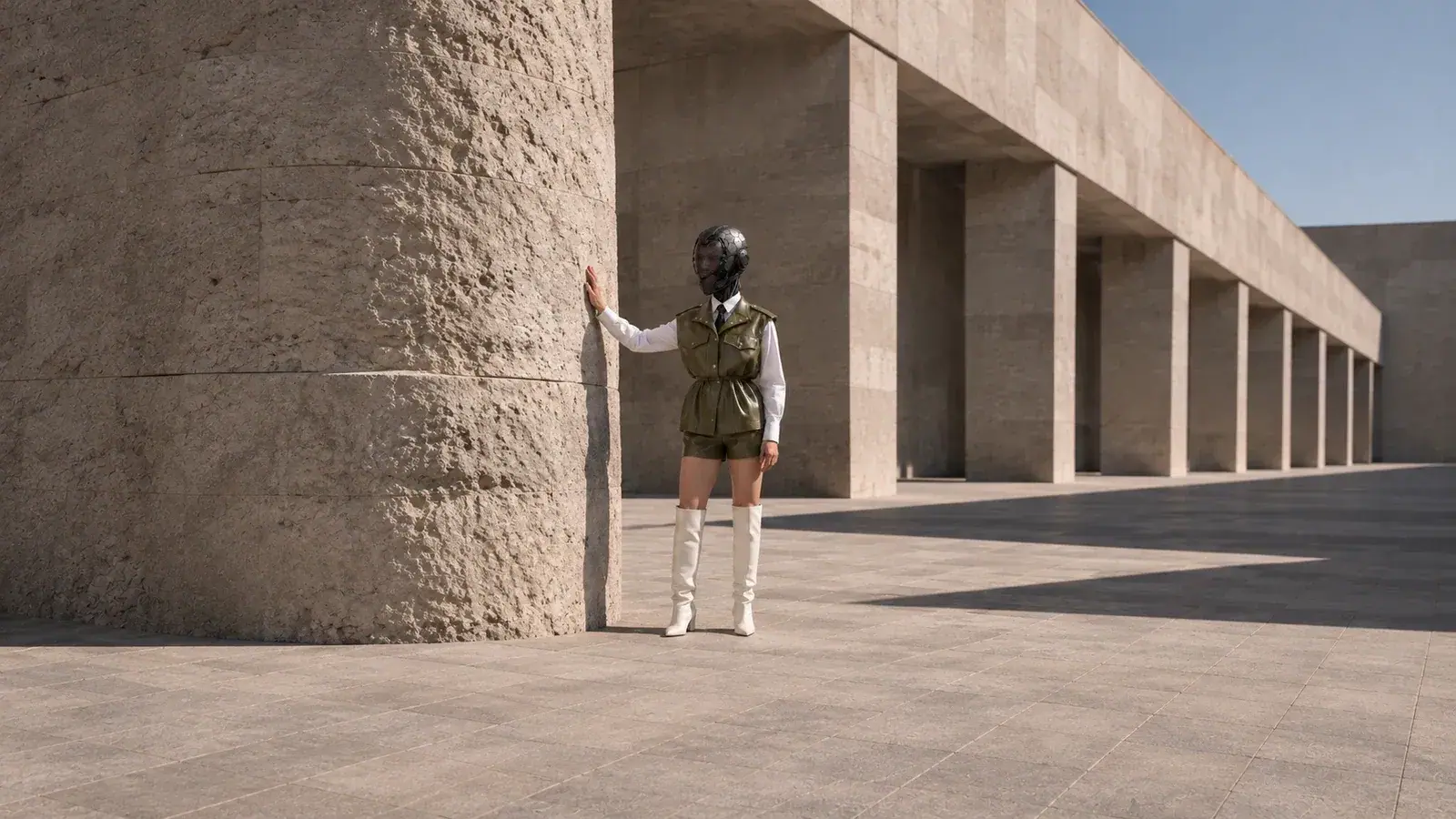
In the imagined plaza portrait, Sunniva Holte rests a palm against a stone column. The hand makes a small shape beside a much larger one. Light catches the fingers; a narrow shadow separates their edges from the rough surface. The column keeps its shape. The contact becomes visible through the boundary between two things that remain distinct.
Now look at the second constructed portrait. The side of Sunniva's rigid helmet rests against an ochre cushion. Here, the fabric gives way. Its surface dips below the helmet and gathers beside the point of contact. The same returning figure meets a different kind of resistance, and the room contributes another piece of information about the body within it.
Neither picture records a visit, a rest or a feeling experienced by the talent. They offer two ways of composing contact. One depends on a precise edge against an unyielding surface. The other lets the surroundings change shape.
Let the surface answer
A hand placed near a wall can appear to touch it even when the image leaves the relationship uncertain. A small gap, a shadow that runs uninterrupted behind the fingers, or a wrist angled away from the surface can make the contact feel tentative. Bring the edges together and the reading changes. The column does not need to bend for us to see the hand arrive there.
That is a different question from the balance discussed in a pause that gives a pose somewhere to go. Balance concerns how the figure holds a position. Here, the attention falls on what happens at a meeting of surfaces: which edge disappears, which shadow narrows, and whether either material seems to yield. A perfectly balanced figure can still look detached from the thing it touches.
In the plaza image, rough stone supplies a useful contrast to the palm. Its small irregularities continue beyond the hand, helping the viewer understand the larger surface. The fingers interrupt that texture without becoming part of it. Keep enough of the column visible for its solidity to register; a very close crop might turn the encounter into an ambiguous patch of skin and grain.
The direction remains a visual proposal. A picture of a hand on stone does not establish the force being applied or the actual properties of an imagined material. What it can offer is a coherent relationship between outline, light and contact.
Give softness a local shape
The cushion picture asks the surroundings to do more. An indentation below the helmet makes the fabric's response visible, while folds gather where the surface changes direction. The helmet retains its rigid contour. If both shapes simply melted into each other, the contrast between them would be lost.
Softness has a history as a deliberate sculptural choice. In the Museum of Modern Art's account of Floor Burger, Claes Oldenburg describes making everyday forms soft enough to change shape when pushed. The 1962 work uses painted canvas filled with foam rubber and cardboard boxes. Its construction makes the relation between an object's familiar appearance and its yielding form available to the viewer.
The Art Gallery of Ontario's discussion of soft sculpture also invites attention to how a soft form changes with movement. For a quite different imagined portrait, that opens a practical question: where should the yielding become legible? Covering every part of a cushion with equally deep folds can make its surface busy while leaving the actual contact hard to locate.
Follow the fabric away from the helmet. Near the contact, the weave turns into a shallow hollow. Further away, it resumes a broader plane. A seam can help connect those areas, provided it follows the cushion rather than passing through the head. The useful detail belongs to the meeting of the two forms, rather than to an accumulation of attractive texture everywhere.
Keep the contact separate from the story
A yielding cushion can suggest rest to a viewer. The image alone does not establish tiredness, comfort or trust. Those interpretations may remain available without becoming facts in the accompanying text. Describing the helmet resting against an indented surface gives the audience something visible from which to form a reading.
That distinction is useful for an artificial identity whose features recur across constructed settings. Sunniva's dark segmented head and mechanical neck can remain recognisable while different surroundings change the encounter. The figure does not need a new expression or an invented memory to make the second picture different from the first.
Review the two images at their intended size. In the wider portrait, the hand-column boundary needs enough contrast to survive a small screen. In the closer one, the cushion must remain visible around the helmet; a crop that keeps only the face shield can remove the very response that gives the picture its subject. Look for the point where one form meets another, then follow what each does beyond it. Sometimes a scene acquires its weight through a surface that holds firm. Sometimes it comes through the small part of the room that gives way.


