Artificial identities · Lyfera · 2026-11-13
The pause that gives a pose somewhere to go
How weight, space and a held gesture can leave a character with room to move.
A photograph can hold a person still without making the scene feel finished. A hand rests on the back of a chair; weight settles into one leg; the space beside a doorway stays open. Nothing has to happen next. Yet the arrangement gives the eye a reason to imagine what might.
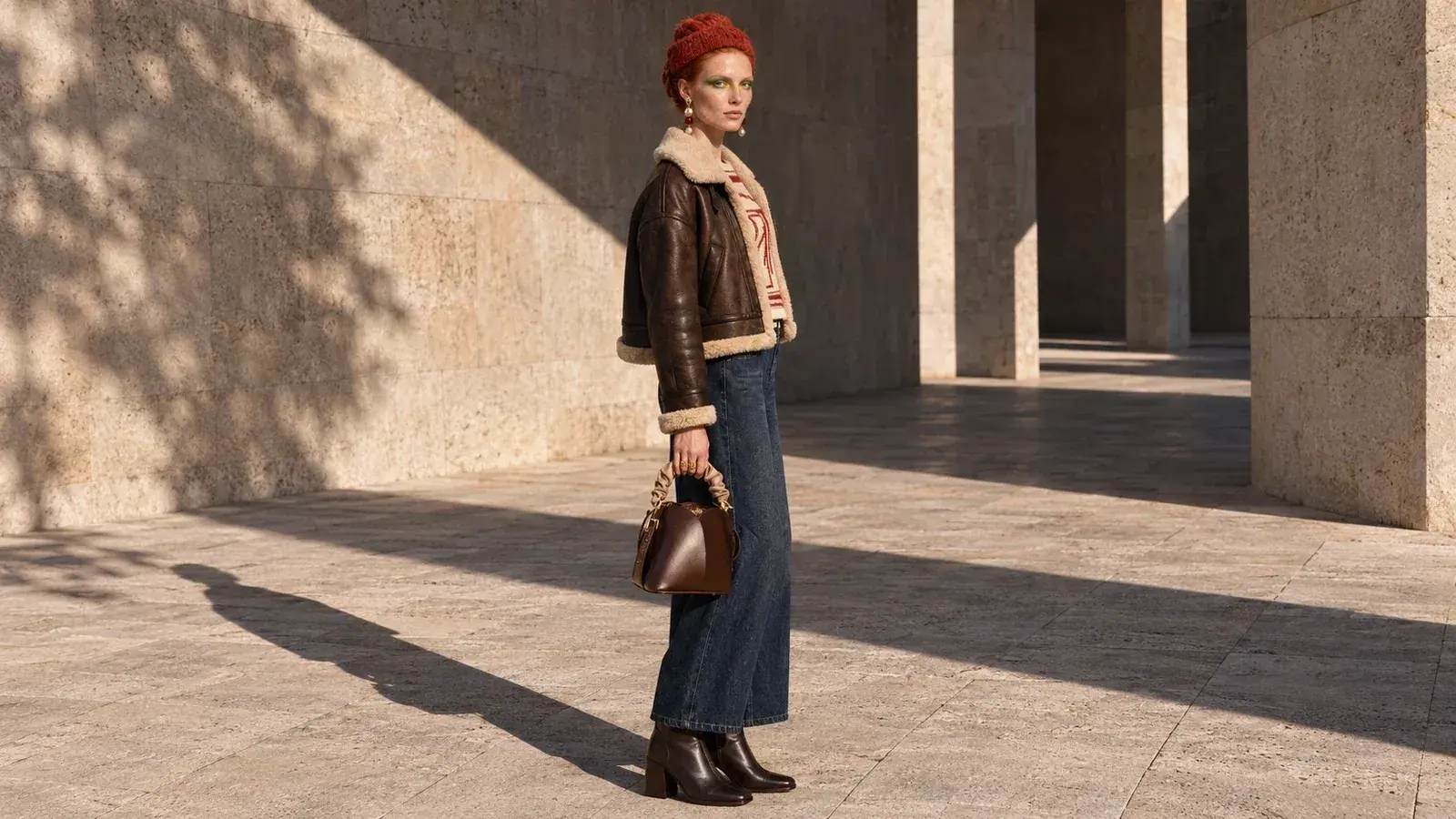
For an artificial character, that sense of possibility is a matter of direction. It begins with a body that appears to belong to its surroundings, rather than a gesture added to explain a feeling. In this imagined portrait, Lyfera talent Alma Voss occupies a courtyard where architecture and stance share the frame. The picture is a constructed scene, not a record of an event or evidence of an inner life.
Begin with weight
A convincing pause needs somewhere to settle. Consider where the body's weight meets the floor and how that choice affects the hips, shoulders and feet. A standing figure leaning lightly into one leg gives the other leg a different job; both feet need credible contact with the surface. If a hand rests against a chair, the chair must be close enough to support it. These are small relationships, but they make a pose legible before any expression is considered.
The point is not to make every figure look candid. A deliberately arranged fashion portrait can be formal and still suggest an instant inside a longer sequence. What matters is whether the posture has a clear structure. An elegant line that ignores balance can pull attention away from the character and toward the mechanics of the image.
The generated gesture as a performance reference considers how a gesture can guide work across images. Here the question is narrower: what can a single frame imply when a pose is allowed to remain unresolved?
Leave room around the gesture
A pause also depends on what the frame does not fill. An open path, an unoccupied chair or a strip of floor can make a figure's position feel chosen. A tighter crop might turn the same posture into a study of texture and proportion. Neither choice automatically creates a story; each changes the information available to the viewer.
Imagine two versions of the courtyard portrait. In one, Alma stands close to the edge of the frame with an empty passage visible ahead. In another, the crop ends just beyond her shoulder, leaving the direction of the space uncertain. The first invites a possible movement through the setting; the second gives more weight to the shape of the pose itself. These are hypothetical alternatives, not descriptions of separate shoots.
A hand can carry the same uncertainty. Fingers curled around a chair might suggest support, preparation to sit, or simply a composed line. It is tempting to assign a single emotion to that contact. The image offers less certainty: a placement, a surface and a relationship between them. The viewer supplies much of the rest.
Let ambiguity stay visible
Photography has long explored how posture can be composed as well as observed. The Museum of Modern Art's exhibition Gesture and Pose: Twentieth-Century Photographs from the Collection considered composed and involuntary gestures across different photographic approaches. That history is a useful reminder that an arranged image can invite interpretation without documenting a spontaneous moment. Generated portraits have a different production process; they should be presented on their own terms.
For creative direction, a useful final review is practical. Look first at the image without a caption. Does the posture read clearly? Are hands and supports connected? Does the crop preserve the detail that makes the pause interesting? Then read the accompanying copy. If it describes a memory, intention or experience the picture cannot establish, pull that claim back to what the image actually shows.
The strongest pause is not necessarily dramatic. It may be a quiet distribution of weight and space that lets an artificial character appear present in a constructed world, while leaving the next gesture to the imagination.