Artificial identities · Lyfera · 2026-10-09
A cultural reference is more than a visual style
A cultural source carries more than a palette or motif. How an artificial-talent editorial can make its interpretation clear while keeping the source available to readers.
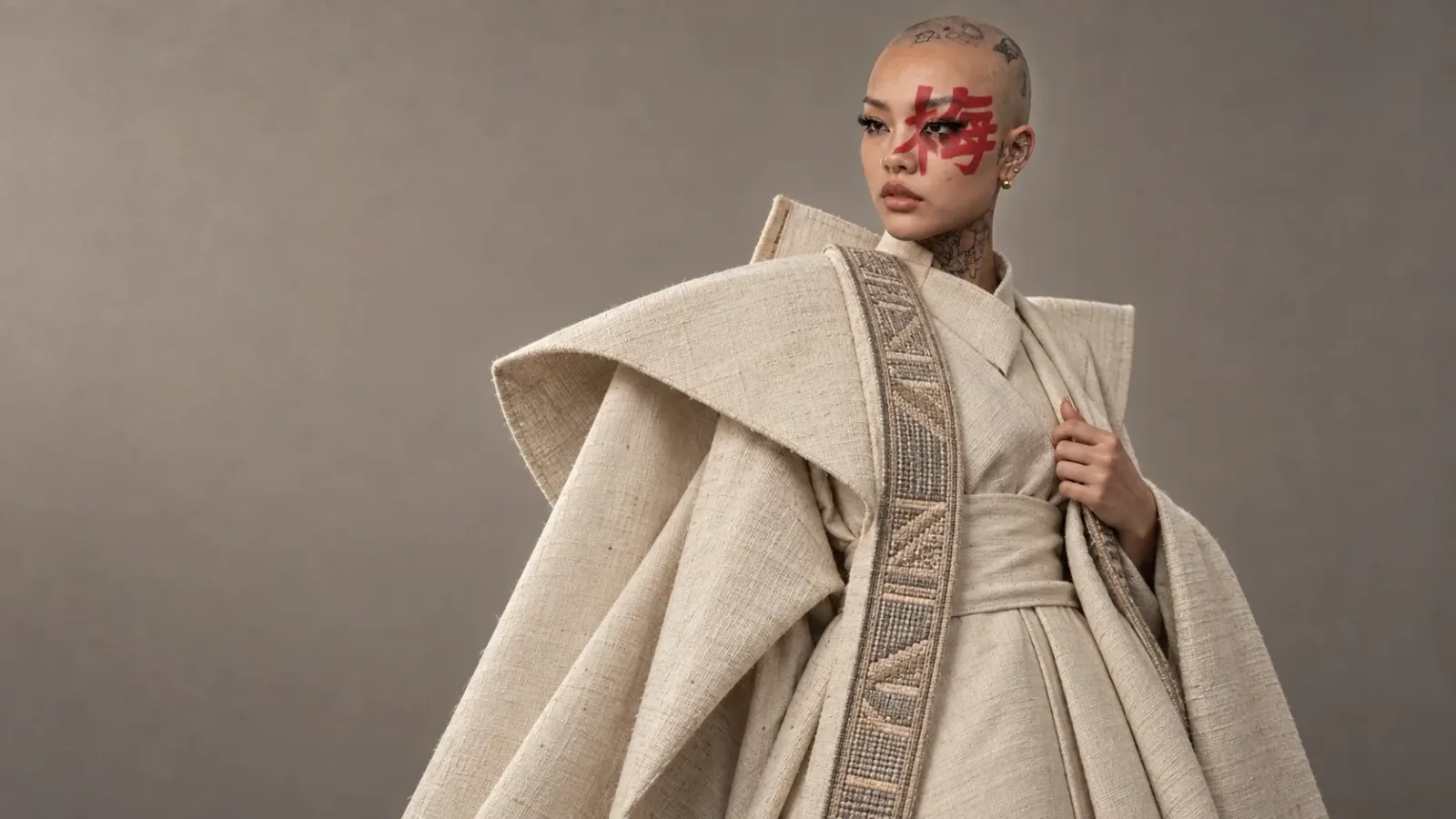
A moodboard can make a textile look available before anyone has understood it. A border becomes a graphic device, a ceremonial form becomes a silhouette, and a museum photograph becomes a colour palette. Each observation may begin a worthwhile fashion image. The difficulty comes when a creative team treats the visible feature as everything there is to know about its source. An artificial talent can wear the resulting interpretation convincingly while the reference has lost the context that made it interesting.
Two forthcoming programmes give this question a particular setting. AMACI lists Antonio Lavorgna's AI Fashion — Art Becomes Fashion for 10 October 2026. Its description proposes an imaginary collection that moves through references to art history towards the artist's own visual language. The programme is an announcement, rather than a review of work already presented. It offers a timely starting point for asking what happens between encountering a source and making a new image from it.
At Sorbonne University Abu Dhabi, The Way of the Sun and Andean Archaeology is scheduled for 19–24 October. The university describes an Arqueomoda exhibition connecting research into Andean clothing systems with contemporary creation. Its account includes textile structures, techniques and cultural meanings, and distinguishes reinterpretation from historical reconstruction. These are the organisers' descriptions of a forthcoming exhibition. They do not establish how either programme's visitors will respond, but they show how much more a reference can contain than its appearance.
Begin with something you can identify
Consider a hypothetical editorial about the way a woven border changes the proportions of a garment. The team begins with a museum catalogue image of a particular textile. Before developing the portrait, it can retain the catalogue entry alongside the image: the object's description, attributed place and period, maker where known, and any uncertainty recorded by the institution. The source now remains something another collaborator can find and read.
That small step changes the discussion. “Traditional pattern” gives the team little to investigate. A particular object, with a particular account of its construction and use, provides questions. Does the border frame a field? Does its scale alter the way a surface is divided? Is the feature that attracted the team a technique, an image or a consequence of how the object was used? Those questions require looking again rather than immediately collecting more examples that appear similar.
The catalogue is also a starting point with limits. An absent maker's name does not mean that nobody made the object. An uncertain date should remain uncertain. A short institutional description may leave questions that need further reading or a conversation with someone knowledgeable about the work. The editorial should not fill those gaps with a character's plausible account of what the textile means.
Explain the transformation
In the invented commission, the team might take the relationship between a narrow border and a large central field as the subject of a new silhouette. The portrait could use an original arrangement of panels to explore that relationship, without presenting the garment as a reproduction of the catalogue object. The creative connection would be specific enough to discuss: a way of organising space has become a question about proportion on a body.
A different proposal might reproduce a recognisable motif and describe it as an authentic expression of a broad culture. That introduces a much larger claim. Visual resemblance alone cannot establish the meaning, suitability or authority of that description. Before retaining it, the team would need to understand what the motif signifies in its particular context and whether the proposed account is supportable. If that knowledge is missing, changing the caption to a vague word such as “inspired” leaves the underlying question unresolved.
This is where research can improve the creative idea rather than merely supply its credit. Learning that the original feature had a specific function might lead the team to reconsider its placement. Discovering differences between objects initially grouped together might narrow the reference. The result could become less immediately recognisable as a borrowed look while gaining a more exact relationship to what prompted it.
Our discussion of art direction in AI fashion photography concerns why the subject, garment and setting belong together. A cultural source adds a prior question: what have the people making the image actually learned from the material they are bringing into that relationship?
The character does not inherit the source's authority
An artificial talent can express curiosity about the hypothetical textile without acquiring a fictional apprenticeship, community membership or family history to explain the interest. Those additions would change the character and the meaning of the presentation. They should never arrive simply because a first-person caption sounds warmer with an invented personal connection.
For the border study, a caption could identify the work as a constructed editorial and explain the compositional question. An accompanying note could name the source and direct the reader to its documented context. If a real maker or researcher contributed, their actual role could be credited in plain language. The talent would remain the subject of the interpretation, while the people and records supplying knowledge would remain identifiable.
This differs from the object history discussed in our article on second-hand wardrobes. There, a particular garment's past has to survive a new presentation. Here, the creative team is making something new and needs to keep its relationship to a cultural source intelligible. It cannot borrow the authority of that source merely by carrying some of its visible features into another image.
Leave the reference open to further reading
The final portrait will not contain everything the team learned, and it need not become an illustrated lecture. A concise explanation can still distinguish the source, the team's interpretation and the newly imagined garment. Where the work raises a factual question, the reader should have a route beyond the image's own account of itself.
For Lyfera's human mentor, this creates room for a more particular kind of character development. An interest can become a habit of looking closely, returning to a source and changing a choice after learning something. The talent's continuity would come from that developing attention, rather than from accumulating cultural labels as personality traits. A reference has contributed something substantial when the new work makes its relationship to the source clearer and gives the reader a reason to encounter that source on its own terms.