Artificial identities · Lyfera · 2026-10-23
A making-of should leave a decision visible
Showing how an artificial portrait was made can offer more than a transformation. A useful making-of lets the audience follow a choice and see its consequence in the finished work.

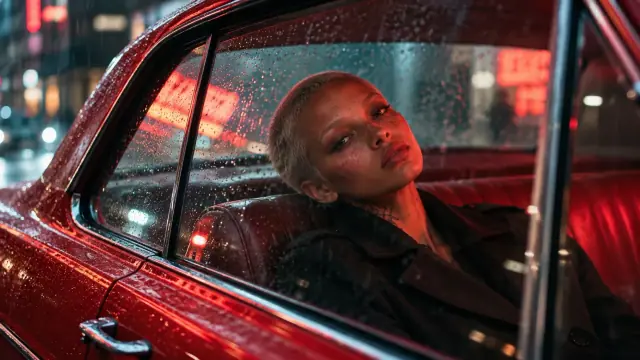
Imagine a hypothetical portrait of an artificial talent beside a shop window. The final image places the figure slightly away from the glass, with a reflection interrupting the view of one shoulder. A short making-of accompanies it: early images appear, the music builds, and the finished portrait arrives. The sequence establishes that work took place. It leaves something more interesting unanswered: why did this particular relationship between figure and reflection become worth keeping?
A making-of gives an audience another way into a constructed identity. Someone can enjoy the portrait and also become curious about the judgement behind it. That second encounter needs its own subject. Showing an image becoming more polished can hold attention, but explaining a consequential choice lets the viewer return to the finished work with something new to notice.
There is a timely public example of image making becoming something to watch. The One Club's announcement of its AI Creative Challenge lists a Buenos Aires event for 23 October 2026. Organised with Google, the competition gives participants a surprise brief and ten minutes to produce a response with generative AI. Its format puts the act of making before spectators. Today's event is scheduled, rather than a performance reviewed here; the programme does not establish how a particular creative decision will be understood by its audience.
Give the explanation a choice to follow
Return to the invented window portrait. An early version might place the talent directly against the glass, making the reflection look like another complete figure. A later version could move the subject far enough away that the reflected shoulder becomes a partial interruption. Both images might be attractive. The useful explanation concerns the change in the encounter: the first offers a doubled presence, while the second leaves the viewer uncertain about where the body ends and the surrounding street begins.
That account gives the two versions a reason to appear together. It does not require presenting the early image as an embarrassing failure. An alternative can be convincing and still serve a different purpose. Calling every discarded version bad makes the final selection seem obvious and conceals the judgement the making-of could have explored.
The distinction is especially useful when a change removes a conspicuous effect. Suppose the mentor chooses the quieter reflection, although the doubled figure would make a more dramatic reveal in the process film. Explaining the quieter choice can help the audience see restraint as part of the portrait's construction. The making-of then serves the work instead of choosing its examples solely for their ability to advertise a transformation.
This extends the question of art direction in an AI fashion image into a different encounter. The brief gives the maker a purpose. The making-of gives another person access to a decision made in pursuit of that purpose. The explanation succeeds when the viewer can recognise the consequence in the picture, even if they would have preferred the alternative.
Keep the record and the retelling distinguishable
Photography offers a useful historical comparison. In its account of the 2012 exhibition Magnum Contact Sheets, the International Center of Photography describes direct prints of negatives as records through which viewers can examine photographers' working and editing processes. The surrounding frames make a selected photograph available in another context. This is historical material, rather than a new exhibition announcement.
A sequence of generated alternatives has a different relationship to its subject. It records images produced during a construction; it does not establish that a person stood before a camera through successive physical moments. That difference matters when a process film borrows the familiar appearance of a contact sheet or studio documentary. Its presentation should let the audience understand what kind of record they are seeing.
The retelling also has its own sequence. In the hypothetical window project, the mentor might have made the quieter version first, explored the doubled figure and then returned to the earlier direction. Editing the film into a simple progression from clumsy beginning to elegant ending would create a cleaner story. It would also give a misleading account of how the selection happened. A return to an earlier image can be the decision worth showing.
An explanation prepared afterwards can still be useful. The maker may understand a preference more clearly once several alternatives are beside one another. The wording can acknowledge that later reflection: looking back, this is the difference that now seems consequential. A reconstruction made specifically to illustrate the point needs an equally clear description. Neither has to pretend to be an unedited record of the original work.
Let the maker speak about making
An artificial talent can carry a fictional voice while a human mentor explains the production. Those two voices offer different things to the audience. The character might describe being drawn to reflections within a disclosed story. The mentor can explain choosing a partial reflection because it changed the composition. Keeping the speakers clear makes both accounts more precise.
In our invented portrait, a caption in the character's voice could describe noticing a second outline in the window. A process note saying that the character rejected several images would imply another kind of agency. If the mentor made the selection, the explanation should identify that judgement accordingly. There is no need to invent a conversation with the talent to make the production feel personal.
The same care applies to contributors. The account should name the work people actually did, whether that concerned the concept, styling, image selection or writing. Our discussion of the work surrounding a generated delivery concerns how those responsibilities are organised. A public making-of has a narrower task: give enough of that authorship to make the explanation intelligible, without claiming that one visible action accounts for everything.
This does not require exposing private production material. A selected comparison and a clear account of the compositional choice can explain a great deal. Unrelated personal information, confidential briefs and private instructions contribute nothing simply by appearing on screen. The editorial decision concerns what the viewer needs to understand the work, rather than how much of a working environment can be displayed.
Return the audience to the portrait
A making-of can become more elaborate than the piece it accompanies. That may be justified when the process is itself the subject. For the quiet window portrait, however, the explanation earns its place by changing what remains available in the finished image. After watching, someone might notice the interrupted shoulder, consider the alternative doubled figure and understand what was gained by leaving part of the reflection unresolved.
These are proposals for a separate editorial treatment, not a description of a making-of service supplied by Lyfera. They offer a mentor a way to share judgement without turning the fictional identity into its own production crew. The final portrait should remain enjoyable on its own. Beside it, the making-of can preserve the moment when another good image was possible and someone chose this one.