Artificial identities · Lyfera · 2026-11-09
The story a gaze leaves outside the frame
How an eyeline can suggest a world beyond a portrait without turning interpretation into fact.
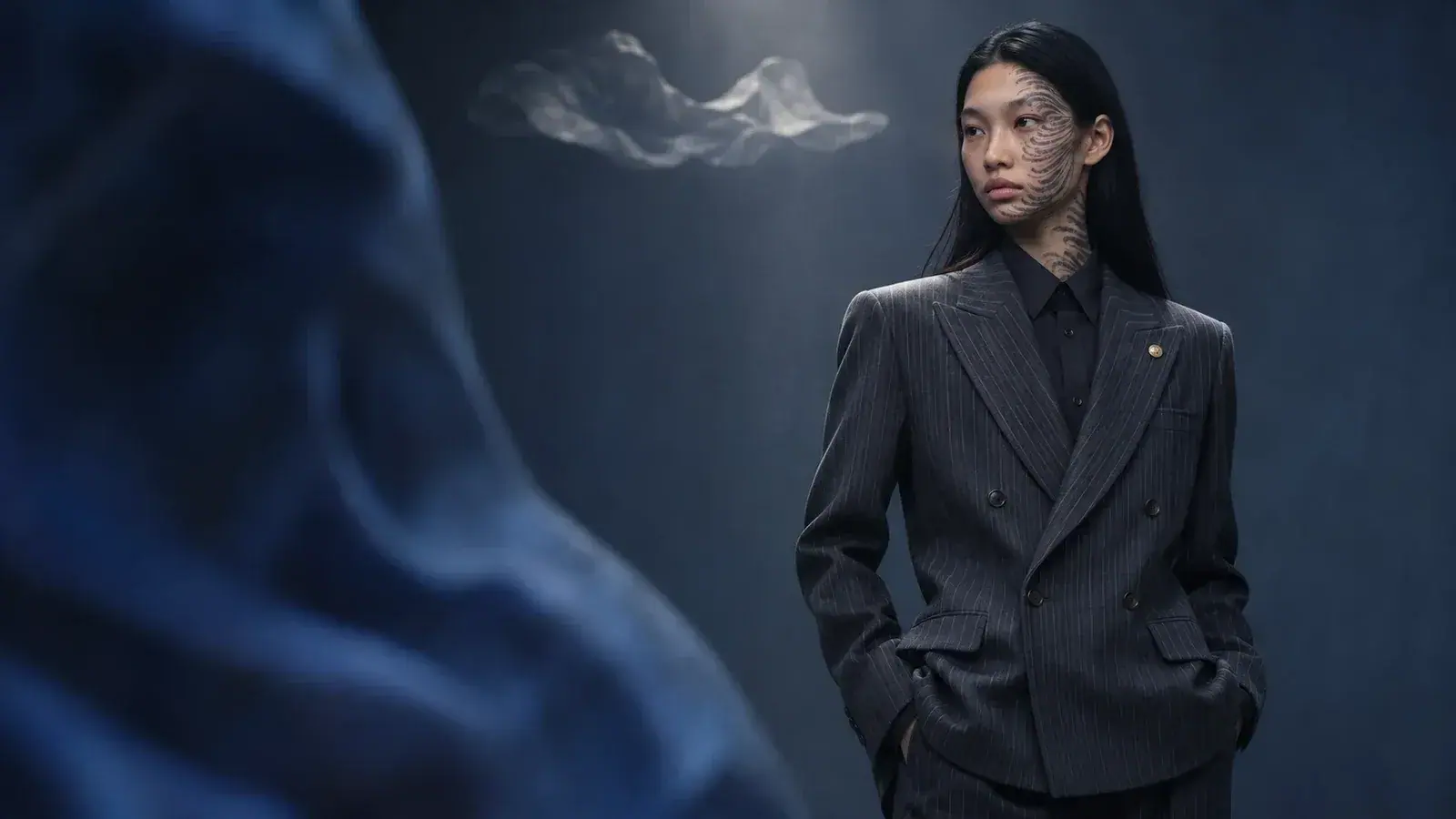
A portrait can make space for someone who is not pictured. A glance toward the edge asks us to consider what might sit beyond it: a person, a movement, an object or simply an interruption. The image gives us a direction, but it does not have to provide an answer.
For an artificial talent whose identity continues across images, that small decision can change the relationship between portrait and audience. A direct gaze offers one encounter; a gaze elsewhere suggests another world in progress. Neither is inherently more intimate or more mysterious. Their meaning comes from the rest of the picture and from what the reader already knows.
A direction is not a backstory
Imagine Shiori Moriyama looking past a blue form in the foreground. The line of sight connects her to an unseen point, while the blurred shape gives the space depth. We might wonder whether she is watching someone or considering an object. The portrait itself cannot tell us which, and it would be misleading to present either explanation as something she experienced.
Film uses a related idea when an image makes viewers aware of space beyond its edges. Oklahoma State University's introduction to cinematography describes ways filmmakers activate offscreen space. A still image has no next shot to settle the question, but the direction of a face and the objects around it can still invite a reader to imagine what the frame leaves out.
This is a different decision from choosing how tightly to crop a face. As our piece on what a crop lets an image say explores, the boundary changes what is visible. An eyeline gives a visible subject a possible relationship to what remains outside that boundary. Together they can suggest a wider scene without pretending to document it.
Give the unseen something to work against
The space around the subject matters. If Shiori looks toward a nearly empty area, the direction can feel open. If a wall, doorway or foreground object interrupts the same view, it can make the space feel more specific. Neither reading is guaranteed: posture, light, context and the viewer's own associations can shift it.
A useful creative exercise is to write two descriptions of the same hypothetical image. The first records only what can be seen: where the eyes point, how the shoulders turn, which parts of the setting are sharp. The second notes the questions those choices invite. Keeping observation separate from interpretation helps a team preserve ambiguity without turning a possible story into a claimed fact.
Continuity leaves room for uncertainty
Across a series, a talent need not hold the same expression or look in the same direction. What can remain recognisable is the character's visual identity, the care given to pose and the editorial intention behind each image. A later portrait can look directly at the reader without needing to resolve an earlier offscreen glance.
For a human creative director, the question is not whether every image explains itself. It is whether the uncertainty belongs there. A gaze can open a scene, but the restraint to leave its destination unnamed can be just as deliberate.