Artificial identities · Lyfera · 2026-11-22
Ten riders share one frame budget
Moonfold’s crowded scene separates download size, geometry, drawing calls and scene resolution instead of treating one small file as proof of speed.
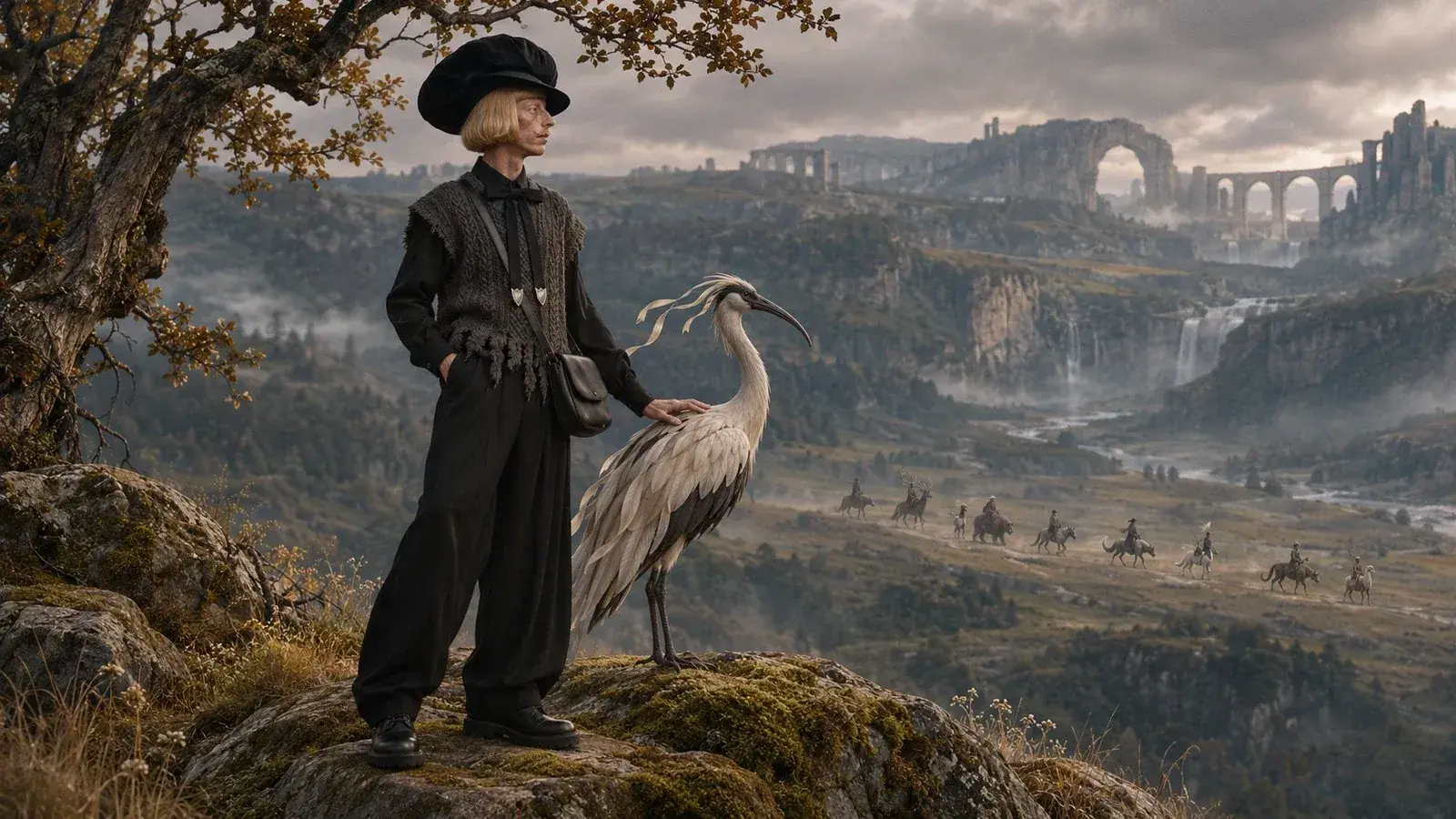
Bring ten talent–animal pairs into Moonfold Menagerie’s field and there is more to recognise, but there is also more to draw. Callum Hayward and his Compass Ram occupy one part of that shared view; nine other pairs need to remain visible around them. The scene has a practical budget for turning all those relationships into another frame.
To explore the scene in your browser, play Moonfold Menagerie.
The laboratory revision addresses several different costs. Nine added cast models are supplied as compressed files. Static geometry is combined, remote poses are handled more lightly, and the resolution of the rendered scene can adapt. These choices act at different stages, so their benefits should not be collapsed into a single claim that compression makes the game fast.
Smaller on the wire is not fewer triangles
A compressed model can reduce the bytes transferred before it is loaded. After decompression, the renderer still has geometry to process and a figure to draw. The downloaded file size alone cannot establish how much work a crowded view will require.
The recorded revision reduced the environment from 330,030 triangles to 286,898. In the sampled scene with ten pairs, the receipt recorded 408,872 triangles in total and 469 drawing calls. Those are different quantities: one describes the triangles submitted in that view; another counts the separate drawing operations. Neither is a frame-rate guarantee.
Combining static geometry can reduce repeated submission work where objects can be drawn together. The scene still needs the distinctions that make a location readable. Removing the object that tells a player where to return could save work while damaging the reason for the view to exist.
Spend resolution on the scene without hiding the decision
Adaptive scene resolution changes the amount of image detail the renderer has to produce. Moonfold confines that adjustment to the scene rather than treating every interface label as disposable detail. A softer distant tree and an unreadable objective are different losses for the player.
The ten-pair capture used Chromium with software WebGL rendering. Its sampled median frame duration was about 208 milliseconds, with slower frames beyond that. This is an expensive laboratory rendering setup, not evidence for smooth play on a physical graphics card or phone. Publishing the scene counts without that context would turn an optimisation record into a performance promise it cannot support.
Our essay on evaluating an upgrade through the work’s actual question offers a related discipline. The question here is whether a crowded scene preserves the cast, cargo and destinations at an acceptable pace on the intended device. A smaller asset is one useful piece of evidence, not the answer by itself.
Physical-device fluidity remains a separate measurement. What the current record establishes is that all ten models were loaded in one shared view and that several costs were identified and reduced. The budget matters because the next frame has to arrive while the player’s choice still feels connected to the rider crossing the field.


