Artificial identities · Lyfera · 2026-11-22
Chiara’s expedition begins by making room for a creature
Moonfold Menagerie turns observing, placing an instrument and returning with a lens into a sequence of different responsibilities.
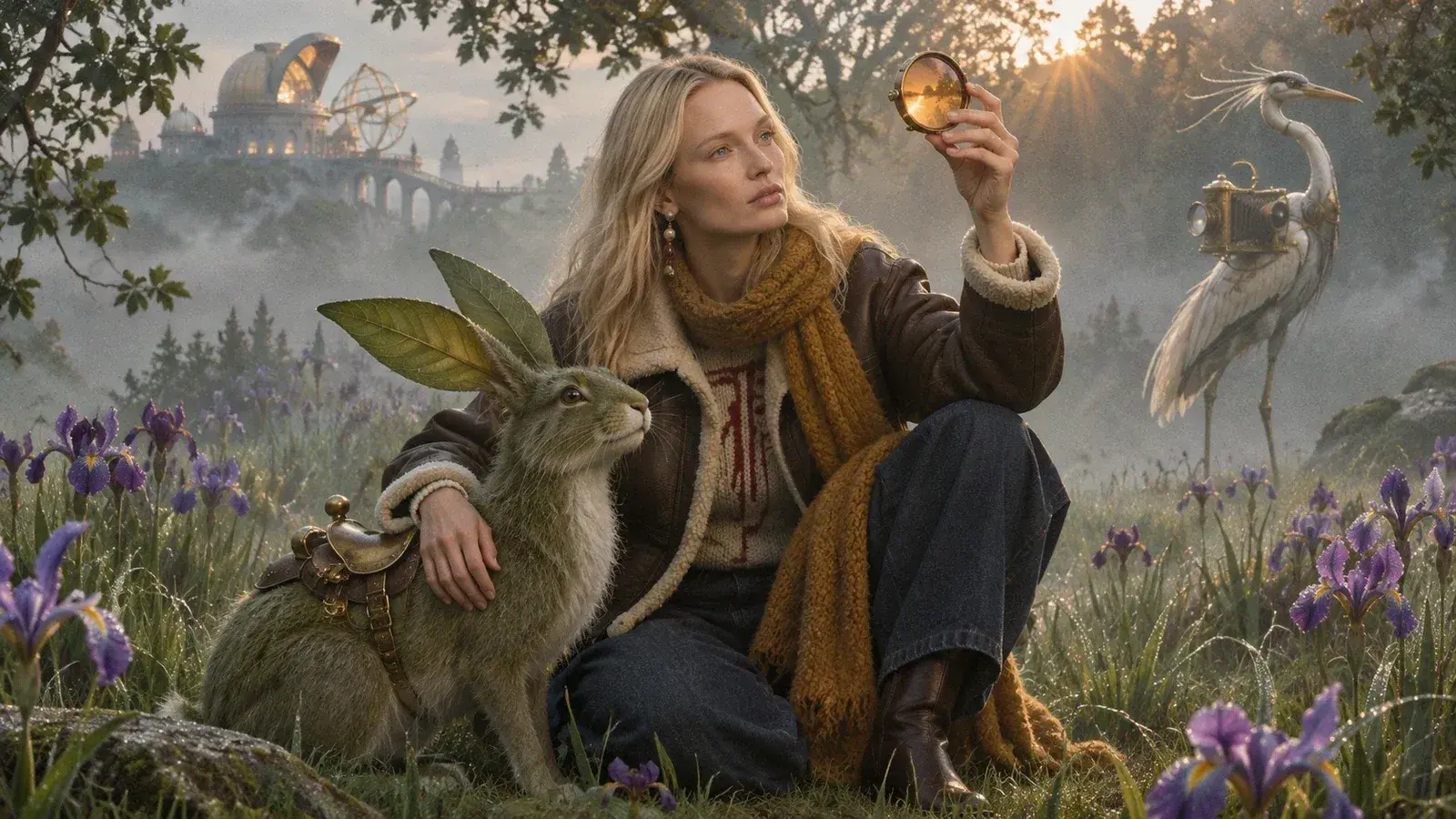
Set the instrument beside Chiara Conti’s companion, carry it to the calling patch and step back. The distance is part of the invitation. In Moonfold Menagerie, meeting the Aperture Heron begins with arranging a place the creature can approach, rather than running directly into it and collecting a reward.
To begin Chiara’s expedition, play Moonfold Menagerie.
The solo campaign’s laboratory edition follows three habitats. Each contains a creature, an illustrated field sketch and an instrument choice. E observes; the sketch helps the player decide what to prepare. Q first unpacks, then places or secures the apparatus according to the stage of the encounter. One key can therefore perform related actions without making their order arbitrary.
An encounter needs a sequence
After placing the instrument and backing away, Chiara secures three marked stays in order. The first habitat names them Reed, Shell and Star. The later habitats change that sequence and their setting. The player is moving through a procedure that belongs to the scene, with objects and locations that explain why the next action is possible.
At the signal post, a shutter action leads to a spring from the leaf and a lens caught in the air. The return to the press then completes a circuit. The creature is not simply a target at the end of a movement challenge; the field camp, calling patch, stays and press give its appearance a set of spatial relationships.
This is where the pause that gives a pose somewhere to go becomes a practical design question. Stepping back changes what the figure is waiting for. Returning with a lens changes the meaning of a place visited earlier. The scene can reuse its ground while giving the player a different reason to cross it.
Bring something back that changes the next visit
The Amber lens from Iris Meadow unlocks a mounted gallop. The Rose lens from The Bell Orchard opens constellation sight. The Blue lens from Orrery Hill restores the observatory. These rewards give the three encounters different consequences rather than treating each lens as another interchangeable counter.
The recorded solo playthrough completed all three and signed CHI at 1,908 points. It also deliberately lost a light, collected three moonseeds and confirmed the light’s return before continuing. Those observations show that the expedition can combine its main procedure with a separate recovery decision. A later stopped run remained distinguishable in the local ledger.
Moonfold’s solo expedition works from its static cartridge. The separate crew relay requires a host offering the room service; a successful solo delivery does not demonstrate that the cooperative service is available on a public site. This article follows the laboratory edition and its recorded campaign.
For Chiara, the small act of backing away is a useful place to begin reading the game. It makes space for something other than the player’s immediate motion. The lens becomes worth carrying home because the expedition has made the meeting, the preparation and the return into different parts of one encounter.


