Artificial identities · Lyfera · 2026-11-21
Rain gives a portrait a shared condition
Rain gives an imagined portrait a shared condition. Shelter, glass, clothing and paving make its local consequences visible.
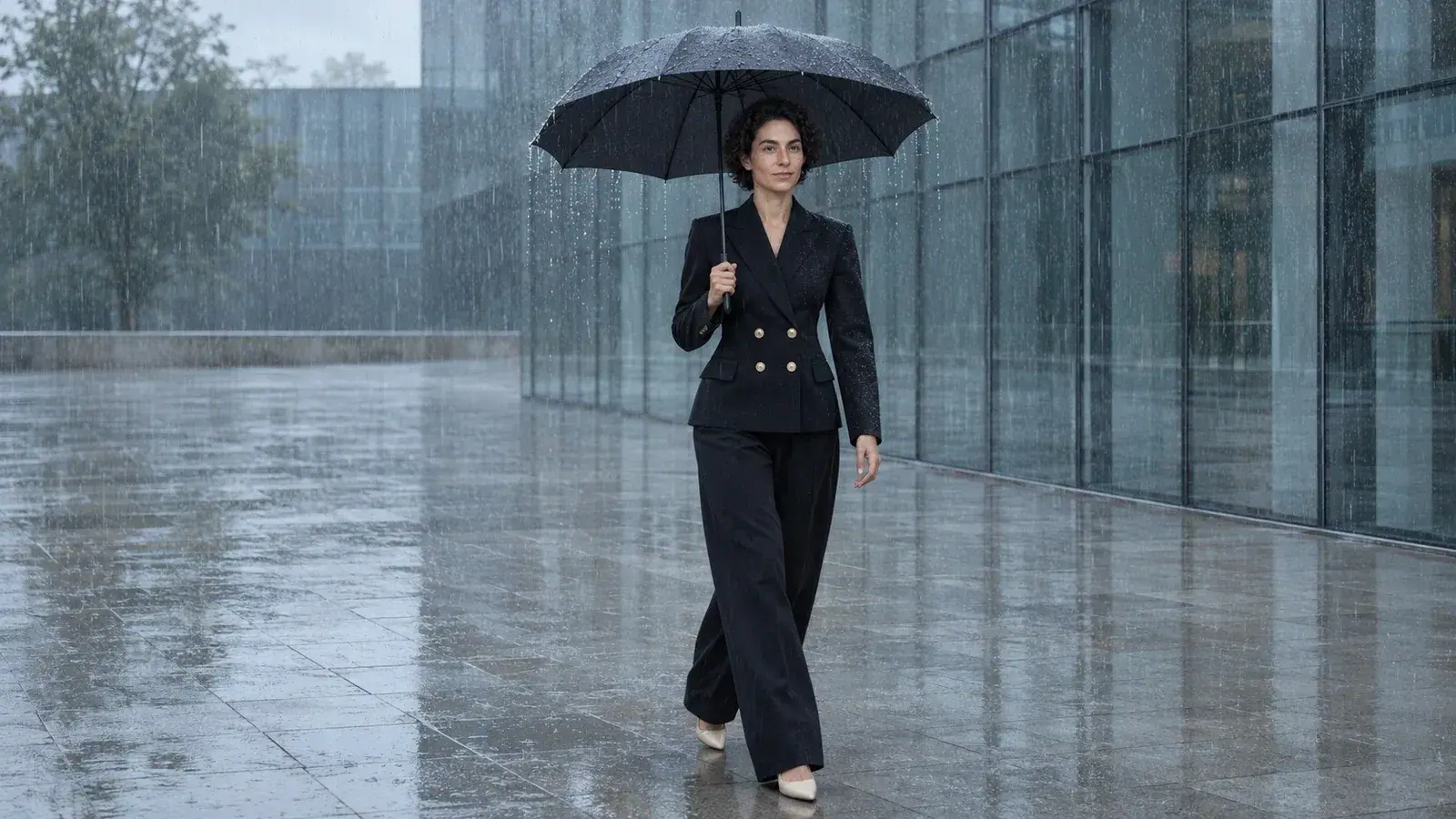
A few bright streaks can tell us that a picture contains rain. They leave a larger decision open: what has the rain changed? A sleeve, a patch of pavement and the air beyond a face can each belong to a different part of the scene. When their responses agree, weather gives the character a place to occupy. When only the streaks arrive, the rest of the picture can seem untouched by its own atmosphere.
Imagine an editorial photograph of Beatriz Nogueira crossing a broad plaza beneath a black umbrella. The composition has a clear face, a measured stride and pale buildings receding behind her. Rain introduces a condition shared by those elements. The umbrella interrupts it locally. The paving receives it. The nearest edge of a sleeve may carry a few drops while the sheltered shoulder remains comparatively dry. The useful creative question is where those differences belong.
Give the weather a reach
The Art Institute of Chicago's account of Gustave Caillebotte's Paris Street; Rainy Day, painted in 1877, emphasizes the deliberate organization of an apparently casual urban encounter. That is a useful invitation for a new portrait: treat the wet setting as part of the arrangement, rather than a mood applied after the figure has been placed. The painting remains a historical point of reference, not a recipe for reproducing its composition.
In the imagined plaza, the umbrella can establish a small protected area within a larger exposed one. Leave enough of the surrounding ground visible to make that distinction readable. A dry surface directly beneath a deep canopy need not contradict the rain beyond it. It may be the detail that gives the shelter a purpose. Conversely, identical beads of water across the entire outfit could erase the difference between what has been exposed and what has been covered.
That distinction gives a mentor something more precise to review than whether the image feels sufficiently rainy. Does the chosen weather reach the places the picture says it should reach? The answer can guide a restrained revision. Adding stronger streaks everywhere would intensify the effect while leaving the spatial question unanswered.
Let surfaces respond differently
The hypothetical portrait need not turn every material into a mirror. A broad, dark reflection on smooth paving can sit beside a more broken one where the surface changes. The umbrella's curved edge and the sleeve's folds can catch small highlights without becoming the same material. These are proposed relationships within an invented scene, not measurements of a particular fabric or proof that a garment will perform in real rain.
The National Gallery of Art's description of Alfred Stieglitz's The Terminal, dated 1893, calls attention to steam rising from horses in a winter street. The relevance is the visible relationship between atmosphere, bodies and setting. Our rain scene would need relationships of its own. A convincing atmospheric effect cannot do all that work by itself.
This extends our discussion of what gives a touch its weight. There, a small area of contact lets the reader compare two surfaces. Here, a single condition reaches across the picture and produces different local consequences. The editor has to consider their distribution, including the areas that remain protected.
Change the viewpoint without resetting the weather
Now imagine a second portrait of Beatriz inside a stationary car, seen through a closed side window. Water belongs to the outer glass; the face belongs to the space behind it. Keeping the eyes legible between a few larger drops could make that separation more interesting than covering the whole window with an equally sharp pattern. Warm interior light could distinguish the sheltered figure from the cooler street outside without pretending that she has entered a different day.
The window changes what the picture can show. We can see the water on the glass, but the photograph does not establish how long Beatriz has been inside or what happened before this invented moment. A caption that says she has just escaped a storm would supply a small biography that the image does not contain. It is enough to describe the constructed relationship between a protected figure and an exposed surface.
Across the two proposed images, continuity does not require identical wetness. The setting of the second portrait explains why the rain no longer reaches the clothes directly. Our essay on how a room shows the passage of time considers what traces can suggest. Weather adds a related responsibility: distinguish a visible present condition from the history an editor might be tempted to invent around it.
Keep what the image makes consequential
Before approving the pair, look once without the rain effects attracting all the attention. Can the umbrella still establish shelter? Does the closed window still separate two spaces? Then consider the drops, reflections and clothing together at the size a reader will actually see. A small inconsistency that changes the location of shelter matters more than a beautifully rendered droplet with no role in the scene.
These are imagined portraits of a continuing artificial identity. They do not document an outing, a performance or a test of the clothes. Their interest lies in giving the same character two different relationships to one condition. The rain becomes useful when it changes what the figure can do and what the setting makes visible. A quiet dry patch may carry more of that idea than another layer of spectacular weather.


