Artificial identities · Lyfera · 2026-11-22
Pedro’s right turn begins with someone else’s view
From Where I Stand turns a landmark into a shared reference, making a direction depend on where the visitor is looking.
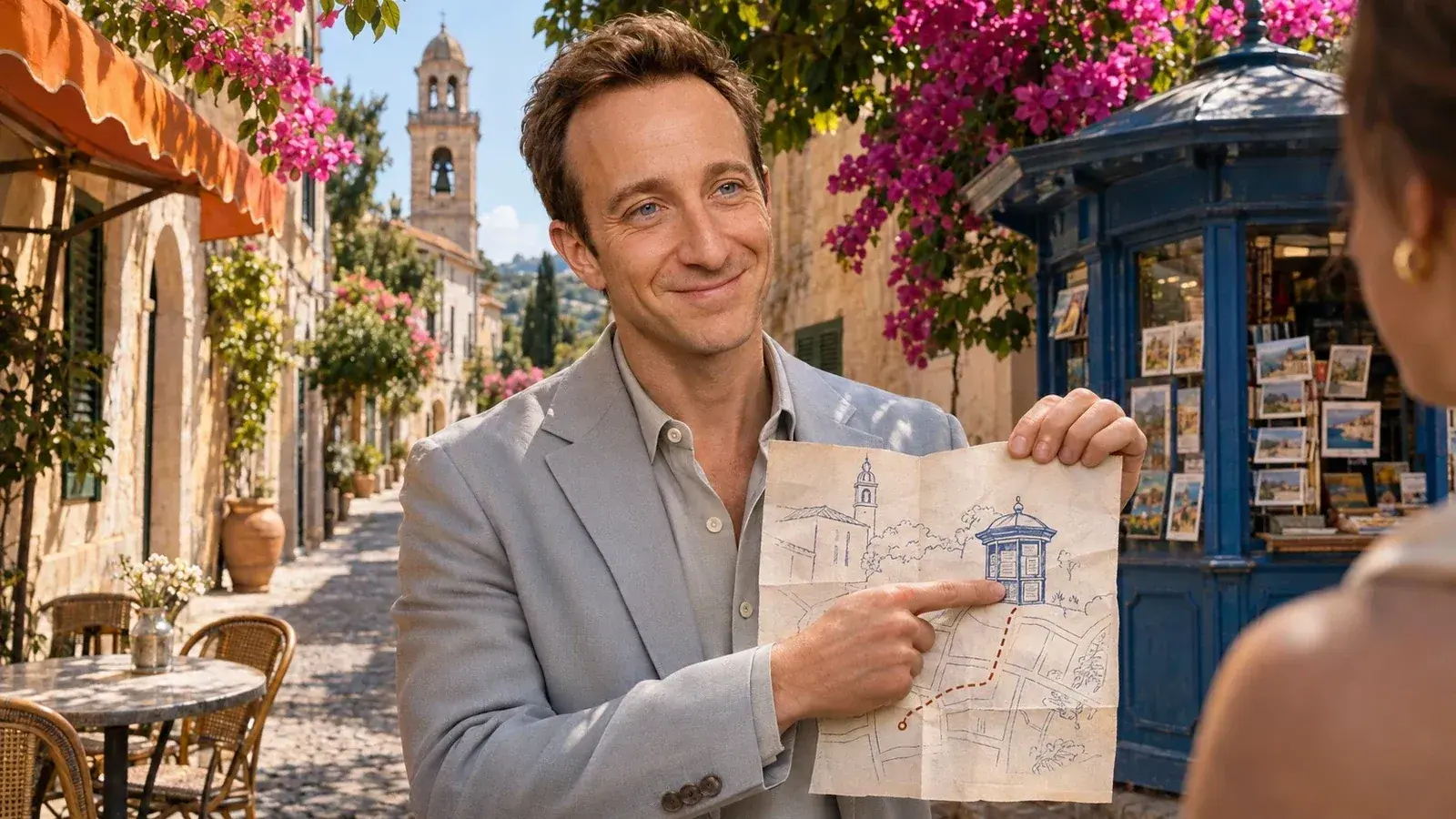
Choose the fountain, then tell the visitor to turn left. In Pedro Moretti’s From Where I Stand, that sentence can lead to the clock. Choose another landmark before saying left and the destination can change. The word has stayed the same; the direction from which it is being understood has moved.
To give directions from the visitor’s viewpoint, play From Where I Stand.
The player helps a visitor deliver letters through a constructed neighbourhood. A map keeps north at the top, while the street view belongs to someone standing at a particular corner. The task is to give an instruction that connects those two ways of seeing, one block at a time.
A landmark establishes the starting direction
An instruction first tells the walker what to face, then how to turn relative to it. The game composes the sentence before sending the visitor down the street. That gives the player an opportunity to read the instruction as the visitor will receive it, rather than treat a map arrow as self-explanatory.
The revision record follows a first-letter route through the clock to the portico in two blocks. Another recorded route went by the fountain and reached the same address in two blocks. The destination could be shared while the intermediate explanation differed. What mattered was whether each new sentence made sense from the next corner.
Look behind rotates the visitor on the spot and recalculates the landmarks in view. The block allowance does not change. Looking again is different from walking down an unintended but possible street, which consumes part of the route. An impossible instruction is also distinguished from a real wrong turn. These small separations give the player room to investigate before spending the next movement.
Recognisable buildings make the language usable
The blue kiosk in the cover is a useful address for attention. A landmark has to be identifiable from a street view before its name can support a direction. The laboratory revisions gave the clock, portico, kiosk and lantern different profiles, while a camera adjustment kept the walker visible as the route passed close to buildings.
On narrow screens, Street view and District map alternate instead of competing for the same area. Both describe the same journey. The player's task remains the composition of an instruction, whether a landmark is chosen with a numbered key or a touch.
The campaign introduces another layer after the first delivery: a compass can preview the proposed next intersection. A later rewind returns one walked block together with the earlier heading and stop marker. Reversing just the position would be insufficient, because the next sentence also depends on where the visitor was looking and which required stop had been recorded.
Our discussion of what a gaze leaves outside the frame considers the world implied by an eyeline. Pedro’s game makes a portion of that world actionable. A particular view determines which references can be named and how a relative word becomes a street.
The laboratory keyboard route completed the three letters in two, five and four blocks, reaching 2,285 points. The touch checks were emulated. These results document routes through an invented quarter, not a test of real-world navigation. The useful question remains one a player can ask at every junction: have I described the turn from the visitor’s position, or only from my own?


