Artificial identities · Lyfera · 2026-11-22
Elian’s companions walk through decisions he made seconds earlier
A Walking Canon makes a group tableau depend on the leader’s actual movement history, including pauses and changes of pose.
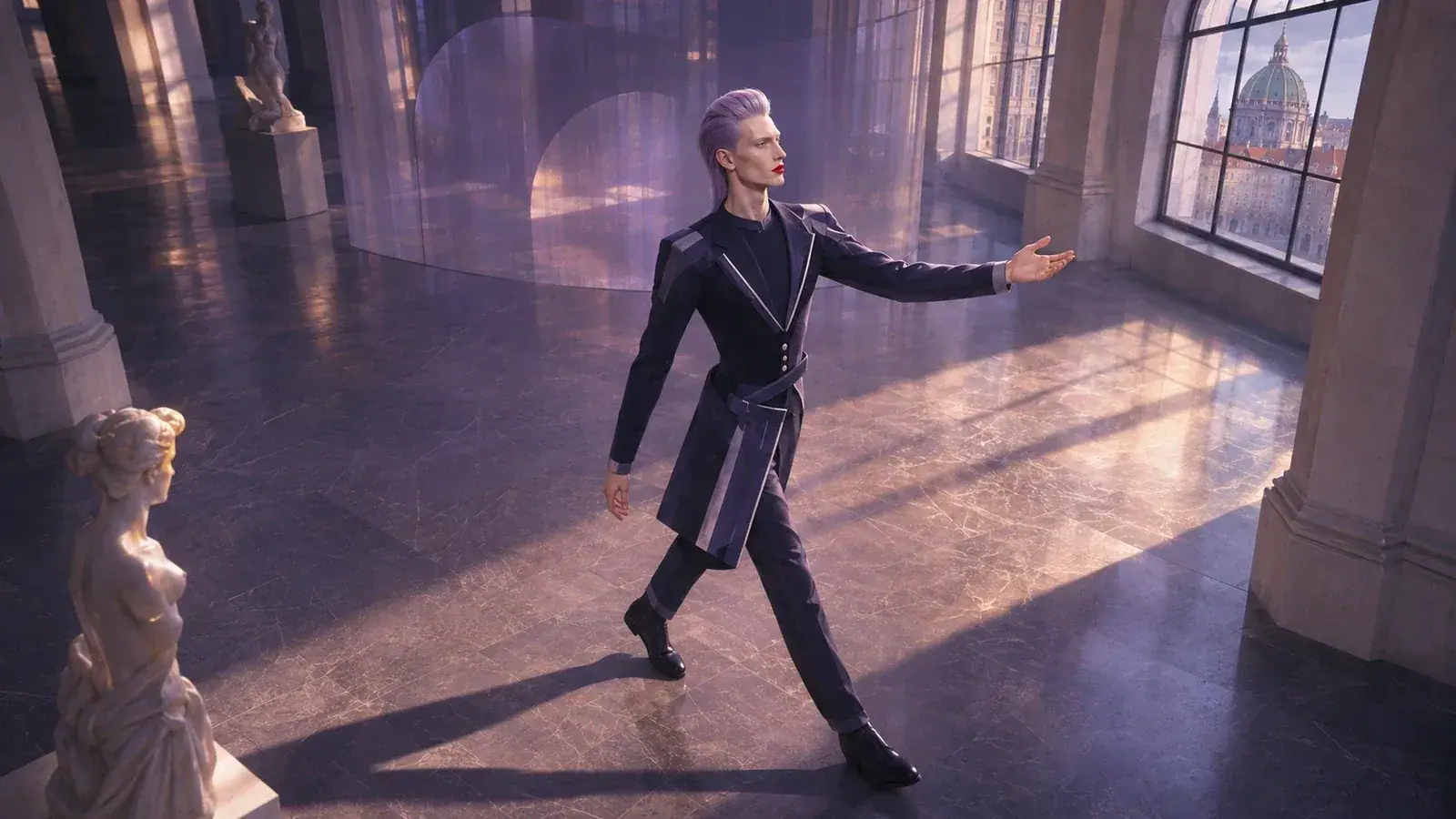
Elian Voss closes his arms while a following performer is still opening theirs. In A Walking Canon, two companions replay his earlier movement after delays of 2.6 and 5.2 seconds. Their different present poses can come from one continuous sequence the player has already made.
You can play A Walking Canon to enter the first gallery. Choosing a point on the floor moves Elian, while changing pace and arm position adds those changes to the sequence the followers will repeat.
A follower needs a history, not just a target
The companions repeat position, direction and arm opening, including pauses. Their movement is consequently more specific than a rule that tells them to approach the leader’s current location. What Elian did on the way to a mark matters after he has left it.
The player can revise a destination during a crossing, but that revision becomes part of the history too. A hypothetical detour around the gallery screen will later be taken by both following performers at their own delays.
This gives a pause a compositional role. Remaining still can hold a useful arrangement in the sequence long enough for another performer to occupy it while Elian continues elsewhere.
The tableau needs an interval of agreement
Each performer must reach their own mark and adopt its requested pose at the same time. The conditions have to coexist for 0.45 seconds before the tableau is ready to keep. A single fleeting frame of alignment is not the same as a held composition.
The final room makes the delayed relationship explicit: Elian must leave an open-armed pose for a companion, then close his own arms. One shared instruction would make that arrangement impossible; the recorded history allows distinct roles to emerge from the same performer’s decisions.
The gallery offers both an architectural view and a following camera onto that one action. The group is most interesting when its apparent simultaneity can be traced back to a sequence. Elian’s present movement is composing not only where he stands now, but what the others will be able to do a few seconds later.


