Culture & perspective · Lyfera · 2026-10-02
The authority a portrait seems to carry
A portrait can suggest expertise before the caption names a profession. How to give an artificial character a point of view while keeping the source of knowledge clear.

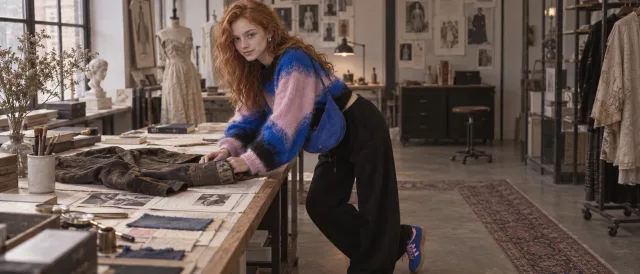
Imagine a fictional talent photographed at a workbench, examining the seam of a jacket. The scene contains no explicit claim of expertise. Yet the tools, the concentrated expression and the caption could invite the reader to understand the character as someone who knows how the garment was made. Before adding a professional title, the creative team may already have suggested one through the picture.
For an artificial identity, that suggestion deserves attention. Appearance is available to design, while knowledge needs a basis outside the portrait. A mentor can give a character curiosity about construction, repair or materials without making the character a substitute for the people who can answer technical questions. The useful editorial distinction is between directing attention towards a subject and presenting an authority on it.
A new study raises a narrower question
A study published on 2 October 2026 in the Journal of Research in Interactive Marketing examines how age, race and gender cues interact in evaluations of virtual influencers. The accessible abstract describes two online experiments with US social media users, involving 492 and 430 participants, in a pro-environmental campaign context. It reports differences in perceived warmth and competence alongside behavioural intentions. Those are audience evaluations within a particular study, not evidence of a character's actual knowledge or a universal rule for casting.
The full paper was not available for this reading, so the abstract cannot support an assessment of every design choice or limitation. It does provide a timely reason to question a familiar instruction in creative briefs: make the character look trustworthy. Our editorial response is to ask what, exactly, the audience is being asked to trust and where that trust can be checked.
Give the character a question to ask
Return to the invented workbench scene. One version of the caption could have the talent noticing an unusual seam and asking the maker why it was constructed that way. Another could declare that the seam proves the jacket will last for decades. The same portrait now accompanies two very different propositions. The first opens a subject for explanation. The second makes a claim that the image cannot establish.
A character's curiosity can be specific enough to sustain an interesting story. Perhaps the talent keeps a collection of details that are usually hidden inside clothes, or returns to a maker to understand why two apparently similar pieces need different treatment. Within a clearly fictional narrative, those interests can shape the direction of the work. Any factual explanation attributed to a real maker still needs to come from that maker and remain faithful to what they said.
This extends the distinction between presenter and original character discussed in our approach to AI casting. Once the role is chosen, the script still needs to decide what authority the role carries. A fictional host can introduce someone else's expertise without absorbing their qualifications into its own biography.
Review the setting as carefully as the sentence
In the hypothetical commission, the team might remove the unsupported durability sentence but leave a caption identifying the talent as a master tailor. That revision would preserve much of the original implication. A professional label, the arrangement of the workbench and the character's apparent demonstration belong to the same editorial decision. Reviewing them separately makes it easier to miss what they suggest together.
An editor could ask a colleague to describe what they believe the subject knows and which part of the piece led them to that conclusion. The answer would help reveal an unintended implication; it would not prove that every viewer reads the image identically. If the colleague assumes a professional qualification that the team cannot substantiate, the next revision should clarify the role rather than merely soften the most obvious sentence.
The aim is to make room for a rich visual identity without assigning competence through a face, age or other personal characteristic. A character can appear thoughtful, playful or absorbed in an activity. The factual claims around that activity need their own support. The casting decision should not become a shortcut for deciding whether a statement deserves belief.
Keep the source of knowledge visible
For the workbench story, a stronger final piece might pair the talent's question with an attributed explanation from the maker, accompanied by a clear description of what is illustrated. If no such explanation has been obtained, the creative team can keep the scene within the character's fictional interest. It does not need an invented expert biography to make the image worth considering.
This gives the mentor a practical standard for future work. The character may guide the reader towards a subject, but the reader should still be able to locate the basis for a factual assertion. A portrait can make an introduction memorable. The explanation beside it should make clear whose knowledge the audience is actually receiving.